Public-domain ebook
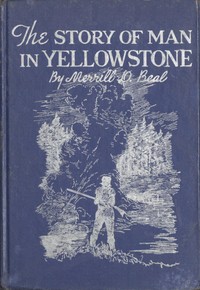
The Story of Man In Yellowstone
Language: en699 downloads on Project Gutenberg
Subjects
In: History - American·Environmental Issues
Public-domain ebook sourced from Project Gutenberg #59092.
Public-domain ebook
Language: en699 downloads on Project Gutenberg
Subjects
In: History - American·Environmental Issues
Public-domain ebook sourced from Project Gutenberg #59092.
The opening · free to read
The world is too much with us; late and soon, Getting and spending, we lay waste our powers; Little we see in Nature that is ours; We have given our hearts away, a sordid boon! This Sea that bares her bosom to the moon; The winds that will be howling at all hours, And are up-gathered now like sleeping flowers; For this, for everything, we are out of tune; It moves us not. --Great God! I'd rather be A Pagan suckled in a creed outworn; So might I, standing on this pleasant lea, Have glimpses that would make me less forlorn; Have sight of Proteus rising from the sea; Or hear old Triton blow his wreathed horn.
After many years of indifference to the claims of nature, the American people are coming into accord with the wise teachings advanced by John Muir more than fifty years ago. Today, legions of tired, nerve-shaken, over-civilized people realize that going to the mountains is like going home. They have found a brief sojourn in the wilderness a necessity of life. There is a balm in the sun, wind, and storm of mountain heights. There is healing in willow parks and gentian meadows. Cobweb cares of the world's spinning give way before the vibrant touch of Mother Earth when her children venture boldly into unbeaten paths. There they may attune their ears to strange sounds; their lungs respond to pine sap air. Jumping from rock to log, tracing rivers to their sources, brings men up from panting puffs to deep-drawn breath in whole-souled exercise unto a newness of life.
The story of Yellowstone has been told many times, but seldom does one catch that elusive something that so mightily impresses the sensitive visitor. The theme is at once so inspiring and grand, the details so varied and minute, as to challenge one's finest discrimination to seize upon the major features and bring them into relief. There is still much that is primitive in Wonderland, and in this setting it is appropriate to envision the salient traits of the Old West. Hereabouts was once enacted a colorful panorama of frontier life. There were Indians, trappers, miners, cowboys, rustlers, poachers, soldiers, and settlers. A description of these picturesque people and their ways might bring enjoyment to many. Perhaps the spirit of appreciation that characterizes this history is its chief claim upon the attention of Yellowstone visitors.
This monograph was written for them, and it represents a synthesis of many lectures that evolved in their presence, in the afterglow of Yellowstone campfire programs. Visitors whose enjoyment of life seems particularly enhanced by a visit to the Park may find the reason therefore in those lines:
One impulse from a vernal wood May teach you more of man, Of moral evil and of good, Than all the sages can. --WORDSWORTH
In the interest of economy of time in reading this history, it is suggested that chapters three, four, and ten might be skimmed. However, a knowledge of the Indians and trappers whose haunts and activities impinged upon the Park area is essential to a full appreciation of Yellowstone National Park in its western setting.
Former Superintendent Edmund B. Rogers and Park Naturalist David de L. Condon gave me access to the records of the Park. Their interest in advancing the knowledge of Yellowstone has been keen and constant.
My Yellowstone Park ranger-colleagues also served as sources of information and occasional critics. It is probable that each of them will be able to identify an element of his own thought or expression in the narrative. As my campfire lectures evolved into a unified monograph, guidance was received from professional historians. They have been more critical than the rangers but not less kind.
At the State College of Washington, Dr. Herman J. Deutsch and Dr. Claudius O. Johnson made the college's Northwest Collection available. They also joined their colleagues, Dr. W. B. Thorson and Dr. C. M. Brewster, in making many fine and comprehensive criticisms, which combined to strengthen the narrative. Several of my colleagues at Idaho State College gave direction and increased purpose to the discussion of conservation and wild life principles. They are Dr. Ray J. Davis, Albert V. S. Pulling, and DuWayne Goodwin. Dr. Carl W. McIntosh, president of the college, has extended many courtesies. Professor Wallace E. Garets edited the manuscript.
Former Yellowstone National Park Naturalist, Dr. C. Max Bauer, gave encouragement from the inception of the study and reviewed the final draft. Other National Park officials from whom wise council and valuable suggestions were received include Dr. Carl P. Russell, former National Park Supervisor of Interpretation, and Dr. Alvin P. Stauffer, Chief of Research and Survey. The collaboration of J. Neilson Barry was invaluable in the exposition of the discovery phase in the chapter on John Colter. J. Fred Smith, Delbert G. Taylor, and Mr. and Mrs. George Marler have also given material support to this effort.
The illustrations are principally the work of William S. Chapman, North District Ranger.
The support of Yellowstone Park Superintendent Lemuel A. Garrison and Chief Park Naturalist Robert N. McIntyre in bringing forth this Third Edition under the auspices of The Yellowstone Library and Museum Association is indeed appreciated.
Lastly, gratitude is due my wife, Bessy N. Beal, and our son, David, and his wife, Jean, for the typing of the manuscript and for the rendering of much additional service to this enterprise. MERRILL D. BEAL
IDAHO STATE COLLEGE POCATELLO, IDAHO June 10, 1960
It is interesting and significant that this book, telling the story of man in the area of our oldest National Park, should be available soon after a season of record-breaking public use of the area. During the travel year 1948, one million thirty-one thousand five hundred and thirty-one people visited Yellowstone National Park.
The discoverer of The Yellowstone Country early in the nineteenth century, and re-discoverers through the years prior to 1872, as well as all visitors to the Park before the advent of modern highways and automobiles probably gave no thought to the reality and problems of a million visitors a year.
Dr. Beal's well documented and carefully prepared book brings us through the history of man in a wilderness, through that period of history before annual visitation of a million visitors in that wilderness. Readers will find the story of the before-one-million-visitors-years most interesting. It is a period, especially since the establishment of the National Park in 1872, in which we as a nation were experimenting for the most part in wilderness preservation and, at the same time, encouraging its use. Dr. Beal's book covers a period in U.S. history when shameful exploitation of natural resources was common practice. The preservation of The Yellowstone Country as a National Park is an action during the period of exploitation, an action of which we can all be proud. The story of man in Yellowstone is a fascinating one. It can also be a challenge to everyone to assume responsibility in continued preservation of Yellowstone National Park so that future generations may benefit from all of the things that unimpaired natural areas can offer by way of recreation, education, and inspiration.
JOHN E. DOERR Former Chief Naturalist, National Park Service
Where the sky is the boundary up above And the earth is the measure below, And the trail starts on where the sun comes up And ends where the sun sinks low.
Where the wind blows sweet as a baby's breath, And the sun shines bright as its eyes, And the showers come and the showers go As the tears when the little one cries.
And the brook runs merrily through the glade, Singing its gladdening song, And the pine trees murmur their soothing sighs, Still bearing that song along.
Yes, carry me back to the lake's white shores With its deer and its lily pad. Where the loon calls out into the moonbeams bright Through the mist on the waters sad.
Let me hear the elk's far cry As it sweeps through the forest deep, Where the silence hangs as over the dead At rest in eternal sleep.
I'll pitch my tent by some lonesome pine, By the rippling water's edge, With the great outdoors as my garden, And the willows round as my hedge.
And surrounded by pretty flowers, That perfume the gentle breeze, I'll idle away the whole long day, In the shade of my old pine trees.
And I'll watch on yonder mountain The colors change with the day, And I'll follow each shadow creeping So silently on its way.
And then I'll give thanks to God above And in gratitude I'll pause, And I'll love, not hate, each care that comes In that great big home--Outdoors.
The book keeps going
Reading is free forever. Sign up and watch scenes appear while you read.



Scenes Storieta drew for other classics.
New illustrated classics
Once or twice a month: the latest books to get full character casts, scene art, and free comic editions. No account needed.