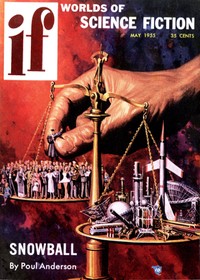
Simon's new source of power promised a new era for Mankind. But what happens to world economy when any_one can manufacture it in the kitchen oven?... Here's_ one answer!
[Transcriber's Note: This etext was produced from Worlds of If Science Fiction, May 1955. Extensive research did not uncover any evidence that the U.S. copyright on this publication was renewed.]
It did not come out of some government laboratory employing a thousand bright young technicians whose lives had been checked back to the crib; it was the work of one man and one woman. This is not the reversal of history you might think, for the truth is that all the really basic advances have been made by one or a few men, from the first to steal fire out of a volcano to E=mc^2. Later, the bright young technicians get hold of it, and we have transoceanic airplanes and nuclear bombs; but the idea is always born in loneliness.
Simon Arch was thirty-two years old. He came from upstate Massachusetts, the son of a small-town doctor, and his childhood and adolescence were normal enough aside from tinkering with mathematics and explosive mixtures. In spite of shyness and an overly large vocabulary, he was popular, especially since he was a good basketball player. After high school, he spent a couple of tedious years in the tail-end of World War II clerking for the Army, somehow never getting overseas; weak eyes may have had something to do with that. In his spare time he read a great deal, and after the war he entered M.I.T. with a major in physics. Everybody and his dog was studying physics then, but Arch was better than average, and went on through a series of graduate assistantships to a Ph.D. He married one of his students and patented an electronic valve. Its value was limited to certain special applications, but the royalties provided a small independent income and he realized his ambition: to work for himself.
He and Elizabeth built a house in Westfield, which lies some fifty miles north of Boston and has a small college--otherwise it is only a shopping center for the local farmers. The house had a walled garden and a separate laboratory building. Equipment for the lab was expensive enough to make the Arches postpone children; indeed, after its requirements were met, they had little enough to live on, but they made sarcastic remarks about the installment-buying rat race and kept out of it. Besides, they had hopes for their latest project: there might be real money in that.
Colin Culquhoun, professor of physics at Westfield, was Arch's closest friend--a huge, red-haired, boisterous man with radical opinions on politics which were always good for an argument. Arch, tall and slim and dark, with horn-rimmed glasses over black eyes and a boyishly smooth face, labelled himself a reactionary.
"Dielectrics, eh?" rumbled Culquhoun one sunny May afternoon. "So that's your latest kick, laddie. What about it?"
"I have some ideas on the theory of dielectric polarization," said Arch. "It's still not too well understood, you know."
"Yeh?" Culquhoun turned as Elizabeth brought in a tray of dewed glasses. "Thank'ee kindly." One hairy hand engulfed a goblet and he drank noisily. "Ahhhh! Your taste in beer is as good as your taste in politics is moldy. Go on."
Arch looked at the floor. "Maybe I shouldn't," he said, feeling his old nervousness rise within him. "You see, I'm operating purely on a hunch. I've got the math pretty well whipped into shape, but it all rests on an unproven postulate about the nature of the electric field. I've tried to fit it in with both relativity and quantum mechanics and--well, like I said, it's all just a notion of mine which demands experimental proof before I can even think about publishing."
"What sort of proof?"
"It's this way. By far the best dielectric found to date is a mixture of barium and strontium titanates. Under optimum conditions, the dielectric constant goes up to 11,600, though the loss rate is still pretty high. There's a partial explanation for this on the basis of crystal theory, the dipole moment increases under an electric field.... Well, you know all that. My notion involves an assumption about the nature of the crystalline ionic bond; I threw in a correction for relativistic and quantum effects which looks kosher but really hasn't much evidence to back it up. So--uh--"
Elizabeth sat down and crossed trim legs. She was a tall and rather spectacular blonde, her features so regular as to look almost cold till you got to know her. "Our idea suggests it should be possible to fit a crystalline system into an organic grid in such a way that a material can be made with just about any desired values of dielectricity and resistivity," she said. "Constants up in the millions if you want. Physically and chemically stable. The problem is to find the conditions which will produce such an unorthodox linkage. We've been cooking batches of stuff for weeks now."
Culquhoun lifted shaggy brows. "Any luck?"
"Not so far," she laughed. "All we've gotten is smelly, sticky messes. The structure we're after just doesn't want to form. We're trying different catalysts now, but it's mostly cut and try; neither of us is enough of a chemist to predict what'll work."
"Come along and see," offered Arch.
They went through the garden and into the long one-room building beyond. Culquhoun looked at the instruments with a certain wistfulness; he had trouble getting money to keep up any kind of lab. But the heart of the place was merely a second-hand gas stove, converted by haywiring into an air-tight, closely regulated oven. It was hot in the room. Elizabeth pointed to a stack of molds covered with a pitchy tar. "Our failures," she said. "Maybe we could patent the formula for glue. It certainly sticks tightly enough."
Arch checked the gauges. "Got a while to go yet," he said. "The catalyst this time is powdered ferric oxide--plain rust to you. The materials include aluminum oxide, synthetic rubber, and some barium and titanium compounds. I must admit that part of it is cheap."
They wandered back toward the house. "What'll you do with the material if it does come out?" asked Culquhoun.
"Oh--it'd make damn good condensers," said Arch. "Insulation, too. There ought to be a lot of money in it. Really, though, the theory interests me more. Care to see it?"
Culquhoun nodded, and Arch pawed through the papers on his desk. The top was littered with his stamp collection, but an unerring instinct seemed to guide his hand to the desired papers. He handed over an untidy manuscript consisting chiefly of mathematical symbols. "But don't bother with it now," he said. "I blew us to a new Bach the other day--St. Matthew Passion."
Culquhoun's eyes lit up, and for a while the house was filled with a serene strength which this century had forgotten. "Mon, mon," whispered the professor at last. "What he could have done with the bagpipes!"
"Barbarian," said Elizabeth.
As it happened, that one test batch was successful. Arch took a slab of darkly shining material from the lab oven and sawed it up for tests. It met them all. Heat and cold had little effect, even on the electric properties. Ordinary chemicals did not react. The dielectric constant was over a million, and the charge was held without appreciable leakage.
"Why doesn't it arc over?" wondered Elizabeth.
"Electric field's entirely inside the slab," said Arch absently. "You need a solid conductor, like a wire, between the poles to discharge it. The breakdown voltage is so high that you might as well forget about it." He lifted a piece about ten inches square and two inches thick. "You could charge this hunk up with enough juice to run our house for a couple of years, I imagine; of course, it'd be D.C., so you'd have to drain it through a small A.C. generator. The material itself costs, oh, I'd guess fifty cents, a dollar maybe if you include labor." He hesitated. "You know, it occurs to me we've just killed the wet-cell battery."
"Good riddance," said Elizabeth. "The first thing you do, my boy, is make a replacement for that so-called battery in our car. I'm tired of having the clunk die in the middle of traffic."
"Okay," said Arch mildly. "Then we see about patents. But--honey, don't you think this deserves a small celebration of sorts?"
Arch spent a few days drawing up specifications and methods of manufacture. By giving the subject a little thought, he discovered that production could be fantastically cheap and easy. If you knew just what was needed, you had only to mix together a few chemicals obtainable in any drugstore, bake them in your oven for several hours, and saw the resulting chunk into pieces of suitable size. By adding resistances and inductances, which could be made if necessary from junkyard wire, you could bleed off the charge at any desired rate.
Culquhoun's oldest son Robert dropped over to find Arch tinkering with his rickety '48 Chevrolet. "Dad says you've got a new kind of battery," he remarked.
"Uh.... Yes. I'll make him one if he wants. All we'll need to charge it is a rectifier and a volt-meter. Need a regulator for the discharge, of course." Arch lifted out his old battery and laid it on the grass.
"I've got a better idea, sir," said the boy. "I'd like to buy a big piece of the stuff from you."
"Whatever for?" asked Arch.
"Run my hot rod off it," said Bob from the lofty eminence of sixteen years. "Shouldn't be too hard, should it? Rip out the engine; use the big condenser to turn a D.C. motor--it'd be a lot cheaper than gas, and no plugged fuel lines either."
"You know," said Arch, "I never thought of that."
He lifted the ridiculously small object which was his new current source and placed it inside the hood. He had had to add two pieces of strap iron to hold it in position. "Why a regular motor?" he mused. "If you have D.C. coming out at a controlled rate, you could use it to turn your main drive shaft by a very simple and cheap arrangement."
"Oh, sure," said Robert scornfully. "That's what I meant. Any backyard mechanic could fix that up--if he didn't electrocute himself first. But how about it, Dr. Arch? How much would you want for a piece like that?"
"I haven't the time," said the physicist. "Tell you what, though, I'll give you a copy of the specs and you can make your own. There's nothing to it, if your mother will let you have the oven for a day. Cost you maybe five dollars for materials."
"Sell it for twenty-five," said Bob dreamily. "Look, Dr. Arch, would you like to go into business with me? I'll pay you whatever royalty seems right."
"I'm going to Boston with just that in mind," said Arch, fumbling with the cables. "However, go ahead. Consider yourself a licensee. I want ten percent of the selling price, and I'll trust a Scotch Yankee like you to make me a million."