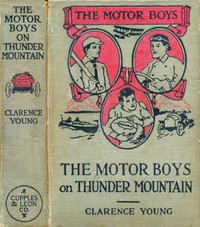
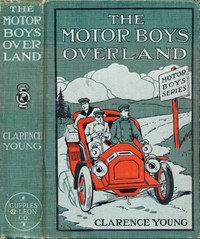
“What do you think of it, fellows?” asked Jerry Hopkins. The tall lad ruffled in his hand some sheets of paper covered with typewriting. He looked closely at his two chums.
“You mean Tinny Mallison’s gold mine proposition?” inquired Ned Slade, flicking a bit of dust from the trousers of his new suit.
“That’s what I mean,” replied Jerry. “He didn’t say anything else in his letter worth considering, did he?” and the tall lad again referred to the screed.
“Except about chicken,” put in the third member of the trio, a stout, good-natured looking lad with a beaming face.
“Chicken? What do you mean--chicken?” demanded Ned Slade, with just a slight note of impatience in his voice. Jerry, looking hastily through the letter, added:
“Tinny didn’t say anything about going into the chicken business, did he? Not that I remember. Anyhow, he isn’t in a chicken-raising country. He’s out in the tall timber where the only things they raise are Rocky Mountain goats. Chickens! How do you get that way, Chunky?”
The fat lad flushed, having drawn this much attention to himself, and, to justify his remark, he said:
“I didn’t mean it that way. You know, as well as I do, he didn’t propose to us to go out there to raise chickens. We could do that here at home a lot better.”
“Just what do you mean by harping on fowls?” asked Ned.
“I mean Tinny said in his letter that he was in a restaurant where they served him roast chicken and mushrooms, and he got to thinking of us and----”
“You mean he got to thinking of you!” and Ned exploded into a laugh, at which Bob Baker blushed a deeper pink.
“Oh, I see what Chunky means!” chuckled Jerry. “Tinny did speak of being in a restaurant eating chicken when he found himself remembering us and the measly feeds we sometimes got in the mustering-out camp. That’s what caused him to write us about the gold mine.”
“And you can make up your mind that Bob would pick out that part of the letter first!” exclaimed Ned. “That part about chicken! Did it make you hungry, Chunky?” he demanded, giving the stout youth a poke in his well-covered ribs.
“Oh, cut it out!” snapped Bob, with a trace of annoyance on his face. “I was up early and I didn’t have much breakfast. It’s nearly noon now, and if you want me to give any serious consideration to this gold mine proposition I’ve got to eat--that’s all!”
There was such a tone of resolve in the stout lad’s voice, and such an air of bravado about him, that Ned and Jerry looked at each other in surprise.
“Well, Bob, if that’s the way you feel about it,” began Ned, “we might as well----”
“That’s how I feel about it!” cracked out Bob. “I’m hungry--I don’t care who knows it! Ever since Jerry read that in the letter about Tinny having such a glorious feed of roast chicken and mushrooms--oh, boy!”
Bob did not go on, but Jerry, looking at his watch, remarked:
“It is almost noon, and I happen to know Bob was up early, for I telephoned over just before I ate breakfast and they said he’d gone out in a hurry.”
“I did. And I had nothing for breakfast but some slices of toast, bacon and eggs, and coffee,” broke in Bob. “No breakfast at all! Had to go down on an errand in a hurry for dad in the new car, and I stepped on the gas, let me tell you. Now, what about eating?” he asked eagerly.
“Well, don’t go to sleep, and I’ll go on with my speech of acceptance,” chuckled Jerry. “I was going to say, why not come to lunch at my house? Then we can talk over this gold mine dope.”
“Suits me,” said Ned briefly.
“It more than hits me in the right spot,” sighed fat Bob Baker.
“But it’s queer,” murmured Jerry, as he and his chums arose from a bench where they had been sitting on the edge of Cresville’s only park--the place designated as a meeting place when Jerry had received a letter which was destined to play a momentous part in the lives of the Motor Boys.
“What’s queer?” Ned Slade wanted to know.
“How Bob happened to pick out the three lines in Tinny’s letter that had to do with eating,” Jerry resumed. “The most unimportant part of the whole business, and yet Bob spots it like--like----”
“Like a hawk after a chicken,” supplied Ned, when he saw his tall chum at a loss for a simile.
“Thanks,” murmured Jerry.
“Think you’re a regular moving-picture-art-title writer, don’t you?” mumbled Bob. “All right--go on--poke all the fun you want. But if you fellows get out to Thunder Mountain--or whatever the place is--and starve to death, don’t blame me.”
“We aren’t likely to--not if we die of hunger,” said Ned. “But if we go, won’t you come with us?”
“I don’t know--maybe.” Bob was not quite restored to his usual good-natured self after the bantering to which he had been subjected.
“Well, let’s go!” cried Jerry, and the words recalled vividly to the minds of his chums how often those same words were used when they were in France during the World War.
“Is that you, Jerry?” called Mrs. Hopkins, when a little later she heard the tramp of feet in her hall--feet that unconsciously fell into the swing of a military march.
“Yes, Mother. I’ve brought Ned and Bob home to lunch.”
“That’s nice. I’ll tell Katie to get things ready for you out in the sun parlor. John is polishing the dining room floor.”
“Anywhere as long as there’s something to eat,” murmured Bob.
And then, a little later, when the Motor Boys were sitting about a well laden table in the pleasant sun parlor of the Hopkins home, their discussion turned upon the letter Jerry had received that morning from Tinnith Mallison, a Westerner, whom they had first met as a congenial officer in the training camp where the lads were mustered out of Uncle Sam’s service.
“Just what is his proposition?” asked Bob, who, having the first sharp edge taken from his appetite, could now give more consideration to other matters. “I didn’t listen very closely when you first read it, Jerry.”
“No, I reckon not--chicken and mushrooms,” murmured Ned.
“Shut up!” ordered Bob, but the words were accompanied by a smile which took all malice from them.