Public-domain ebook
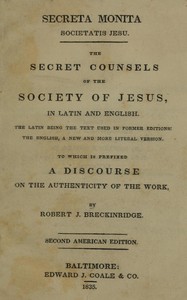
Secreta Monita Societatis Jesu. The Secret Counsels of the Society of Jesus, in Latin and English
Language: en293 downloads on Project Gutenberg
Subjects
Public-domain ebook sourced from Project Gutenberg #59382.
Public-domain ebook
Language: en293 downloads on Project Gutenberg
Subjects
Public-domain ebook sourced from Project Gutenberg #59382.
The opening · free to read
Transcriber’s Note: A list of changes made to the text to correct typos, etc., is given at the end.
The original of this book was printed with the Latin and English on opposite pages. This isn’t terribly practical for an e-text, so instead, the chapters are presented first in Latin, followed by the English translation (and the original page numbering has been removed, as it would no longer be accurate or helpful).
SECRETA MONITA SOCIETATIS JESU.
THE SECRET COUNSELS OF THE SOCIETY OF JESUS, IN LATIN AND ENGLISH.
THE LATIN BEING THE TEXT USED IN FORMER EDITIONS: THE ENGLISH, A NEW AND MORE LITERAL VERSION.
TO WHICH IS PREFIXED A DISCOURSE ON THE AUTHENTICITY OF THE WORK,
BY ROBERT J. BRECKINRIDGE.
SECOND AMERICAN EDITION. BALTIMORE: EDWARD J. COALE & CO. 1835.
Entered According to Act of Congress, In the year Eighteen Hundred and Thirty-five, By EDWARD J. COALE & Co. In the Clerk’s office of the District Court Of Maryland.
DEDICATION.
TO The present ARCHBISHOP of BALTIMORE; Who is said, By his friends, to be a person of talents and learning; And who is believed, By many, to belong to the ORDER OF JESUITS; THIS VOLUME IS INSCRIBED: Under the conviction, that his duty, as a GENTLEMAN, A SCHOLAR, AND A CHRISTIAN, Requires him, To refute the book if false; or, To admit its genuineness, if it is true:
By his obedient servant, THE EDITOR.
BALTIMORE, July 22, 1835.
DISCOURSE ON THE AUTHENTICITY OF THE SECRETA MONITA.
I. It is certainly of the greatest importance, in determining the value of the SECRETA MONITA as evidence in estimating the character of the Society of Jesus, to come to some satisfactory conclusion as to the authenticity of the work itself. If it can be shown to be really what it purports to be, then indeed the most secret principles of the most extraordinary and most universally execrated fraternity that ever appeared amongst men, are plainly laid open to the public view; and all may see the profound source of all those active, extended and unceasing operations, by which these persons kept so large a part of the world in ceaseless commotion for so many years. If indeed the work be not perfectly authentic, that is, if instead of being the real Secret counsels of the order emanating from its very head, revealed by accident; it should appear to be a revelation made by an expelled Jesuit, as some of them say, or a mere supposititious composition as others pretend, compiled from their various authors and embodying what an enemy might suppose they would say, if they officially propounded their real secret instructions, the case would perhaps appear to be somewhat weakened. But even then, if an expelled member had written it, it might all be true; and while the power to show it was not, if indeed it was not, would be complete in the society, its failure to do so, added to inherent evidence of genuineness, in the work itself, might establish its reality on as unquestionable grounds as if it had the imprimatur of the general himself upon its face. Or if the last supposition can be considered as possible, a compilation of the most clear and well defined rules of action drawn from unquestionable sources, and thrown together into one volume would seem if possible the very clearest mode, of exhibiting the general and real spirit of the body, to which all the writers belonged. There are schools of morals, of politics, of crime, as well as of letters and of all things else. It is a wide, terrible, and peculiar school whose opinions and conduct are here illustrated. And if it be faithfully done, by the laborious compilation and classification of materials drawn from a thousand sources, a more impressive and fair method cannot well be imagined.
II. It is certainly past all dispute that this book has, for a very long period, been in possession of the world. Here it is, handed down to us through several centuries. To sneer at it, and pass it by, is simply to establish its unanswerable authority. To be unable to give any satisfactory account of it; is to let it prove itself. It exists; it could not have produced itself. Whence did it come? But three solutions are possible.
1. It is an authentic work, containing the real facts it pretends to contain; and being what it purports to be.
2. It is the work of some expelled Jesuit, and may be more or less true, according to his knowledge of what he tried to reveal, or his integrity in telling truly what he knew.
3. It is the work of an enemy, who never was a Jesuit, but who has pretended to put into the mouth of the chief authorities of that order, what he believed they would say, if they uttered their real sentiments on the points here treated of.
III. Let us then briefly examine each of these suppositions in turn. And first, is this work authentic? I reply there is scarcely a particle of reason to doubt it.
1. In the British Museum there is a work printed at Venice in 1596, with this title “_Hæ Formulæ diversarum Provisionum a Gaspare Passarello summo studio in unum collectæ et per ordinem in suis locis annotatæ_.” At the end of that (and where more likely?) the SECRETA MONITA, in Latin is copied in Manuscript, apparently by a Jesuit, for his own private use;—with solemn cautions at the end, similar to those found in the printed preface to the work itself, that the utmost care was to be taken that few, and these most trusty, should know them; and that if ever imputed to the society, they must be denied.
2. In the year 1658, there was a translation of the work from Latin into English, published in England. This edition is frequently to be met with. In the preface to it, it is related that Duke Christian of Brunswick took possession of the Jesuit College at Paderborn, in Westphalia, when he entered that place, and gave the Library and Manuscripts to the Capuchins, who found the SECRETA MONITA amongst the archives of the Rector. It is also asserted that other copies were found at Prague and elsewhere.
3. Dr. Compton, the celebrated Bishop of London published another English version of the SECRETA MONITA in the year 1669; having satisfied himself, after full examination, of the genuineness of the work.
4. In the year 1717, there was published at Amsterdam, a Latin edition of the SECRETA MONITA, under the title of “_Machiavelli Mus Jesuiticus_,” inscribed to John Krausius, a Jesuit. A copy of this edition is in the British Museum.
5. There are also in the British Museum several German editions of the SECRETA MONITA.
6. In the year 1722, another edition of this work was published in London, dedicated to Sir Robert Walpole, prime Minister of England.
7. Another Edition, and which is supposed to have been the last that appeared in England, was published in 1746. This, as well as the last preceding Edition, has the Latin, and English, on opposite pages; and are both preserved in the British Museum.
8. In the year 1727, a French edition of the SECRETA MONITA was published at Cologne under the title Les Mysteries les plus secret des Jesuites contenus en diverses Pieces originales.
9. In the year 1831, the first American edition of the SECRETA MONITA was published at Princeton N. J. with the original Latin on one page, and a very diffuse English translation on the other. This edition is said on the title page to be printed verbatim from the English edition of 1725; which is one not contained in the above list, and will therefore be added, by the reader as an additional testimony. In the advertisement to this edition a statement is made, which I suppose relates to the edition, numbered 4 in the above series. If however the statement relates to a different edition, it forms an additional support to the proof in the case. The story in substance is that a bookseller in Amsterdam, by name John Schipper, bought a copy of the SECRETA MONITA at Antwerp, and reprinted it. The Jesuits hearing that he had such a work, demanded it of him, but he had sent it to Holland. A Jesuit of Amsterdam, soon afterwards learned from Van Eyk, a Catholic Bookseller that Schipper was printing a book that concerned the Society; he replied that if it was only the Rules of the Society he should not be under any concern: but desired him to ascertain what it was. When the Bookseller discovered that it was the Secreta Monita, the father greatly agitated said, it must be denied that this piece comes from the Society. As soon however as the book appeared, the whole edition nearly was bought up by the Jesuits. From one of the few copies not suppressed, the book was reprinted, with this story prefixed, there said to be taken from two Roman Catholics of Credit.
Now, here is 1. the Venice Edition of 1596, or thereabouts; 2. the English edition of 1658, taken from the Paderborn and Prague copies;—3. Dr. Compton’s edition of 1669, to which let us add the other English editions of 1722, 1725 and 1746, and the first American edition of 1831, as all drawn from the same source, though this is entirely gratuitous; 4. the Amsterdam edition of 1717, to which add the other two Amsterdam editions, mentioned in the first American edition, which is also gratuitous; 5. the several editions, (supposing them to be reprints of each other, which is gratuitous,) found in German in the British Museum; 6. the French edition of 1727. At the least we produce six separate, and wholly independent proofs, from six different sources that this is a perfectly genuine and authentic record. These records are found in the Latin, German, French and English Languages. They extend over a period exceeding two hundred years. They were found in five or six sovereign states, the most of which, professed the Catholic faith and one of them, Venice, under the very eyes of the Sovereign Pontiff. And they all agree, in every fact, stated by each. Now it would be the most incredible event ever established by proof, if this various and concurring evidence should be proven to have accidentally conduced all to the very same result and still all be false. It would on the other hand be the most extraordinary circumstance ever conceived of, that so many persons, in so distant places, and so separated by ages, should conspire, and succeed in practising such a fraud as this, upon the minds of men. Indeed it is hard to imagine, how the genuineness and perfect authenticity of any record, could be established on more irrefragable proofs.
IV. There are however those who deny that the SECRETA MONITA is authentic: but make the allegation contained in the second of the three suppositions made above. This brings us to consider, whether as they say, this book may not be the work of some expelled Jesuit, and therefore false.
It may be observed that, it would not by any means follow that because the Jesuits had expelled a man, therefore all his statements must necessarily be false. Perhaps the contrary would be quite as fair a conclusion; unless indeed, all the allegations of history against this order be false. It would seem, amongst the most probable events, that an upright man, who chanced to become possessed of their real designs, would desire to leave them as fast as he could; and would thus subject himself to expulsion, if that were their way of treating the refractory.
The book keeps going
Reading is free forever. Sign up and watch scenes appear while you read.



Scenes Storieta drew for other classics.
New illustrated classics
Once or twice a month: the latest books to get full character casts, scene art, and free comic editions. No account needed.