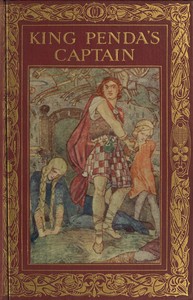
It chanced in the days when the preaching of Augustine and his followers had stirred all England from the Tyne to the Thames and the English sea that there arose in the Midlands, by the waters of Trent, a king of the Mercians named Penda, son of Wybba, who, though he counted full fifty years when he came to be king, had spirit like to that of a young man, and he was a great warrior and faithful unto death to that which he held true. When he saw the people of the lands around him casting over the gods of their forefathers and following the new faith he was wrath, and the more so with Northumbria, which had far outstripped the other nations of the Angles under its noble and mighty king. For Edwin had broken the old gods and brought under his overlordship the countrymen of Penda, and the North Angles, the Middle Angles, East Angles, and Southumbrians or men of Lindesey. Penda had seen all these things but had bided his time, though the great heart in him beat hard as he beheld. And when he came to be king he saw himself beset with foes: on the one hand his people were hemmed in by the Welsh and West Saxons, on the other by the North English and Middle English, East Angles and Lindiswaras or Lindeseymen, while towering above all was impregnable Northumbria. When Penda arose the heathen people, seeing the front of him, rallied, and he led them forth and conquered: his sword fell first upon his near neighbours the North Angles, Middle Angles, East Angles, and Southumbrians, and he brought them in under him. And, the heathen people still gathering to his banner, he tore the lands to the west from the West Saxons and overthrew king Cadwalla of Wales. Then the Welsh king, seeing what a mighty man was Penda, joined hands with him, and together they brought the kingdom of Wessex to their feet. So everywhere the Mercians had the victory. Then, at length, king Edwin lifted his war brand and gathered together a mighty host and went to meet the Mercians, but in a great fight Penda overthrew the Northumbrians, and Edwin himself was slain. So the power of Northumbria waned, until its new king, Oswald, roused himself, and went forth to help the Christian East Anglians against Penda, and with him went a mighty host. When Penda heard of his coming, he looked to his men and sent out ships bearing a messenger to one Nechtan of the Hundred Battles, a great chief among the Albanich or Picts, who, though most of the Pictish tribes had adopted the new religion, still stood by the old gods of his race. Now battle was to Nechtan as the breath of his nostrils, so that, though he cared less for his faith than did Penda for Odin and Thor and Freya, yet, whenever they brought him the summons he arose, and taking with him his son Feargus, and the most tried of his warriors, as many as the ships would carry, he sailed south for the land of Mercia.
Great was the joy of Penda at gaining so mighty a chief to his aid, and they went out together to meet king Oswald. Then Penda took command of the one half of that great host and Nechtan with his son Feargus of the other. And Penda fought with great might, and king Nechtan likewise, and his son Feargus. And it chanced in the midst of the fight that Penda saw the Pictish chief stumble, and ran forward to catch him, and carried him to his tent. Then the son of Nechtan was wrath at the wounding of the king his father, and he led his men so cunningly, as did also the mighty Penda, that the forces of Oswald were routed, and Oswald himself was slain. So Penda was greatly pleased with the hardihood of Nechtan and of his son, and before they went forth to their own land he begged the Pictish king to leave the youth, Feargus, with him to be his man, and he would, on his side, train him up in all manly ways. Now Nechtan was loth to part with his best captain, for, though yet but a boy, such he deemed his son, Feargus, but at length, for love of Penda and for that great service he had done him on the field of battle, he agreed.
“For well I wot,” said he, “that home-keeping youths have homely wits, and I know there is not such a warrior as Penda the world through.”
So Feargus put his hands between the hands of Penda and became his man, and swore on his father’s sword to be faithful and obedient, and to stand by the king in all matters soever. Then, after a short sojourn for the healing of his wound, king Nechtan departed, leaving behind a company of two hundred Picts, especially chosen for their size and strength and hardihood, to serve his son.
My Heart Doth Beat
“My heart doth beat for thou art fair, As Luga’s shower[3] thy glowing hair, As down thy soft white cheeks and red, As fleecy clouds thy pale forehead.
“Oh, never man had love so meet, Oh, never maiden face so sweet, Oh, ne’er will be so sad a heart As mine shouldst thou bid me depart.
“But shouldst thou whisper, ‘Lover, stay, I cannot live an thou’rt away, So I the whole world will defy To have my sweetheart ever nigh;’
“Then all these clouds will turn to rose As at an August evening’s close, And mating song-birds in the brake Will sing of love for thy dear sake.”
Torfrida paused in her walk when the first notes fell upon her ear. She heard the song right through and smiled sadly and wept a little, and then turned swiftly and ran through the green bushes and threw her arms round the tall minstrel with a little cry of joy. And when she had found her tongue she said—
“Feargus, O Feargus! what dost thou here? If the men of Sigmund do but see thee, then neither I nor any other can save thee.”
“Then thou art of a mind, sweet Torfrida, to save the enemy of Sigmund and the conqueror of the Christians.”
“Thou hast wronged me if ever thou hast thought that I could betray thee; but what brings thee here?” she added, with a woman’s disingenuousness.
“Thyself, Torfrida.”
“Myself!”
“Nay now, thou well knowest ’tis thyself; never since the day thy father took thee away has there been any joy in the world for Feargus, nor will be till thou art back.”
“Back, ah! that I will never be, noble Feargus, slayer of Christians though thou art—but get thee hence, for hast thou not broken Penda’s bidding by coming into this land?”
“That have I, and that must I again, if I may not see thee without, for thou, Torfrida, hast the heart of Feargus.”
“And thou that of Torfrida.”
Long time they stood with hands locked, and much they spake, till the maidens of Torfrida came out to seek their mistress. Then said Torfrida, “Never again must thou come, O Feargus, for an the men of Penda or of my father caught thee, even though death were not dealt to thee, thou wouldest be for ever disgraced.”
“I cannot live without seeing thee, sweet Torfrida, and must come.”
“Nay, rather will I ride forth to meet thee on Penda’s land than that thou shouldst break thine oath to the king.”
“Brave indeed thou art, but I am loth to break my faith with the old man, though sorry that thou shouldst run into danger.”
“Nay, little danger will it be to me in my father’s land, and in Penda’s thy presence will shield me from all questions.”
And so they left it, and many times Torfrida rode out to meet her lover on the verge of king Penda’s land.
And Penda waxed more and more bitter against the Christians, while Feargus’s ardour grew less and less as he learnt something of their faith from Torfrida, for hard she beset him. At length it fell one evening that king Sigmund asked for his daughter, and her maidens could not find her; high and low they looked, but in vain, till at nightfall she returned, and Sigmund asked whither she had been, and Torfrida blushed and at length told the king her father, and he was much angered.
“So thou hast been holding tryst with thy father’s foe, and thou a Christian!”
Then Torfrida wept and asked forgiveness.
“Nay, I cannot forgive thee till thou hast broken this bond with young Feargus. The Christian may not wed with the worshipper of false gods. I little thought that child of mine could wish to wed with one who had lifted his hand against me.”
And then Sigmund sent for the priest who dwelt with them, and he was wrath and forbade her trysting with Feargus, and they kept her a prisoner in her room until such times, said her father, as she promised to abandon her lover.
And at the end of a month they came to her for an answer, and she said: “Never will I break my troth with Feargus, or wed other, Christian or heathen, for that I love him; and where love is, God will not and man may not come between; if he is infidel, will he not surely need a Christian to wife the more?”
And there was anger between Sigmund and Torfrida, for he was wishful that she should strengthen his hands by wedding a Christian king. So Torfrida sent her brother Edwy secretly to meet Feargus at their tryst, to bid him beware, and Feargus turned homewards heavy-hearted.
Now it happened that at this time Penda sent Feargus as a messenger to Northumbria, and there he fell in with one of the Christian priests of his own race, who took a liking to the young Pict, and Feargus, being by no means as bitter against the Christian as was his master Penda, listened to all he had to say, and received it kindly. So that before leaving he told the priest if it had not been for his duty to the old king and to his father, he would have almost become a Christian, whereupon the priest tried to show him that being of this mind his duty to his Maker was before that to his king and father.
“Such is not the law of my father’s people,” said Feargus, “for if I betray my trust to my master, how will I be fit to keep that to the God of the Christians. If thou canst overcome the old king with thy reasoning I will be glad, but if thou canst not, then must I yet stand by him to the end, and his enemies will still be mine.”
Feargus went his way southward till he won home again, but from that day much of the merry youthfulness of him died, and he walked with knotted brow and doubting heart and no longer sang blithely the war songs of the Albanich, but chose the plaintive and sorrowful ones instead, that suited best his spirit. And he could see dimly that in the days to come the new faith would rise triumphant over all lets and hindrances soever, for in it was truth so great and so plain withal that men had but to hearken to be overcome, and in the future he saw trouble for Penda and trouble for himself.
And when he reached home he found that Penda was making ready to march upon king Sigmund and had sworn to burn his city and harry his land, and Feargus was much troubled; for he knew that he must lift his hand against the kin of Torfrida—and what might not happen to her in the press and thick of the fight, when men spared neither old nor young; and how would her people let her marry with him who entered their land as a destroyer? And one day, as he was riding abroad, a man dressed as a beggar came up and drew close to him and whispered as he passed, and Feargus started, and, gathering his reins from the beast’s neck, rode on all that night and, at the morning, came to a wood. By this he lingered, until at noon he heard the sound of hoofs and saw Torfrida with two maidens accompanying her on palfreys; and he took her in his arms and kissed her, and saw that she was pale and careworn.