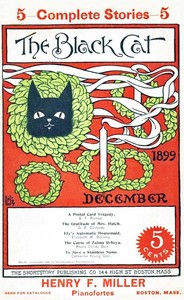
Public-domain ebook
Ely's Automatic Housemaid
Language: en348 downloads on Project Gutenberg
Subjects
In: Science-Fiction & Fantasy·Humour
Public-domain ebook sourced from Project Gutenberg #59486.
Public-domain ebook
Language: en348 downloads on Project Gutenberg
Subjects
In: Science-Fiction & Fantasy·Humour
Public-domain ebook sourced from Project Gutenberg #59486.
The opening · free to read
BY ELIZABETH W. BELLAMY.
In order for a man to have faith in such an invention, he would have to know Harrison Ely. For Harrison Ely was a genius. I had known him in college, a man amazingly dull in Latin and Greek and even in English, but with ideas of his own that could not be expressed in language. His bent was purely mechanical, and found expression in innumerable ingenious contrivances to facilitate the study to which he had no inclination. His self-acting lexicon-holder was a matter of admiring wonder to his classmates, but it did not serve to increase the tenacity of his mental grasp upon the contents of the volume, and so did little to recommend him to the faculty. And his self-feeding safety student-lamp admirably illuminated everything for him save the true and only path to an honorable degree.
It had been years since I had seen him or thought of him, but the memory is tenacious of small things, and the big yellow envelope which I found one morning awaiting me upon my breakfast-table brought his eccentric personality back to me with a rush. It was addressed to me in the Archimedean script always so characteristic of him, combining, as it seemed to do, the principles of the screw and of the inclined plane, and in its superscription Harrison Ely stood unmistakably revealed.
It was the first morning of a new cook, the latest potentate of a dynasty of ten who had briefly ruled in turn over our kitchen and ourselves during the preceding three months, and successively abdicated in favor of one another under the compelling influences of popular clamor, and in the face of such a political crisis my classmate’s letter failed to receive immediate attention. Unfortunately but not unexpectedly the latest occupant of our culinary throne began her reign with no conspicuous reforms, and we received in gloomy silence her preliminary enactments in the way of greasy omelette and turbid and flavorless coffee, the yellow screed of Harrison Ely looking on the while with bilious sympathy as it leaned unopened against the water-bottle beside me.
As I drained the last medicinal drop of coffee my eye fell upon it, and needing a vicarious outlet for my feelings toward the cook, I seized it and tore it viciously open. It contained a letter from my classmate and half a dozen printed circulars. I spread open the former, and my eye fastened at once upon this sympathetic exordium:
“Doubtless, my dear friend, you have known what discomfort it is to be at the mercy of incompetent domestics--”
But my attention was distracted at this point by one of the circulars, which displayed an array of startling, cheering, alluring words, followed by plentiful exclamation points, that, like a bunch of keys, opened to my enraptured vision the gates of a terrestrial Paradise, where Bridgets should be no more, and where ill-cooked meals should become a mechanical impossibility. The boon we had been sighing for now presented itself for my acceptance, an accomplished fact. Harrison Ely had invented “An Automatic Household Beneficent Genius.--A Practical Realization of the Fabled Familiar of the Middle Ages.” So the circular set forth.
Returning to the letter, I read that Harrison Ely, having exhausted his means in working out his invention, was unable to manufacture his “machine” in quantity as yet; but that he had just two on hand which he would sell in order to raise some ready money. He hoped that I would buy one of his automatons, and aid him to sell the other.
Never did a request come at a more propitious moment. I had always entertained a kindness for Harrison Ely, and now such was my disgust at the incompetence of Bridget and Juliana and their predecessors that I was eager to stake the price of a “Household Beneficent Genius” on the success of my friend’s invention.
So, having grasped the purport of the circulars and letter, I broke forth to my wife:
“My dear, you’ve heard me speak of Harrison Ely--”
“That man who is always so near doing something great, and never has done anything?” said she.
“He has done it at last!” I declared. “Harrison Ely is one of the greatest geniuses the world has ever seen. He has invented an ‘Automatic-Electric Machine-Servant.’”
My wife said, “Oh!”
There was not an atom of enthusiasm in that “Oh!” but I was not to be daunted.
“I am ready,” I resumed, “to invest my bottom dollar in two of Harrison Ely’s machine-servants.”
Her eyes were fixed upon me as if they would read my very soul. “What do they cost?” she mildly asked.
“In comparison with the benefits to be derived, little enough. Listen!” I seized a circular at random, and began to read:
“The Automatic Household Genius, a veritable Domestic Fairy, swift, silent, sure; a Permanent, Inalienable, First-class Servant, warranted to give Satisfaction.”
“Ah!” said my wife; and the enthusiasm that was lacking in the “Oh!” made itself eloquent in that “Ah!” “What is the price?” she asked again.
“The price is all right, and we are going to try the experiment.”
“Are we though?” said she, between doubt and desire.
“Most assuredly; it will be a saving in the end. I shall write to Harrison Ely this very night.”
The return mail brought me a reply stating that two Electric-Automatic Household Beneficent Geniuses had been shipped me by express. The letter enclosed a pamphlet that gave a more particular account of the E. A. H. B. G. than the circulars contained. My friend’s invention was shaped in the likeness of the human figure, with body, head, arms, legs, hands and feet. It was clad in waterproof cloth, with a hood of the same to protect the head, and was shod with felt. The trunk contained the wheels and springs, and in the head was fixed the electric battery. The face, of bisque, was described as possessing “a very natural and pleasing expression.”
Just at dusk an oblong box arrived by express and was duly delivered in our hall, but at my wife’s urgent entreaty I consented not to unpack the machines until next day.
“If we should not get the knack of managing them, they might give us trouble,” said this wise wife of mine.
I agreed to this, and having sent away Bridget with a week’s wages, to the satisfaction of all parties, we went to bed in high hopes.
Early next morning we were astir.
“My dear,” I said, “do not give yourself the least concern about breakfast; I am determined that Harrison’s invention shall have fair play.”
“Very well,” my wife assented; but she prudently administered bread and butter to her offspring.
I opened the oblong box, where lay the automatons side by side, their hands placidly folded upon their waterproof breasts, and their eyes looking placidly expectant from under their waterproof hoods.
I confess the sight gave me a shock. Anna Maria turned pale; the children hid their faces in her skirts.
“Once out of the box,” I said to myself, “and the horror will be over.”
The machines stood on their feet admirably, but the horror was not materially lessened by this change of position. However, I assumed a bold front, and said, jocosely:
“Now, which is Bridget, and which is Juliana--which the cook, and which the housemaid?”
This distinction was made clear by dial-plates and indicators, set conspicuously between the shoulders, an opening being cut in the waterproof for that purpose. The housemaid’s dial-plate was stamped around the circumference with the words: Bed, Broom, Duster, Door-bell, Dining-room Service, Parlor Service, etc. In like manner, the cook’s dial-plate bore the words that pertained to her department. I gave myself first to “setting” the housemaid, as being the simpler of the two.
“Now, my dear,” said I, confidently, “we shall see how this Juliana can make the beds.”
I proceeded, according to the pamphlet’s directions, to point the indicator to the word “Bed.” Next, as there were three beds to be made, I pushed in three of the five little red points surrounding the word. Then I set the “clock” connected with the indicator, for a thirty minutes’ job, thinking it might take about ten minutes to a bed. I did not consult my wife, for women do not understand machinery, and any suggestion of hesitancy on my part would have demoralized her.
The last thing to be done was to connect the indicator with the battery, a simple enough performance in itself, but the pamphlet of directions gave a repeated and red-lettered “CAUTION,” never to interfere with the machine while it was at work! I therefore issued the command, “Non-combatants to the rear!” and was promptly obeyed.
What happened next I do not pretend to account for. By what subtle and mysterious action of electricity, by what unerring affinity, working through a marvellous mechanism, that Electric-Automatic Household Beneficent Genius, whom--or which, for short--we called Juliana, sought its appropriate task, is the inventor’s secret. I don’t undertake to explain, I merely narrate. With a “click” the connection was made, and the new Juliana went up-stairs at a brisk and business-like pace.
The book keeps going
Reading is free forever. Sign up and watch scenes appear while you read.



Scenes Storieta drew for other classics.
New illustrated classics
Once or twice a month: the latest books to get full character casts, scene art, and free comic editions. No account needed.