THE BURIAL OF THE OLD FLAG.
BY MARY A. BARR.
There is not in all the north countrie, Nor yet on the Humber line, A town with a prouder record than Newcastle-upon-the-Tyne. Roman eagles have kept its walls; Saxon, and Dane, and Scot Have left the glamour of noble deeds, With their names on this fair spot. From the reign of William Rufus, The monarchs of every line Had a grace for loyal Newcastle, The city upon the Tyne.
By the Nuns' Gate, and up Pilgrim Street, What pageants have held their way! But in seventeen hundred and sixty-three, One lovely morn in May, There was a sight in bonnie Newcastle! Oh, that I had been there! To hear the call of the trumpeters Thrilling the clear spring air, To hear the roar of the cannon, And the drummer's gathering beat, And the eager hum of the multitudes Waiting upon the street.
Just at noon was a tender hush, And a funeral march was heard; With arms reversed and colors tied, Came the men of the Twenty-third. And Lennox, their noble leader, bore The shreds of a faded flag, The battle-flag of the regiment, Shot to a glorious rag; Shot into shreds upon its staff, Torn in a hundred fights, From the torrid plains of India To the cold Canadian heights.
There was not an inch of bunting left; How could it float again Over the faithful regiment It never had led in vain? And oh, the hands that had carried it! It was not cloth and wood; It stood for a century's heroes, And was crimson with their blood; It stood for a century's comrades. They could not cast it away, And so with a soldier's honors They were burying it that day.
In the famous old North Humber fort, Where the Roman legions trod, With the roar of cannon and roll of drums They laid it under the sod. But it wasn't a tattered flag alone They buried with tender pride; It was every faithful companion That under the flag had died. It was honor, courage, and loyalty That thrilled that mighty throng Standing bare-headed and silent as The old flag passed along.
So when the grasses had covered it, There was a joyful strain; And the soldiers, stirred to a noble thought, Marched proudly home again. The citizens went to their shops once more, The collier went to his mine; The shepherd went to the broomy hills, And the sailor to the Tyne; But men and women and children felt That it had been well to be Just for an hour or two face to face With honor and loyalty.
NOTE.--In May, 1763, the soldiers of the Twenty-third Regiment of the British army buried with military honors at Newcastle-on-Tyne the regimental flag, which had been torn to shreds at the battle of Minden.
A TERRIBLE EXPERIENCE.
BY ALLAN FORMAN.
One rainy day, as the children were amusing themselves by ransacking their uncle Harry's closets, Tom pulled his hand out suddenly from the back part of a deep drawer, and shouted triumphantly, "Preserves!" at the same time holding out a large glass jar for inspection. A cry of disgust followed, for instead of preserves there was nothing in the bottle but a strange-looking animal floating in some brown liquid.
"Pah! It's a horrid bug," said Alice, turning up her nose in disgust.
"'Tain't," contradicted Charlie, regardless of his grammar. "It's a tarantula."
"And what is that but a bug?" replied Alice.
"It's a spider," said Charlie. "You ask Uncle Harry if it isn't."
In the mean time Tom and Alice had taken the jar over to the desk where Uncle Harry was writing.
"What is this, Uncle Harry?" said Alice.
"It is a tarantula. I brought it home from California with me."
"I told you so!" exclaimed Charlie, from the closet.
"It is a kind of spider, and one of the largest that lives in this country. They don't make webs like ordinary spiders, but dig a hole in the ground and line it with a sort of silky web like the cocoon of a silk-worm. Their hole is about six inches deep, and is closed by a funny little trap-door made of the same silky lining, and covered on the outside with sticks and gravel so cleverly that one can rarely find a tarantula's burrow unless you see him going in; and even if you do see him going in, it is very difficult to get him to come out, as he pulls his trap-door shut after him, and holds it tight from the inside."
"If he don't build a web, how does he catch flies and things?" inquired Charlie.
"He jumps after them. A lively tarantula can jump from three to five feet, and when he once catches hold of any kind of a bug or small bird with those great hairy legs, it has but little chance to get away."
"Is their bite really so poisonous?" asked Alice, eying the jar rather timidly, as if she was afraid the terrible insect would get away.
"That question is a hard one to answer. Some people who have lived in countries where they are common claim that it is only fatal in a few cases, while others seem to think it is deadly poison."
"What are you laughing at, Uncle Harry?" demanded Charlie.
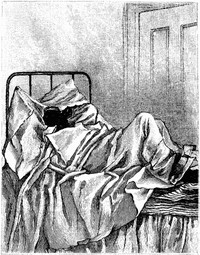
"I was thinking of the most horrible night I ever experienced," replied his uncle. "You know," he continued, "while I was in the West I spent some two weeks camping out in the mountains with a party of four young men. We had an old cabin, where we slept at night, and we spent our days delightfully, fishing, hunting, geologizing, and botanizing. We had not been in camp long before we discovered a tarantula village not far from our cabin, and we all determined to catch some specimens to take home with us. At first we had considerable trouble in catching them; they were so lively and so ugly that we always ended in killing them in self-defense. At last a brilliant member of the party discovered that by placing a wide-mouthed bottle over the mouth of the tarantula's burrow, and then thumping on the ground around it, the animal would crawl out into the bottle, and the captor could turn the bottle over, clap a piece of board over the top, and secure his prisoner. As soon as the discovery was made known, all the old pickle jars were called into requisition, and as the former occupants of the cabin had left a number, we were soon lucky, or unlucky, enough to have about twenty-five large specimens. We covered the jars with bits of shingle, and set them on a shelf which was nailed to one side of the cabin. Everything went well, and we determined that as soon as we had leisure we would kill them with chloroform, and preserve them in spirits as that one is. But one night, after we had all got comfortably settled for sleep, one of the party thought that he was thirsty, so rising carefully from his bunk, he groped his way over to the corner, under the shelf, where the water-pail stood; he had his drink, and forgetting the existence of the shelf, raised his head. Crash! down came the rotten old shelf, and down came the jars with the tarantulas in them. The party heard the fall, and like one man sprang from their beds and rushed for the door, but before they had got half-way across the floor they remembered that the tarantulas were loose, and they stopped; a moment more and it was too late. We were all afraid to move, for fear that we would put our feet on a tarantula; so there we stood, as if turned into statues. In a short time our positions became strained and cramped, but we did not dare to change them. Our nerves became excited, and we imagined that we could feel them crawling up our backs and walking over our bare feet. The minutes seemed lengthened to hours, and the hours seemed months. At last the day began to break, but we had manufactured curtains out of old newspapers, that we might sleep undisturbed by the light. Oh, how we bemoaned our laziness! Finally it grew light enough to see, and we carefully opened the door and went out. One of the party went back into the cabin and got our clothes, and after examining them carefully we dressed ourselves."
"And nobody was bitten?" said Alice, with a sigh of relief.
"No," replied her uncle, rising from his chair as the supper-bell rang; "but I don't think I ever was so badly scared before or since."
PLANTS AND ANIMALS--THEIR DIFFERENCE.
BY MRS. S. B. HERRICK.
If the question were put to you suddenly, "What is the difference between a plant and an animal?" how do you think you would answer? Stop a minute, and think. Do not be satisfied with saying that a plant has leaves, and an animal has not. Look deeper, and answer more thoughtfully. There are many plants which have no leaves, nor roots, nor flowers, and there are some animals which seem to have all these things (Figs. 1 and 1_a_). In some cases they are so much alike (Figs. 2 and 3) that it has taken the most careful study to decide whether they are plants or animals.
Look up into the bright blue sky, and then down at the solid earth beneath your feet--you do not find any difficulty in telling, without taking a moment to think, which is sky and which is earth; but if you are so happy as to live in the wide open country, or near the sea, or on a lofty hill, look off and off and off until you see only the delicate blue haze, like smoke, which divides the heavens from the earth. You can often see the same thing by looking from the upper windows of a high house. You will find that many and many a time you can not tell which is earth and which is air.
Just so it is in the world of nature. You may look at a group of cows standing under the trees, or watch the merry little grasshoppers skipping about in the weeds, or catch a bee at his early drink in a morning-glory bell, and you would laugh if anybody asked you if you could tell the animal from the plant. But get far enough away from these common things, and study the animals and plants that need your microscope to see them, and you would find things so much alike that you could not tell which was which. Many of these plants have no roots nor leaves, no flowers nor seed, and many of the animals have no heads nor legs, no eyes, nor mouths, nor stomachs. In Fig. 4, a is a plant, and b is an animal. Now how do you suppose anybody knows this? People who study these things do not _guess_--they know. The real difference lies in what these tiny little creatures do, not at all how they are formed.
About three-fourths of all the kinds of sea-weed, for instance, are found to be animal--not one animal, but a colony. The other fourth are vegetables. All these used to be considered vegetables; so did the sponge and the coral and the sea-anemones, and they are all now known to be animals. Every time you play the game of "Twenty Questions" you have to think and decide whether the particular thing you have chosen is "animal, vegetable, or mineral." Have you any notion what makes the real difference between them?
I imagine that, sooner or later, you will think and say the difference is that animals can move and plants can not. That will be a very sensible conclusion if you do come to it, though not a correct one, for plants do move, some of them very much as animals do; others, and the greater number, in another way; which all seems very wonderful, and which I want to talk over next time.
What makes the real, deep-down difference is this: Plants can live on mineral matters alone, on earth and water and air, and these things they can change into their own flesh and blood, their stems and sap and fruit. Animals can only live on what the plants have already turned from dead into living material. We need water--that is a mineral--and salt and air, which are minerals too, if we are to keep alive and well. But we can not live on these things alone: we should soon die if we had no food; and all really nourishing food, all that keeps our blood warm and makes us grow, has once been vegetable. Not one bird, or fish, or animal, not one single human being, could ever have lived on this earth, in the air, or in the water, if the plants had not come first, and prepared the earth for us to live in.