Public-domain ebook
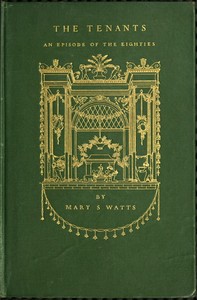
The Tenants: An Episode of the '80s
Language: en423 downloads on Project Gutenberg
Subjects
In: Historical Novels·Novels·American Literature
Public-domain ebook sourced from Project Gutenberg #59640.
Public-domain ebook
Language: en423 downloads on Project Gutenberg
Subjects
In: Historical Novels·Novels·American Literature
Public-domain ebook sourced from Project Gutenberg #59640.
The opening · free to read
They were tearing down the old Gwynne house the other day as we drove past, and it was not without a twinge of sentimental regret that we beheld the spectacle. The old Gwynne house was what our newspapers delight to honour by referring to as an "historic landmark." In the huge, expensive, devastating, and reconstructing haste of a growing American town--a town of the middle West at that--any building twenty-five years of age is likely to be so described; but this must have numbered all of four-score. Many valiant notable deeds and people were associated with it; it went through a whole epic of adventures like--as one might whimsically fancy--a stationary Odysseus. At the latter end it fell to be that common drudge and slattern among homes, a boarding-house; reached the last sordid depth as a tenement; and now they are abolishing it utterly, and a new subdivision to be called, I believe, Gwynne Park Place, will presently flourish above the grave. Once upon a time there was a park; it lay upon the utmost border of town, and brick walls bound with a ribbon of stone along the top, kept the house and its outlying lawns in a pompous seclusion. That was all swept away long ago; of late the ground has been reclaimed from slums and shanties and laid out in building-lots, curbed, sewered, gas-mained. But you may see here and there a single elm or buckeye, keeping yet amongst the spruce new flower-beds and within call of factory-whistles, some air of its antique dignity, remote and cool. In my time Doctor Vardaman's cottage, hard by where you used to turn into the Gwynne driveway, was the only other dwelling hereabouts; a great, spraddling, staring apartment-house covers the site of it now.
Governor Gwynne built his mansion--as he probably called it--in the year eighteen-thirty or thereabouts; and being an admirer of the classic and a wealthy man for those days, treated himself to a fine Parthenon front, with half a dozen stone pillars in the Doric taste springing from the black-and-white pavement of the veranda to uphold the overreach of the roof, "Governor Gwynne's Attic roof," as some wit of the mid-century once styled it; that wretched pun survives to-day in a kind of deathless feebleness; it will only pass from men's memories with the house itself. Much the same fashion of architecture is popular nowadays, but people pay more attention to comfort. The governor's pillars were ingeniously disposed so as to darken all the windows looking that way, whether in the double parlours on the first floor, the bed-chambers on the second, or the big ballroom over the entire house on the third. It was a rather gloomy splendour in which the old gentleman lived, I think. The rich, ponderous mahogany furniture, the dismal brocade draperies, the hair-cloth and brass nails, the ghastly white marble mantelpieces carved with mortuary-looking urns and cornucopias spilling out cold white marble fruits, with which he embellished his abode, were yet to be seen when I was a child. The hall was decorated with a wall-paper setting forth the wanderings of Aeneas, wherein he and his companions marched, fought, and sailed progressively all about the walls and up the stairs, ending--entirely innocent of any irony--with the descent into hell, and the awful waves of Phlegethon flaming on either side of the double-doors into the ballroom, on the top landing. The sternness of the subject somehow subdued or dominated its brilliant colouring; and I have never been able to divest my mind of that incongruous association. For me the pale helmsman still steers toward that ballroom door; and it is beside Governor Gwynne's ancient black walnut newel-post that I shall always behold the splendid figure of the hero lusty and living amongst the exiguous shadows. In the library the Governor's law-books paraded along the shelves in close order behind the securely locked, shining glass-and-mahogany doors; in the dining-room there stood a grim old mahogany wine-cellaret like a short upright coffin; it was difficult to imagine any sort of good-cheer proceeding from that forbidding receptacle, but out of it Governor Gwynne had entertained Andrew Jackson, Captain Marryat, Henry Clay, a whole long register of celebrities. And I believe--under correction, for the date is cloudy in my recollection--that he was preparing to entertain the Prince of Wales with its help, when that young gentleman visited this country, had not humanity's oldest and best-known guest called upon him earlier. They used to show you the exact spot in the vast darkling front parlour on the south side where his body had lain in state a September afternoon in 1851, and Chase had pronounced the funeral oration over him. There was a full-length portrait of him scowling at a scroll of legal cap, with a big double-inkstand on the table beside him--"handy so he could shy it at you in case you disagreed," Gwynne Peters used profanely to suggest--hanging on the parlour wall just opposite the long mirror between the windows; the chairs and sofas were always shrouded in white linen covers; white net bags swathed the ornate gilt-and-glass chandeliers. It was a ghostly place, that room, with a clock mounted in a kind of Greek temple of alabaster under a glass dome on the mantel sepulchrally ticking out the irrecoverable hours, and Governor Gwynne eyeing you sternly from his elevation. He looked not too well pleased with his canvas immortality and considering what he must see, it was no wonder.
He was born some time during the last quarter of the eighteenth century, and therefore must have been upwards of sixty before the day when Chase sonorously reminded his hearers in the south parlour that--"The history of Samuel Gwynne's life was, in very truth, the history of his native State, so closely was he associated with her struggles, her vicissitudes, and her achievements.... If zeal, if integrity, if courage and ability in the discharge alike of public and private duties can establish a claim upon the grateful remembrance of posterity, then, fellow-citizens, we may well point with pride.... This was the noblest Roman of them all," etc. A neat pamphlet containing the address and the Resolutions of the Bar Association was afterwards printed and distributed; it was only the other day that I came upon a copy of it, very yellow and dusty, but bearing no marks of ever having been tampered with by a reader--indeed, some of the leaves were yet uncut--among other essays and orations of a like nature blushing unseen in the darkest corner of a second-hand book-shop. From it I extracted the rhetorical gems just cited, and it is doubtful if they will ever see the light again, yet I am confident that the old gentleman deserved much that was said of him, and would have been the first to deprecate any "pointing with pride." He was an upright judge, a temperate and God-fearing man; he amassed a handsome fortune, and served his particular section of the country through two terms as Governor, rather fancying himself, I believe, in the role of statesman, and all unwittingly laying the foundations of that intolerable, absurd, and tragic Gwynne family pride; it beset all his descendants and all the countless kindred of Gwynnes like a curse. No more arrogantly self-righteous set of people ever existed; and no more hysterically clannish. The Governor's memory held them all together for forty years after his death; only recently, with the introduction of new blood, has that strange, intangible bond dissolved. Samuel died and was gathered to his fathers; and Samuel, his son reigned in his stead, and busily drank himself to death in as short a time as that agreeable result could be compassed; he was not the first nor the last of the family to make thus the easy Avernian descent. I have heard some of the Gwynnes themselves comment upon the familiar fate and character of great men's sons, as exemplified by Governor Gwynne's with a kind of melancholy complacence.[1] The Governor left a queer, unjust, and wrong-headed will--realising, perhaps, how queer, unjust, and wrong-headed were some of his prospective heirs--tying up a part of his property to the third generation, devising what seemed an unfair proportion to his brothers and sisters, of whom it might be said that their name was legion--Lucien Gwynne, David Gwynne, Charlotte, Eleanor, Marian; I have never known anyone who could accurately catalogue all the Gwynnes--and bequeathing the house and furniture to all his children in succession, as if he had a premonition that none of them would enjoy it long. There was a son who had run away to sea and was never heard of again; no provision was made for him in case he should reappear, although he was the oldest. Then came Sam, that died in a fit of delirium tremens; then Arthur. Him they found hanging to a beam under the "Attic" roof one summer morning not long after he had succeeded to the kingdom of the Gwynnes; and I suppose there was a horrid silence in the attic, and presently wild, pale-faced women and running and hurry and horses' hoofs churning the gravel before the door. The body was laid in the same south parlour and Governor Gwynne stared over his scroll at the suicide. Arthur left two daughters, young women grown; by the time I put on long dresses they were two old maids and lived narrowly, doing their own work, in a little cheap house at the other end of town. They were always clad alike in the last bombazine that was ever seen among us, I am sure, and wore their hair in the ringlets of eighteen-sixty, with knobs of black satin ribbon at the temples. They had the name of being queer, but then all the Gwynnes were queer.
After Arthur, a daughter, Harriet Peters, went to live in the house; she was a widow, Donald Peters having gone into the army--about '62 or '63, I think--and died of typhus in Libby Prison. One would have thought the house held out very slender attractions for the remaining Gwynnes, by this time; but all the heirs were pretty well straitened in means, and Mrs. Peters probably welcomed any way of reducing expenses. No one, least of all the heirs themselves, ever seemed to know, or be able to explain what had become of the Gwynne fortune; but it is certain that ten years after the Governor's death it was almost entirely dissipated, except what was held in trust or otherwise secured. This included the house, which could not be sold, as I have been told; at any rate Mrs. Peters had it for her life rent-free. I dare say she had pleasant enough memories of old days when she was a child and played about the pillars with her brothers and Caroline; she had two children, two little boys of her own, and she liked the idea of bringing them up in what she called without the least notion of being affected, her ancestral home. All the Gwynnes loved their dreary inheritance; they had as great a fondness and reverence for their name as if everyone that ever bore it had lived and died in the odour of sanctity; and doubtless regarded the house with something akin to the sacred affection of the Israelites for the Temple. I remember Mrs. Peters when she lived there, a tall woman with the thin, aquiline features and red hair of the family, going about with her black skirts and solemn face. Being constantly treated by her friends as a broken-hearted heroine, the daughter of one departed patriot and widow of another, I believe the pose became not distasteful to her as years went on; I have heard her refer to herself in sounding and mournful phrase as "the last of the Gwynnes,"--whereas, Heavens knows there were enough Gwynnes to stock a colony! She must have meant that she was the last of the Governor's immediate descendants--and so she was, excepting Caroline.[2]
The book keeps going
Reading is free forever. Sign up and watch scenes appear while you read.



Scenes Storieta drew for other classics.
New illustrated classics
Once or twice a month: the latest books to get full character casts, scene art, and free comic editions. No account needed.