Public-domain ebook
Family Tree
Language: en229 downloads on Project Gutenberg
Subjects
Public-domain ebook sourced from Project Gutenberg #59643.
Public-domain ebook
Language: en229 downloads on Project Gutenberg
Subjects
Public-domain ebook sourced from Project Gutenberg #59643.
The opening · free to read
You don't like Darwin's theory of Evolution? Maybe you're right. Maybe Man's ancestors weren't monkeys after all....
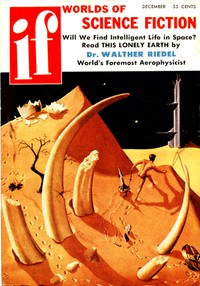
[Transcriber's Note: This etext was produced from Worlds of If Science Fiction, December 1956. Extensive research did not uncover any evidence that the U.S. copyright on this publication was renewed.]
How do you get rid of a superman?
The method Masefield Truggles used was the tried-and-true Masefield Truggles method. Of course, he didn't know at the beginning that Blan Forsythe was a superman. But Forsythe had lived in Marston Hill most of his life--born there, in fact--while Truggles had been there only two years. So Truggles gave the case the full treatment with flourishes, including a careful reconnaissance to determine vulnerable spots in Forsythe's reputation.
Truggles determined that reform or removal of Forsythe would be his contribution to the moral welfare of Marston Hill as soon as he heard the rumors, some joking, some serious, about Forsythe's polygamous tendencies. This was a ready-made situation for Truggles.
Truggles began his research with Forsythe's ex-wife, Phyllis Allison. He had learned from experience that an ex-wife usually is a good source of information about vulnerable spots.
She served him tea in the parlor of her modest home. After a routine round of chit-chat designed to put her at ease, Truggles approached the point.
"As you may know, Mrs. Allison, I am president of our Social Standards Protective League," he said, fixing his deep blue eyes on her face.
"I've heard of it, Mr. Truggles," she said in a low voice. "My duties at home keep me too busy to belong to any organizations, though."
As if to emphasize her point, she put her arm around the shoulders of her young son. The boy sat quietly beside her, watching Truggles like a young animal. Truggles figured he must be about five years old--certainly he would be below school age, for school was in session--but he was big for his age. There was something disturbing about his intent gaze.
"I'm not here in the interest of your joining the League, Mrs. Allison, though we'd be glad to have you," said Truggles. "I came to ask you for some confidential information about the shameful way your former husband mistreated you."
Her eyes opened wide.
"Why, Blan never mistreated me!" she exclaimed. "Whoever told you such a thing? I loved Blan, and he loved me. I still love him."
"If he loved you, why did he leave you?" demanded Truggles triumphantly.
"I think you're asking questions about something that isn't any of your business, Mr. Truggles," said Phyllis Allison, her eyes flashing ominously. "Blan Forsythe is ... different. We agreed to separate because it appeared I could give him no children. We were wrong, but it was too late, then."
"So he turned to polygamy through a mad desire to produce children," murmured Truggles happily. "You say you were wrong? I thought the boy was your only child."
"Donald is my only child, but he is Blan's child," said Phyllis, patting the boy on the shoulder.
Truggles raised bushy eyebrows.
"Wasn't it seven years ago you and Mr. Forsythe were divorced?" he asked pointedly.
"Yes, and Donald is only five," she answered defiantly. "My husband--Dr. Allison--tells me I'm foolish to have the feeling I do that Donald is Blan's son. He says it's impossible. But I know it's true. I've been working with Donnie, and, Mr. Truggles...."
She leaned forward intently and fixed her gaze gravely on Truggles' face.
"... Donnie has the Power!" she said in a tense whisper.
Truggles blinked. Phyllis Allison sat back and looked embarrassed, as though she had not intended to confide so much.
Truggles asked no more questions. He did not pursue the line of inquiry this revelation at once brought to mind. He took his leave as graciously as possible and left the house.
He knew that both Phyllis Allison and her son watched him as he walked out the door with shoulders bent in a show of humility. But it was the boy's eyes he felt.
Phyllis Allison. The fresh memory of her slender beauty, her wide, honest eyes, struck pain in Truggles' heart. They were rare--but why did he seem to run across them so often?--these women who reminded him of her. His lost love, his long-lost love, the smiling fairy with the dancing heart, without whom life never had been quite complete again.
The woman really believed the boy was Blan Forsythe's child. It was pathetic. And that reference to Donald's having "the power:" Truggles wondered how many women he had known who thought their sons were "different," who even convinced themselves that the children had been sired by a dream prince or such like. Deluded souls, to so excuse their sins!
He straightened and ran his fingers through his short-clipped gray hair as he strode along the walk. The extensive lawn of Blan Forsythe's mansion stretched only two doors away from the bungalow he had just left. It was decked with flower beds and evergreens.
Truggles was too circumspect to do anything openly at this stage. But he shook a fist at the stone pile, mentally.
Behind him, Truggles had a record of nothing but successes. There had been the alcoholic in Hantown, the Negro fortuneteller in New Bacon, the member of some queer religious sect in Steckleville. Truggles had set his face against them. He had shown the people of these towns what manner of creatures they harbored in their bosoms. They had been driven out (it was unfortunate, in a way, that the alcoholic had been hit by a brick and killed in the confusion of public reaction, but such accidents happen); and eventually Truggles himself, purring inwardly at the consciousness of a job well done, had moved on to fields of further effort.
Blan Forsythe was not big enough to escape his righteousness.
If the mayor of Marston Hill would cooperate, it would save Masefield Truggles a lot of work and possibly some unpleasantness for everyone. Sometimes mayors did cooperate, especially when elections weren't far off.
Truggles was not offended that Mayor Ben Sands received him in the garden of his home on the edge of town. He had known many fine gentlemen with dirt on their hands who abhorred dirt in the mind.
"I haven't seen Blan much lately, but he used to spend a lot of time out here," said Sands, taking his battered pipe from his mouth to speak. "He was interested in the flowers. Those asters, now. They're tetraploid. He developed 'em. Used colchicine."
He looked at Truggles inquiringly, to see if he understood. Truggles allowed a smile to quirk his lips and shook his head slightly.
"Extract from the autumn crocus," said Sands. "Makes plants tend to double their chromosomes."
Around them, the garden was a solid blaze of color. Zinnias, marigolds, phlox cast their colorful bounty to the air.
"I'm afraid I'm not much of a horticulturist," apologized Truggles.
"Well, it's like this," said Sands. "Every cell of every plant of the same species has the same number of chromosomes--you know, those bright little threads that hold the guiding genes of growth and development. Mutations in plants come when there are changes in individual genes from time to time. But when you hit them with colchicine, the chromosomes sometimes double without the cell dividing. Creates a new species, usually bigger, stronger, slower growing. Call them tetraploids. I've heard it called 'cataclysmic evolution.'"
"You mean man tampers with the basic laws of nature?" asked Truggles, awed and disturbed.
The book keeps going
Reading is free forever. Sign up and watch scenes appear while you read.



Scenes Storieta drew for other classics.
New illustrated classics
Once or twice a month: the latest books to get full character casts, scene art, and free comic editions. No account needed.