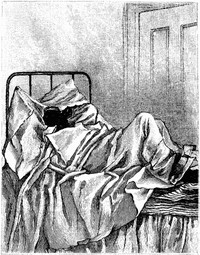
"If a man had eight quarts of wine in one measure, and three in another--"
Nan announced so much of a problem in her arithmetic, and then stopped with a little groan of despair.
"Well?" said her cousin Marian, turning from the window.
"Oh dear!" sighed Nan, "what is the use of lessons, anyway? And if we don't go down town soon, we won't be home in time for tea."
"What if we're not?" said the third inmate of the room, a boy of about thirteen, who was lounging on the sofa. "But hurry up, Nan; there's no use grumbling."
Nan planted her elbows rather more firmly into the table, clutched her curly head with a pair of firm brown hands, and returned to the question of the man and his wine. Marian watched the thin drizzling rain on the garden beds, and Philip read his Robinson Crusoe, regardless of the disorder of shells and minerals about him. For the matter of that, no one of the three young people took special heed of his or her surroundings. Marian did not care; Philip had a boy's feeling that he could not help untidiness; and Nan had, after two years' residence there, grown accustomed to the dingy shabbiness and vulgar disorder of her step-aunt's house in Bromfield.
The room was a nondescript one, above a cheese and butter store. It was half sitting-room, half parlor, and as long as Nan had known it the furniture had been the same, except that the wear and tear of time had made the chairs and table more rickety, the holes in the carpet more dangerous to incautious walkers, and the drawers of the big sideboard or press more uncertain in their way of moving in and out. The room overlooked the main street of Bromfield, and, as I have said, was directly above the store kept by Nan's step-aunt, Mrs. Rupert. A rather dark corridor outside led to a rickety staircase. Below, was only a small room off the store, and a kitchen, while above, the family were crowded into three sleeping-rooms.
When Nan first came to live with the Ruperts she was painfully observant of the things about her; but time had made many of the disagreeables seem natural, although even now any one could read in the bright, sweet face of my little heroine something more delicate and refined than her surroundings.
Just what Nan Rolf looked like at thirteen it is hard to tell you. Sitting at the table on this gray rainy day, she seemed to be the only bright spot in the room. Marian was a head taller than Nan. She was a pretty, rosy girl, in spite of her cramped life, and certainly would develop into a handsome woman. But no one could have predicted anything so definitely of little Nan. Her face was interesting, but not pretty; the features were irregular, the hazel eyes were full of a certain earnest sweetness, and though her mouth was rather wide, her smile was bright and dimpling, and her teeth white and even. Perhaps if Nan's hair had been in order, her clothes tidy and well-fitting, if she should cross a room without awkwardness, she might have looked attractive to any one. As it was, only those who cared to look a second time caught the real spirit of the child's face, the fearless honesty in her glance, the sweetness that made up for much lack of repose in her face and manner.
Nan herself would have laughed gayly at the thought of any one counting up her attractions, or, indeed, of their bestowing five minutes' reflection upon her. Such as she was, she had grown up more like a little wild flower, sharing what others around her had to offer, coming in for scoldings and pettings, the former predominating, no doubt, but never thinking much of her own individuality. Her step-aunt, Mrs. Rupert, was a widow with four children, the eldest of whom was Marian; and young as she was, Nan appreciated the kindness that offered her a home when her parents died; for Nan had never seen her--indeed, had scarcely heard of her, for the tie was not one of blood.
Mrs. Rupert's mother had married, a second time, Nan's grandfather, himself a widower with one little girl, later Nan's mother. The half-sisters had rarely met, for, before Mrs. Rolf was out of school, her step-sister had made a marriage far beneath her, and removed to Bromfield. Mrs. Rolf married, a few years later, a young lawyer, reputed to be very well off in this world's goods; but she knew at the time that he had quarrelled with his grandfather, from whom he had expected a fortune. And so it chanced that little Nan came into the world, and had lived her thirteen years in it, knowing no real relations.
When her mother's death left her a penniless orphan, Mrs. Rupert came forward and took the child to her own home. Mrs. Rupert had made an ineffectual effort, it is true, to reach some of Nan's paternal relations; and even now the child was frequently puzzled by hearing her aunt speak to others of her "having those belonging to her as rolled in money."
Who or where they were Nan often wondered in a vague, childish way, but could not tell. Her mother had died too suddenly to leave her any directions, and her father Nan only remembered dimly. Keen as were her instincts of refinement, and lonely as she often felt, yet little Nan could look forward to no future which should be brighter than Marian's. Philip was a boy; he, Nan liked to think, could go out into the world and carve his own career; but for her, she felt sure, it could only be the butter shop, the crowded little rooms, and the children always needing to be cared for in some fashion from morning until night.
"Don't knock everything over," growled Philip, slowly getting on his feet, while Marian put on her hat and jacket before a cracked mirror hung between the windows. Nan never required to see herself when she dressed. She was only a minute getting into an old woollen coat, and fastening a felt hat down over her wavy locks, after which she began a vain search for her gloves.
"There's mother calling," exclaimed Marian. "It's for you, Nan."
Nan heard the voice sounding down the hall, and darted, out, while Philip uttered another exclamation of disgust.
Nan never could overcome her dislike to the shop. She could hardly have told you why it was, but the butter and cheese and eggs in which Mrs. Rupert dealt were unpleasant to her, and as she ran down the dark hall, it was with a little shiver of dislike and of dread lest her aunt wanted her to "mind" the shop during her absence. Marian rather liked to perform this office, but Nan could never see any "fun" in it, and was always ready enough to change places with her cousin on holidays when they were all day at home. Before Nan reached the shop door she heard voices in pleasant though shrill tones, and going in, was a little startled by seeing a fashionably dressed young lady in earnest conversation with her aunt.
It was a scene Nan never forgot; the twilight of the cold spring day was just falling, and her aunt's stout figure, bending above a cheese, was in strong contrast to that of her visitor, a tall, slender young lady in a rich dress of dark silk, with beautiful furs, and long-wristed gray gloves. She had a handsome, delicate face, a little disdainful in expression, but very refined, and as Nan entered she turned lovely blue eyes toward her.
Nan half drew back, with her hand still on the door.
"Come in, child," said her aunt, in her most excited tones. "Don't hang back that way. Here's a lady wants particular to see you."
"To see me!" Nan gasped. She had never in her life had a special visitor before, but the stranger made things easy at once for her. She went up to little Nan, holding out her beautifully gloved hands.
"How do you do, my dear?" she said, in a soft, sweet voice. "I am your second cousin Phyllis."
"You--I--" Nan began, and felt as if the little shop, cheeses and all, was dancing about her. Could this beautiful lady be one of those who were "rolling in money"?
"Yes, dear," said the lady again. "I have come especially to see you." She turned to Mrs. Rupert, who was still standing with a knife plunged into the cheese, and staring as hard as Nan could at the visitor. "Perhaps I had better call again in the morning--there is so much to say, and it is late now."
"Oh, 'm," began Mrs. Rupert. "I'm sure we'd be glad enough to see you any time. Perhaps it might be as well to-morrow. Where was it you said you was staying?"
"At Mrs. Grange's," the lady answered, looking again at little bewildered Nan. "My name is Miss Rolf, and I live at Beverley." The name made Mrs. Rupert's heart jump. Beverley was the town in which Nan's grandfather had lived and died. Surely this meant something; just what, Mrs. Rupert hardly knew.
"Well, Nan Rolf!" she said, as soon as the lady had departed. "There's fortune in the wind for you; just you wait and see."
"Oh, Aunt Lydia!" exclaimed Nan. "I wonder what it can be?" But Mrs. Rupert could say no more; she could only look wise and shake her head, while Nan darted away to give Marian and Philip her wonderful piece of news.
[TO BE CONTINUED.]
THE SLIGHTED STRANGER.
A STORY FROM PLUTARCH.
BY LILLIE E. BARR.
Athens was keeping holiday; with song and rose Her fair youths lounged beneath her porticoes Discussing Sophocles, or Caesar, or the place Sparta and Corinth took in the last race.
The circus held a crowd of idlers bright and gay With expectation eager, as to-day Each had his favorite horse or wrestler, each was wise, And knew exactly who would win the prize.
The proud Athenians, with insolent disdain, Sat by themselves; the Spartans, poor and plain, Took lower places; they but came to see The races run, or hear some tragedy.
Each waited for the moment, some with jest and gibe, And some, like the Athenians, with still pride, As sure of nothing wonderful, but quite content To pass all blunders with a calm contempt.
Just then into the crowded circus slowly came An aged Lydian, with long wandering lame. He bowed to the Athenian youths; they surely knew He was their guest, and what to him was due.
But no one said, "Be seated," and all coolly saw The slighted stranger to the Spartans go; They rose with one assent the aged man to meet, And every youth cried, "Stranger, take my seat!"
Then with the dignity that years and wisdom give, The old man answered, "Long may Sparta live To teach Athenian youths 'tis not enough to say, "Give place to age, honor the head that's gray"--
"'Tis not enough to know what it is right to do, Unless the action make the precept true; Old Athens to young Athens nobly preaches, But Sparta practices what Athens teaches."