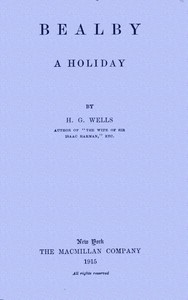
Public-domain ebook
Bealby; A Holiday
by H. G. Wells
Language: en389 downloads on Project Gutenberg
Subjects
In: Humour·Novels·British Literature
Public-domain ebook sourced from Project Gutenberg #59769.
Public-domain ebook
by H. G. Wells
Language: en389 downloads on Project Gutenberg
Subjects
In: Humour·Novels·British Literature
Public-domain ebook sourced from Project Gutenberg #59769.
The opening · free to read
The cat is the offspring of a cat and the dog of a dog, but butlers and lady’s maids do not reproduce their kind. They have other duties.
So their successors have to be sought among the prolific, and particularly among the prolific on great estates. Such are gardeners, but not under-gardeners, gamekeepers, and coachmen—but not lodge people, because their years are too great and their lodges too small. And among those to whom this opportunity of entering service came was young Bealby, who was the stepson of Mr. Darling, the gardener of Shonts.
Everyone knows the glories of Shonts. Its façade. Its two towers. The great marble pond. The terraces where the peacocks walk and the lower lake with the black and white swans. The great park and the avenue. The view of the river winding away across the blue country. And of the Shonts Velasquez—but that is now in America. And the Shonts Rubens, which is in the National Gallery. And the Shonts porcelain. And the Shonts past history; it was a refuge for the old faith; it had priest’s holes and secret passages. And how at last the Marquis had to let Shonts to the Laxtons—the Peptonized Milk and Baby Soother people—for a long term of years. It was a splendid chance for any boy to begin his knowledge of service in so great an establishment, and only the natural perversity of human nature can explain the violent objection young Bealby took to anything of the sort. He did. He said he did not want to be a servant, and that he would not go and be a good boy and try his very best in that state of life to which it had pleased God to call him at Shonts. On the contrary.
He communicated these views suddenly to his mother as she was preparing a steak and kidney pie in the bright little kitchen of the gardener’s cottage. He came in with his hair all ruffled and his face hot and distinctly dirty, and his hands in his trousers pockets in the way he had been repeatedly told not to.
“Mother,” he said, “I’m not going to be a steward’s boy at the house anyhow, not if you tell me to, not till you’re blue in the face. So that’s all about it.”
This delivered, he remained panting, having no further breath left in him.
His mother was a thin firm woman. She paused in her rolling of the dough until he had finished, and then she made a strong broadening sweep of the rolling pin, and remained facing him, leaning forward on that implement with her head a little on one side.
“You will do,” she said, “whatsoever your father has said you will do.”
“’E isn’t my father,” said young Bealby.
His mother gave a snapping nod of the head expressive of extreme determination.
“Anyhow I ain’t going to do it,” said young Bealby, and feeling the conversation was difficult to sustain he moved towards the staircase door with a view to slamming it.
“You’ll do it,” said his mother, “right enough.”
“You see whether I do,” said young Bealby, and then got in his door-slam rather hurriedly because of steps outside.
Mr. Darling came in out of the sunshine a few moments later. He was a large, many-pocketed, earthy-whiskered man with a clean-shaven determined mouth, and he carried a large pale cucumber in his hand.
“I tole him,” he said.
“What did he say?” asked his wife.
“Nuthin’,” said Mr. Darling.
“’E says ’e won’t,” said Mrs. Darling.
Mr. Darling regarded her thoughtfully for a moment.
“I never see such a boy,” said Mr. Darling. “Why—’e’s got to.”
He had no gift of lucid exposition. “I ain’t going to be a servant,” he said. “I don’t see what right people have making a servant of me.”
“You got to be something,” said Mr. Darling.
“Everybody’s got to be something,” said Mrs. Darling.
“Then let me be something else,” said young Bealby.
“_I_ dessay you’d like to be a gentleman,” said Mr. Darling.
“I wouldn’t mind,” said young Bealby.
“You got to be what your opportunities give you,” said Mr. Darling.
Young Bealby became breathless. “Why shouldn’t I be an engine driver?” he asked.
“All oily,” said his mother. “And getting yourself killed in an accident. And got to pay fines. You’d like to be an engine driver.”
“Or a soldier.”
“Oo!—a Swaddy!” said Mr. Darling decisively.
“Or the sea.”
“With that weak stummik of yours,” said Mrs. Darling.
“Besides which,” said Mr. Darling, “it’s been arranged for you to go up to the ’ouse the very first of next month. And your box and everything ready.”
Young Bealby became very red in the face. “I won’t go,” he said very faintly.
“You will,” said Mr. Darling, “if I ’ave to take you by the collar and the slack of your breeches to get you there.”
The heart of young Bealby was a coal of fire within his breast as—unassisted—he went across the dewy park up to the great house, whither his box was to follow him.
He thought the world a “rotten show.”
He also said, apparently to two does and a fawn, “If you think I’m going to stand it, you know, you’re JOLLY-well mistaken.”
I do not attempt to justify his prejudice against honourable usefulness in a domestic capacity. He had it. Perhaps there is something in the air of Highbury, where he had spent the past eight years of his life, that leads to democratic ideals. It is one of those new places where estates seem almost forgotten. Perhaps too there was something in the Bealby strain....
The book keeps going
Reading is free forever. Sign up and watch scenes appear while you read.



Scenes Storieta drew for other classics.
New illustrated classics
Once or twice a month: the latest books to get full character casts, scene art, and free comic editions. No account needed.