Public-domain ebook
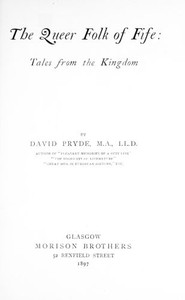
The Queer Folk of Fife: Tales from the Kingdom
by David Pryde
Language: en347 downloads on Project Gutenberg
Subjects
In: Short Stories
Public-domain ebook sourced from Project Gutenberg #59829.
Public-domain ebook
by David Pryde
Language: en347 downloads on Project Gutenberg
Subjects
In: Short Stories
Public-domain ebook sourced from Project Gutenberg #59829.
The opening · free to read
"This letter fell upon the audience like a bombshell, and created the greatest excitement and consternation. But it was evident from the whispers of 'got up,' and 'bribed by the relations,' that the audience had not even yet given up Miss Callendar. And they were very much relieved when they saw the Attorney-General rise. He was evidently going to put a stop to this wholesale slander and forgery. Alas, however, for their hopes! Instead of hearing him expose the evidence that was being given, they heard him make an admission that has very seldom been made in a court of law. In a perfectly calm voice and manner he said that this letter had come upon them as a surprise, that they had neither the time nor the means of throwing any light upon it, and that, therefore, with the concurrence of his learned friends, the attorneys for the plaintiff, he now begged leave to withdraw from the contest. Under these circumstances the plaintiff would be non-suited. Accordingly the case was dismissed; the letter was impounded in order that Miss Callendar might be indicted for conspiracy; and the audience dispersed amid murmurs of astonishment. But it was noted that while the elder members of the crowd muttered their detestation of Miss Callendar's shameless forgery, the young men were louder than ever in their admiration."
"What a fascinating girl she must be," said one, "to be able to take in the sharpest attorneys and the most learned counsel at the bar! what a clever little witch!"
"By Jove," cried another, in a strong Irish accent, "she's too good for a duke's wife. She ought to be a queen. She is a queen, the queen of love and beauty, and should be classed with Helen of Troy, Cleopatra, and Mary Queen of Scots; and, bedad, it's meself that should loike to be Paris or Antony or Bothwell."
Next morning a note appeared in one of the London newspapers stating that Miss Callendar had been apprehended on a charge of forgery; but it was not true. She had vanished, and no one knew where she was.
Imagine the excitement now in Sandyriggs after this report had been read! The town became a fermenting vat of scandal. Whispers swarmed as fast as gnats in August, and, like gnats, they flew abroad and buzzed in the ears of the public. The case was discussed at every shop-counter, at every tea-table, at every street corner, in every public-house, on every turnip field. People who had never spoken to each other before, exclaimed as they passed each other, "Isn't this a dreadful affair?" And it was astonishing to find that everyone had foreseen, nay, had hinted such a catastrophe. So many people pose as true prophets after the fact!
Even Miss Phemie MacGuffog was forced to forego her usual charitable views, and to confess that the poor unfortunate girl had been ruined by her training. Every circumstance, she said, was against her. Her father was a worldly man, engrossed with money-making, and seldom at home. Her mother, a silly woman, was abandoned to romance reading, and neglected her everyday duties, and lived in a world of unreality. The poor girl herself got no solid education. She had no need, her mother told her, to be clever or accomplished. She was lovely, which was far better, and would undoubtedly make a grand match and be a titled lady. To look handsome, and graceful, and fascinating, therefore, was all that she required to do. And the despatching of her to a boarding-school, and then to the Continent, in order to escape her aristocratic admirer, was a mere device. She was sent to a boarding establishment near Oxford because he was a student there, and she afterwards went to France to continue her education because he had gone there. And Miss Phemie was told that the education which she received at both these places was of the flimsiest kind, being limited to the singing of one or two songs, the hammering out on the piano of one or two classical pieces, and the copying of one or two drawings. The most of the pupils' time and attention was devoted to talking about fine dresses, equipages, balls, and aristocratic admirers. "In fact," concluded Miss Phemie, "they were evidently taught to look upon the world, not as a sphere of duty and labour, but as a big cookie shine."
The worthy people of Sandyriggs were still discussing this strange catastrophe, when a new surprise claimed their notice. Intelligence came regarding the long-lost Charles Raeburn. His cousin, the doctor, received a letter from him, bearing the postmark of a town in Spain, and empowering him to sell Cowslip Brae and transmit the price. Before the gossips had ceased to puzzle their brains over this extraordinary sacrifice, another letter arrived and explained the whole mystery. In the frankest and most straight-forward language, Charles Raeburn told his cousin the following romantic tale:--
"I felt that I could not remain in Sandyriggs after the object of my adoration had gone. So I followed her to Oxford and to France, and back again to England, and was present at the trial. From my professional experience I very soon saw how judgment was likely to go, and what a terrible fate was hanging over the head of the unfortunate girl. So, when stung by Ridley's merciless language, she left the Court abruptly, I followed her, and in presence of her mother told her that the verdict was almost certain to be against her, and that, if it were so, she would be apprehended for forgery. While she stood aghast and dumb at this intelligence, I offered my assistance, and they accepted it. I went with them at once to their hotel, paid their bill, packed their luggage, and had everything ready for flight. As soon as the result which I had anticipated was announced, we were off, and by next morning were on the Continent. I took rooms for them in this town, and a lodging for myself not far off, and here we remained till we could see what ought to be done.
"One morning, Miss Callendar sent to say that she wanted to see me. When I went to her, she told me with tears in her lovely eyes that her mother must go back to her husband in England, but that she herself must remain abroad; and what could she do to earn her bread? Would I, the only friend she now had, advise her? What could I do but offer, as her husband, to protect and cherish her for the rest of her life. She started back in horror, declared that she was a criminal, a felon, a forger who ought to be in prison, and utterly unworthy to be the wife of an honest man, and that she would not bring disgrace on one whom she esteemed so much, whom--and here she gave way and cried most bitterly. Then there flashed through my brain and heart Spenser's exquisite lines:--
"'Nought is there under heav'n's wide hollownesse That moves more deare compassion of mind Than beautie brought t' unworthy wretchednesse Through envy's snares, or fortune's freaks unkind. I, whether lately through her brightnesse blind, Or through alleageance and fast fealtie, Which I do owe unto all womankind, Feele my hart perst with so great agony, When such I see, that all for pity I could die.'
"These were the very feelings that were thrilling through me. I lost control of myself. Dropping down on my knees and seizing her hand, I poured out my whole soul. What I said I cannot recall; but at last she reluctantly consented to marry me, on condition that I would do my very best to teach her to be a good woman and a dutiful wife. Poor broken-hearted darling, she was more sinned against than sinning. The persons really to blame were her mercenary father and her novel-reading mother, who neglected her education, and that hollow-hearted aristocrat who trifled with her innocence. And most touching it is to see how humble and yet how loving she is, and how her face is still 'combating with tears and smiles.' If she is not to be forgiven, there can be no such thing as forgiveness on earth. I am sure that I have done what is right. Away from her, I would have been in outer darkness. Beside her, I am in Paradise."
HER DEAD SELF.
The narrative which I am about to give was a prime favourite at the winter firesides of the parish. Its chief incident is so extraordinary, that it has often been scouted as an improbability. But it is literally true, as may be ascertained by those who will take the trouble to investigate the chronicles of the period.
In the early years of the present century, the principal baker in Sandyriggs was Alister Gow. He had one son, Donald, and five daughters. The four elder girls, Flora, Ellen, Marjory, and Nora, were good-looking, with bright complexions and red cheeks; the youngest, Mysie, was plain, with irregular features and dingy colour. The four soon found husbands, thriving tradesmen in the place, who gave them what was called "a good setting down"; but no one came to court Mysie, and she remained at home to attend to the comfort of her parents, and specially to take charge of the shop.
"And when are you gaun aff, Mysie," said old Wull Spears, the most impudent man in the parish, "when are you gaun to be knocked doon to the highest bidder?"
"Oh!" said Mysie, in the bright manner peculiar to her, "I'm no in the market; there's nae demand for gudes like me."
"I wadna wonder," continued Wull, "that ye're gaun to be an auld maid."
"And what for no?" replied Mysie. "Maids, like Scotch whisky, improve by growin' auld."
The years rolled by and brought changes. While Mysie's married sisters, harassed by the ceaseless worries of housekeeping and child-rearing, became more and more careworn, Mysie herself, able and willing for all her duties, grew cantier and cantier every day. While they began to lose their good looks, she began to lose her plainness. The truth is, that she was, though probably she did not know it, a practical philosopher; and in a business-like manner she weighed the advantages and disadvantages of her lot.
"What have I kept," she said to herself, "by remaining single? Good health, good spirits, home comforts, congenial employment, pleasant friends and neighbours. And what have I lost? A husband! And what is a husband? A pig in a poke, a lottery ticket that may take a prize but is far more likely to get a blank. If I'm not happy now, I never deserve to be."
So she resolved to keep a contented mind, to dwell on the blessings she had, and not on those which she had not, to make the most of her life, and to find something good in everything. She was cheerful under all circumstances, and had a smile and a kind word for all her fellow-creatures. As the old people expressed it, "she was everybody's body." However dull and cheerless the weather might be in the streets of the town, there was always sunshine in the baker's shop at the corner of Water Lane. And this genial, kindly disposition soon began to tell upon her own appearance. It actually cleared her complexion, brightened her eyes, and made her look (as an old woman remarked) "halesome, wicelike, and bonny." She became a walking proof of the truth of the proverb that "a kindly disposition is the best cosmetic." And thus it happened, that not only old people and children were attracted by her, but even wooers; and among them came (wonderful to relate) the dandy draper, the woman-killer, the gay Lothario of the town.
The book keeps going
Reading is free forever. Sign up and watch scenes appear while you read.



Scenes Storieta drew for other classics.
New illustrated classics
Once or twice a month: the latest books to get full character casts, scene art, and free comic editions. No account needed.