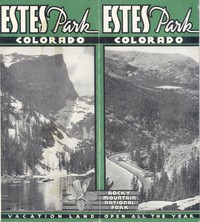
Before the arrival of settlers in the mountain valleys of north-central Colorado in 1860, only the Ute and Arapaho Indians of the region and a few adventuresome white trappers knew the wildlife then so abundant throughout the area. They alone had observed the thousands of elk and small groups of mountain bison (buffalo) grazing the alpine meadows in the summer. Plentiful herds of mule deer roamed the valleys and forests and hundreds of flocks of wild mountain sheep fed on tufts of grass and flowers on rugged mountain slopes above timberline. Even an infrequent moose wandering down from his more northerly habitat could be seen in the lower wet meadows.
Along with these wonderful groups of hoofed animals lived the predatory, or carnivorous, animals. The powerful and vicious wolverines were common in the heavy forests of the high mountains, as were huge grizzly bears, occasional timber wolves, and cougars. The Canada lynx and mountain bobcat preyed on animals their size and smaller in the pine and spruce timber, while the red fox and rare gray fox were effective squirrel, mouse, and rabbit catchers. Pine martens chased small rodents through deeper forested regions, and they in turn were preyed on the larger carnivores. Numerous otter, mink, and weasel played in and along rushing mountain streams and clear lakes, feeding on a great variety of aquatic animals, fish, and small meadow rodents.
This scene might have remained relatively undisturbed had not white man arrived in the region. His rapid settlement and use of the area after 1870 had a startling and widespread effect on the wildlife populations in the next fifty years. Had he been satisfied to develop a small portion of the mountain country and take only sufficient food and clothing materials as they were needed from the wild species, the story might have been different. Instead, the unprecedented mountain scenery, climate, and animals attracted scores of vacationists, sport hunters, trappers, and market hunters, all anxious to profit from the newly-discovered virgin territory.
The great fur demand in St. Louis and Denver at this time attracted scores of trappers; they diligently pursued the valuable fur-bearers until, in 1915, the otters and wolverines were practically extinct in the Rocky Mountain regions of Colorado, and remain in that condition today. A few have been seen recently in the state, but they are exceedingly rare. Beaver were heavily trapped even before the settlers arrived. Mink, marten, and red fox also reached a very low ebb in population in the early 1900's.
The "sportsmen" and market hunters were taking an even greater toll with their systematic slaughter of big game animals. The small herds of mountain bison, as well as any sign of transient moose, had disappeared by 1865. Deer and elk were so plentiful and easy to kill that wagon loads of their meat were hauled from the mountains to Denver markets where they were sold for as little as four cents a pound. Probably the easiest to condemn are the hunters who, in the late 1880's, killed hundreds of elk, plus many deer and sheep, with little effort on their frequent organized hunts of "sport." Often the carcasses were left to rot or just the head trophy and a few choice steaks were taken from the fallen animals. The area around Estes Park was particularly noted for this irresponsible recreation. Actually the greatest reduction in animal numbers was accentuated by the actions of a few individuals and not by the concentrated efforts of all those present in the area. By 1913 elk had entirely disappeared from the Estes Park region and almost from the state. Also, during this infamous period sheep had been reduced from an estimated 4,000 in 1870 to a little over 1,000 forty years later. The mule deer, having a wider natural range, and not banding together in the summer as elk frequently do, were able to survive the hunting pressures somewhat better; however, the former abundant herds were then considerably reduced. The increase of settlements and the introduction of domestic stock further lessened the numbers by decreasing available feeding grounds.
The establishment of man in the main mountain valleys leading to the foothills was particularly important to the past and even present welfare of the rugged mountain sheep, one of the finest of all wild animals in the mountains. Wild sheep in early days always migrated through these valleys in the winter to the foothills (5,000 to 6,000 feet), where they were able to obtain bone-building minerals available in the sedimentary rocks. These minerals were not available in the high mountain granitic rocks and present evidence indicates that they are highly essential for successful and sturdy lamb crops. Man's dwellings created an effective barrier to these animals and no longer did they make their way to the foothills each winter. This situation probably weakened the breeding stock. In addition, there were other declining factors such as hunting and in particular, the grazing of domestic sheep on former wild sheep ranges. This not only reduced available forage for wild sheep, but also introduced certain diseases of domestic sheep into the flocks. Sheep scabies reached epidemic proportions in the late 1800's, wiping out hundreds of wild bighorn.
A woefully miscast belief that gained common acceptance in the early 1900's forecast the decline of another group of interesting animals--the carnivores. The conception, fostered mainly by stockmen of the mountains, was that any kind of animal known to kill domestic sheep or cattle was detrimental and therefore all those animals should be eliminated. Consequently, an organized effort was made by stockmen with the co-operation of the federal government to "trap out" and kill these species. The success of their efforts in Colorado is evidenced in the virtual extinction of such indigenous mammals as the grizzly bear, the timber wolf, and the Canada lynx, and in a great reduction in the numbers of black bears, cougars, and bobcats. The coyote, while not so abundant in the mountains earlier, was the only predatory animal able to hold his own against the trapping, and has actually thrived in settled areas. Wildlife investigators have assembled a mass of evidence indicating that it is not the ordinary habit of these carnivores to feed regularly on domestic stock. Rather, it is the occasional or rare individual animal which confines its predation to domestic sheep or cattle. This being the case, it is the more usual practice now to confine extermination to those marauding individuals, rather than the entire race of animals. Many of the carnivorous animals have been protected since 1926 by state and federal laws.
The hopefulness of mankind regarding wildlife is seen in the aesthetic consideration finally given to these decimated animal populations. The establishment of protection areas, especially Rocky Mountain National Park in 1915, where complete protection is given to all animals, and the passing of state and federal laws for protection of game and regulation of hunting, were last minute efforts to save this splendid portion of American heritage.
In an effort to re-establish the elk in Rocky Mountain National Park, about thirty of these large animals were transported from Wyoming, 1913 to 1914, and released near Estes Park. Under complete protection these elk increased to approximately 1500 animals in 1941. Other early elk "releases" in Colorado brought the total elk population to about 25,000 in the state during the same period. The protection of mule deer in the Park increased their numbers to over 1,700 in 1941 and in Colorado to nearly 400,000. From less than 1,000 in number, the mountain sheep in the area started to increase gradually in 1909 and were "coming back" satisfactorily in the Park area. For Colorado in 1922, Seton optimistically estimated a bighorn sheep population of 8,000. However, in 1922 there began a gradual decline of sheep culminating in a counted number of 300 within the National Park boundaries in 1939. The estimate for Colorado in 1947 was 2,700, most of which were on National Forest land.
Of the formerly trapped smaller mammals in the region, the beaver and marten have come back remarkably well, being abundant in many locations now. As an indication of beaver numbers and value in Colorado, some 40,000 beaver were estimated to be in the state in 1946; of these, 8,640 were trapped. A gross value of $272,323 was realized from beaver for this year. The black bear, cougar, bobcat, red fox, and mink, while not considered common, are still sufficiently abundant to be glimpsed occasionally in the region of the Park. They appear to be maintaining their numbers. Coyotes, originally plains animals, are abundant, probably numbering over 200 individuals. The presence of other mammals such as skunk, badger, porcupine, marmot, muskrat, squirrel, rabbit, and other small rodents indicates they are holding a steady or increasing population, although no definite counts have been made. There is good reason to believe that the coyote, richardson ground squirrel, and abert squirrel are examples of mammals relatively new and increasing in the mountains over 6,000 feet.
Wildlife Management
The problem of restoring and maintaining wildlife in our national parks is not as simple as one might suppose. The mere creation of a preserve or area within which all wild animals are protected has proved non-sufficient. While it is true that these areas offer excellent opportunity for preserving a wonderful variety of primitive wildlife stock in its native habitat for future generations, it is equally true that the very laws establishing the National Park Service in 1916 have almost defeated their original intentions. The law emphasizes that the fundamental purpose of the Park Service shall be to conserve the scenery of Park areas and the wildlife therein, and to provide for the enjoyment of the same in such a way as will leave them unimpaired for the enjoyment of future generations. Roads, camp and picnic grounds, trails, and dwelling conveniences represent efforts by the Service to provide for the enjoyment of Park scenery and wildlife. However, each new road, trail, and "tourist convenience" removes wildlife food and cover from the Park and causes timid animals to retreat from these zones of human use. Moreover, it destroys the natural area which is supposed to be left "unimpaired for the enjoyment of future generations." Furthermore, many animals lack the flexibility to adapt themselves to new habitats, once the ancestral areas are invaded or destroyed by man. With increasing numbers of visitors using the Parks, how can this tremendous conflict between man and wildlife be reconciled without the impairment of primitive wildlife or the restriction of human occupancy? It probably cannot be, and each ideal will have to sacrifice a portion of the original grand intentions. In every decision of human or wildlife use, the Park Service makes a strenuous effort to establish a happy medium and still conform to the basic purpose of the national parks.




![Cover of Rocky Mountain National Park [Colorado]](/covers/37918.jpg)