Public-domain ebook
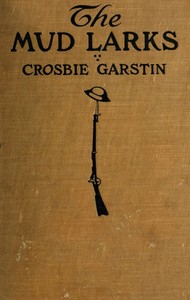
The Mud Larks
Language: en314 downloads on Project Gutenberg
Subjects
In: Humour·Novels·British Literature
Public-domain ebook sourced from Project Gutenberg #59900.
Public-domain ebook
Language: en314 downloads on Project Gutenberg
Subjects
In: Humour·Novels·British Literature
Public-domain ebook sourced from Project Gutenberg #59900.
The opening · free to read
When I was young, my parents sent me to a boarding school, not in any hopes of getting me educated, but because they wanted a quiet home.
At that boarding school I met one Frederick Delano Milroy, a chubby flame-coloured brat who had no claims to genius, excepting as a littérateur.
The occasion that established his reputation with the pen was a Natural History essay. We were given five sheets of foolscap, two hours and our own choice of subject. I chose the elephant, I remember, having once been kind to one through the medium of a bag of nuts.
Frederick D. Milroy headed his effort "The Fert" in large capitals, and began, "The fert is a noble animal----" He got no further, the extreme nobility of the ferret having apparently blinded him to its other characteristics.
The other day, as I was wandering about on the "line," dodging Boche crumps with more agility than grace, I met Milroy (Frederick Delane) once more.
He was standing at the entrance of a cosy little funk-hole, his boots and tunic undone, sniffing the morning nitro-glycerine. He had swollen considerably since our literary days, but was wearing his hair as red as ever, and I should have known it anywhere--on the darkest night. I dived for him and his hole, pushed him into it, and re-introduced myself. He remembered me quite well, shook my chilblains heartily, and invited me further underground for tea and talk.
It was a nice hole, cramped and damp, but very deep, and with those Boche love-tokens thudding away upstairs I felt that the nearer Australia the better. But the rats! Never before have I seen rats in such quantities; they flowed unchidden all over the dug-out, rummaged in the cupboards, played kiss-in-the-ring in the shadows, and sang and bawled behind the old oak panelling until you could barely hear yourself shout. I am fond of animals, but I do not like having to share my tea with a bald-headed rodent who gets noisy in his cups, or having a brace of high-spirited youngsters wrestle out the championship of the district on my bread-and-butter.
Freddy apologised for them; they were getting a bit above themselves, he was afraid, but they were seldom dangerous, seldom attacked one unprovoked. "Live and let live" was their motto. For all that they did get a trifle de trop sometimes; he himself had lost his temper when he awoke one morning to find a brawny rat sitting on his face combing his whiskers in mistake for his own (a pardonable error in the dark); and, determining to teach them a lesson, had bethought him of his old friend, the noble fert. He therefore sent home for two of the best.
The ferrets arrived in due course, received the names Burroughs and Welcome, were blessed and turned loose.
They had had a rough trip over at the bottom of the mail sack, and were looking for trouble. An old rat strolled out of his club to see what all the noise was about, and got the excitement he needed. Seven friends came to his funeral and never smiled again. There was great rejoicing in that underground Mess that evening; Burroughs and Welcome were fêted on bully beef and condensed milk, and made honorary members.
For three days the good work went on; there was weeping in the cupboards and gnashing of teeth behind the old oak panelling. Then on the fourth day Burroughs and Welcome disappeared, and the rats swarmed to their own again. The deserters were found a week later; they had wormed through a system of rat-holes into the next dug-out, inhabited by the Atkinses, and had remained there, honoured guests.
It is the nature of the British Atkins to make a pet of anything, from a toad to a sucking-pig--he cannot help it. The story about St. George, doyen of British soldiers, killing that dragon--nonsense! He would have spanked it, maybe, until it promised to reform, then given it a cigarette, and taken it home to amuse the children. To return to our ferrets, Burroughs and Welcome provided no exception to the rule; they were taught to sit up and beg, and lie down and die, to turn handsprings and play the mouth-organ; they were gorged with Maconochie, plum jam and rum ration; it was doubtful if they ever went to bed sober. Times out of number they were borne back to the Officers' Mess and exhorted to do their bit, but they returned immediately to their friends the Atkinses, via their private route, not unnaturally preferring a life of continuous carousal and vaudeville among the flesh-pots, to sapping and mining down wet rat-holes.
Freddy was of opinion that, when the battalion proceeded up Unter den Linden, Burroughs and Welcome would be with it as regimental mascots, marching behind the band, bells on their fingers, rings on their toes. He also assured me that if he ever again has to write an essay on the Fert, its characteristics, the adjective "noble" will not figure so prominently.
We hoisted it to the top of a tree at sun-up, where it remained, languidly flapping its tatters over leagues of Central Africa bush till sunset, when we hauled it down again--an arduous life. After we had been at M'Vini about six months, had shot everything worth shooting, and knew one another's funny stories off by heart, Frobisher and I grew bored with each other, hated in fact the sight, sound and mere propinquity of each other, and, shutting ourselves up in our separate huts, communicated only on occasions of the direst necessity, and then by the curtest of official notes. Thus a further three months dragged on.
Then one red-hot afternoon came Frobisher's boy to my wattle-and-dab, bearing a note.
"Visitor approaching from S.W. got up like a May Queen; think it must be the Kaiser. Lend me a bottle of whisky, and mount a guard--must impress the blighter."
I attached my last bottle of Scotch to the messenger and sallied forth to mount a guard, none too easy a job, as the Army had gone to celebrate somebody's birthday in the neighbouring village. However, I discovered one remaining trooper lying in the shade of a loquat-tree. He was sick--dying, he assured me; but I persuaded him to postpone his demise for at least half an hour, requisitioned his physician (the local witch doctor) and two camp followers, and, leaving my cook-boy to valet them, dashed to my hut to make my own toilet. A glimpse through the cane mats five minutes later showed me that our visitors had arrived.
A fruity German officer in full gala rig (white gloves and all) was cruising about on mule-back before our camp, trying to discover whether it was inhabited or not. We let him cruise for a quarter of an hour without taking any steps to enlighten him. Then, at a given signal, Frobisher, caparisoned in every fal-lal he could collect, issued from his hut, and I turned out the improvised guard. A stirring spectacle; and it had the desired effect, for the German afterwards admitted to being deeply impressed, especially by the local wizard, who paraded in his professional regalia, and, coming to cross-purposes with his rifle, bayoneted himself and wept bitterly. The ceremonies over and the casualty removed, we adjourned to Frobisher's kya, broached the whisky and sat about in solemn state, stiff with accoutrements, sodden with perspiration. Our visitor kept the Red, White and Black flying on a tree over the border, he explained; this was his annual ceremonial call. He sighed and brushed the sweat from his nose with the tips of a white glove--"the weather was warm, nicht wahr?" I admitted that we dabbled in flag-flying ourselves and that the weather was all he claimed for it (which effort cost me about four pounds in weight). Tongues lolling, flanks heaving, we discussed the hut tax, the melon crop, the monkey-nut market, the nigger--and the weather again.
Suddenly Frobisher sprang up, cast loose the shackles of his Sam Browne, hurled it into a corner, and began tearing at his tunic hooks. I stared at him in amazement--such manners before visitors! But our immaculate guest leapt to his feet with a roar like a freed lion, and, stripping his white gloves, flung them after the Sam Browne, whereupon a fury of undressing came upon us. Helmets, belts, tunics, shirts were piled into the corner, until at length we stood in our underclothes, laughing and unashamed. After that we got on famously, that Teuton and we, and three days later, when he swarmed aboard his mule and left for home (in pyjamas this time) it was with real regret we waved him farewell.
But not for long. Within a month we were surprised by a hail from the bush, and there was Otto, mule, pyjamas and all.
"'Ullo, 'ullo, 'ullo!" he carolled. "'Ere gomes ze Sherman invasion! Burn out ze guard!" He roared with laughter, fell off his palfrey and bawled for his batman, who ambled up, balancing a square box on his woolly pate.
His mother in Munich had sent him a case of Lion Brew, Otto explained, so he had brought it along.
We wassailed deep into that night and out the other side, and we liked our Otto more than ever. We had plenty in common, the same loneliness, fevers, climate, and niggers to wrestle with; moreover he had been in England, and liked it; he smoked a pipe; he washed. Also, as he privily confided to us in the young hours of one morning, he had his doubts as to the divinity of the Kaiser, and was not quite convinced that Richard Strauss had composed the music of the spheres.
He was a bad Hun (which probably accounted for his presence at the uttermost, hottermost edge of the All-Highest's dominions), but a good fellow. Anyhow, we liked him, Frobisher and I; liked his bull-mouthed laughter, his drinking songs and full-blooded anecdotes, and, on the occasions of his frequent visits, put our boredom from us, pretended to be on the most affectionate terms, and even laughed uproariously at each other's funny stories. Up at M'Vini, in the long long ago, the gleam of pyjamas amongst the loquats, and "'Ere gomes ze Sherman invasion!" booming through the bush, became a signal for general goodwill.
In the fullness of time Otto went home on leave, and, shortly afterwards, the world blew up.
And now I have met him again, a sodden, muddy, bloody, shrunken, saddened Otto, limping through a snow-storm in the custody of a Canadian corporal. He was the survivor of a rear-guard, the Canuck explained, and had "scrapped like a bag of wild-cats" until knocked out by a rifle butt. As for Otto himself, he hadn't much to say; he looked old, cold, sick and infinitely disgusted. He had always been a poor Hun.
Only once did he show a gleam of his ancient form of those old hot, happy, pyjama days on the Equator.
A rabble of prisoners--Jägers, Grenadiers, Uhlans, whatnots--came trudging down the road, an unshorn, dishevelled herd of cut-throats, propelled by a brace of diminutive kilties, who paused occasionally to treat them to snatches of flings and to hoot triumphantly.
Otto regarded his fallen compatriots with disgusted lack-lustre eyes, then turning to me with a ghost of his old smile, "'Ere gomes ze Sherman invasion," said he.
Never have I seen a kiltie platoon wading through the cold porridge of snow and slush of which our front used to be composed, but I have said, with my French friend, "_Mon Dieu les currents d'air!_" and thank Fate that I belong to a race which reserves its national costume for fancy-dress balls.
The book keeps going
Reading is free forever. Sign up and watch scenes appear while you read.



Scenes Storieta drew for other classics.
New illustrated classics
Once or twice a month: the latest books to get full character casts, scene art, and free comic editions. No account needed.