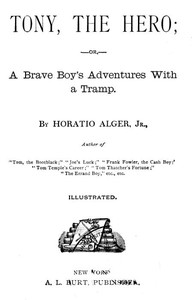
Author of "Tom, the Bootblack;" "Joe's Luck;" "Frank Fowler, the Cash Boy;" "Tom Temple's Career;" "Tom Thatcher's Fortune;" "The Errand Boy," etc., etc.
Illustrated.
New York. A. L. Burt, Publisher.
Copyright 1890, by A. L. Burt.
CONTENTS.
CHAPTER PAGE I. THE TWO WANDERERS. 7 II. THE FARM-HOUSE. 14 III. RUDOLPH'S DISAPPOINTMENT. 20 IV. SETTING A TRAP. 26 V. AN ATTEMPT AT BURGLARY. 33 VI. ABNER'S RUSE. 37 VII. A STRANGE HOTEL. 47 VIII. TONY HIRES OUT AS A COOK AND HOUSEKEEPER. 54 IX. THE FACE AT THE WINDOW. 61 X. THE TRAMP'S UNEXPECTED DEFEAT. 68 XI. THE PRISONER. 74 XII. TONY STARTS OUT ONCE MORE. 81 XIII. TONY GETS A PLACE. 88 XIV. TONY'S RIVAL. 92 XV. THE BOYS' DUEL. 96 XVI. RUDOLPH ESCAPES AND SEES AN ADVERTISEMENT. 103 XVII. THE LADY AT THE ST. NICHOLAS. 110 XVIII. TWO CONSPIRATORS. 116 XIX. THE WICKED COMPACT. 123 XX. THE FIGHTING QUAKER. 130 XXI. RUDOLPH HEARS OF TONY. 134 XXII. RUDOLPH FINDS TONY. 137 XXIII. THE NEGLECTED WELL. 142 XXIV. THE DEED IS DONE. 145 XXV. "I HOLD YOU TO THE BOND." 152 XXVI. TONY'S ESCAPE. 159 XXVII. TONY IS DISCHARGED. 166 XXVIII. THE WORLD BEFORE HIM. 173 XXIX. A STRANGE ADVENTURE. 180 XXX. BREAKFAST AT THE ST. NICHOLAS. 187 XXXI. TONY AND HIS GUARDIAN SET UP HOUSEKEEPING. 194 XXXII. HOME AGAIN. 201 XXXIII. CAPTAIN GREGORY LOVELL. 208 XXXIV. TONY ASTONISHES HIS OLD FRIENDS. 215 XXXV. TONY'S BAD LUCK. 223 XXXVI. "I HATE YOU!" 230 XXXVII. MRS. MIDDLETON AND HER LOVER. 236 XXXVIII. A STORMY INTERVIEW. 240 XXXIX. TONY'S ESCAPE. 243 XL. ALL'S WELL THAT ENDS WELL. 249 WHITMARSH'S REVENGE. 254 THE BOY IN THE BUSH. 264 THE MIDNIGHT RIDE. 273 A THOUSAND A YEAR. 281 A. L. BURT'S PUBLICATIONS 1
TONY, THE HERO.
A man and a boy were ascending a steep street in a country town in Eastern New York. The man was tall and dark-complexioned, with a sinister look which of itself excited distrust. He wore a slouch hat, which, coming down over his forehead, nearly concealed from view his low, receding brow. A pair of black, piercing eyes looked out from beneath the brim. The first impression produced upon those who met him was that he was of gipsy blood, and the impression was a correct one. Where he was born no one seemed to know; perhaps he did not himself know, for all his life he had been a wanderer, but English was the tongue that he spoke, and, apart from the gipsy dialect, he knew no other.
His companion was a boy of fourteen. Between the two there was not the slightest resemblance. Though embrowned by exposure to the sun and the wind, it was easy to see that the boy was originally of light complexion. His hair was chestnut and his eyes blue. His features were regular and strikingly handsome, though, owing to the vagrant life he was compelled to lead, he was not able to pay that attention to cleanliness which he might have done if he had had a settled home.
It was five o'clock in the afternoon, and the boy looked weary. He seemed scarcely able to drag one foot after the other. His companion turned upon him roughly.
"What are you dawdling that way for, Tony?" he demanded. "You creep like a boy of three."
"I can't help it, Rudolph," said the boy, wearily; "I'm tired."
"What business have you to be tired?"
"I've walked far to-day."
"You've walked no farther than I. I don't dawdle like you."
"You're a man. You're stronger than I am, Rudolph."
"And you're a milksop," said the man contemptuously.
"I'm nothing of the sort," said the boy, with a flash of spirit. "I'm not made of cast-iron, and that's why I can't stand walking all day long. Besides, I have had no dinner."
"That isn't my fault, is it?"
"I didn't say it was, but it makes me weak for all that."
"Well," said Rudolph, "perhaps you're right. I feel like eating something myself. We'll go to some house and ask for supper."
Tony looked dissatisfied.
"I wish we were not obliged to beg our meals," he said; "I don't like it."
"Oh, you're getting proud, are you?" sneered Rudolph. "If you've got money to pay for your supper, we won't beg, as you call it."
"Why can't we do as other people do?" asked Tony.
"What's that?"
"Live somewhere, and not go tramping round the country all the time. It would be a good deal pleasanter."
"Not for me. I'm a vagrant by nature. I can't be cooped up in one place. I should die of stagnation. I come of a roving stock. My mother and father before me were rovers, and I follow in their steps."
The man spoke with animation, his eye flashing as he gazed about him, and unconsciously quickened his pace.
"Then, I'm not like you," said Tony, decidedly. "I don't want to be a tramp. Were my father and mother rovers like yours?"
"Of course they were," answered Rudolph, but not without hesitation. "Ain't I your uncle?"
"I don't know. Are you?" returned Tony, searchingly.
"Haven't I told you so a hundred times?" demanded Rudolph, impatiently.
"Yes," said the boy, slowly, "but there's no likeness between us. You're dark and I am light."
"That proves nothing," said the elder tramp, hastily. "Brothers are often as unlike. Perhaps you don't want to look upon me as a relation?"
The boy was silent.
"Are you getting ashamed of me?" demanded Rudolph, in a harsh tone.
"I am ashamed of myself," said Tony, bitterly. "I'm nothing but a tramp, begging my bread from door to door, sleeping in barns, outhouses, in the fields, anywhere I can. I'm as ignorant as a boy of eight. I can just read and that's all."
"You know as much I do."
"That don't satisfy me. When I grow up I don't want to be----"