Public-domain ebook
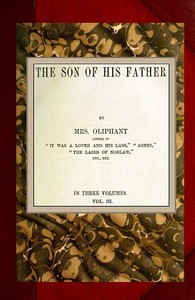
The Son of His Father; Vol. 3/3
Language: en236 downloads on Project Gutenberg
Subjects
Public-domain ebook sourced from Project Gutenberg #60018.
Public-domain ebook
Language: en236 downloads on Project Gutenberg
Subjects
Public-domain ebook sourced from Project Gutenberg #60018.
The opening · free to read
THE GREAT SCHEME.
John’s imagination, though it was so full of other matters, was affected more than he could understand by his strange visitor. He felt himself going back a hundred times in the course of the evening to this man, and those curious sophistries which he produced, always with that half smile in his eyes, as if he himself saw the absurdity in them, and as if morals and reason were something outside of himself to be treated with entire impartiality.
John wondered how far he believed or disbelieved what he had been saying, and whether these dispassionate discussions of what was formally right or wrong took away from a conscience, which could not be very delicate or sensitive, anything of the burden. They set him thinking too, following the career of such a being, trying to understand. Drink--was not in the decalogue, as his visitor had said: and John had seen enough even in his short life to know with what facility, with what innocence of evil meaning, the first step may be taken in that most general, most destructive of all vices--the one which leads to so many other developments, and which involves, as that philosopher had allowed, consequences more terrible, and penalties more prompt and inevitable than any other. John was very strenuous against it, almost bitter, having seen, as everyone has seen, its disastrous effects upon both body and soul. And yet, perhaps it was true what the other had said. Perhaps there were sins which brought no immediate evil consequences, which yet were blacker in the sight of heaven.
He felt himself wondering, with an indulgent feeling which was strange to him, how it was that a man who had nothing in him of the criminal air, a man full of thoughtfulness and humorous observation, and a knowledge of the workings of the mind, should have fallen into crime, and should have sunk into those depths and abysses of misery where he had no friend but Joe. A man must have reduced all the motives of human life to their elements, he must have banished all consideration of the outward and visible, all thoughts of the alleviations, the consolations, the comforts and stays of existence before he could have sunk contentedly to the bottom, and cynically, stoically, smilingly, despairingly, made himself believe that his brutal ‘mate’ was as good as any other, being all that remained to him.
And what, John asked himself, could remain for a convict whose world for so many years had been limited to the interior of a prison, and who in the course of working out his sentence had lost everything? What remained? One would suppose the poor wretch’s family, somebody who belonged to him, some wife or sister, or daughter. And then came his story: It is Corban--a gift. John felt his own heart bleed at the mere thought of this hopeless, succourless, yet uncomplaining misery. A man who could manage still to smile in the face of all that, to maintain still the attitude of a thinker, of an observer looking on at his own entire destitution with impartial eyes, with that calm and full understanding and humorous despair--the young man shuddered in the midst of his own success and prosperity, and love and hope. Could there be a more complete and absolute contrast? It was so great that his heart seemed to stand still as he contemplated it--a distance as of heaven from hell.
The evening was spent in very close work; for he found that a great many details had to be filled in and made clear before the plan, worked out in his own brain, could be made presentable to the experienced and critical eyes to which he meant to submit it. And he was at his writing-table again early in the morning, arranging his papers so as to make the copying easy, with much question in his own mind whether his new protegé would really come, whether he would prove capable of such work. John thought that in all likelihood the man would not come, and was giving up with a regret which seemed even to himself quite uncalled for--regret as for a pet project which he gave up most unwillingly--the plan of active charity which he had so hastily adopted--when his visitor of the previous day suddenly appeared. He came alone, trim and well-brushed, but with a shaking hand, and eyes which were red and muddy, and made his excuses with a deprecating smile.
‘I’m late,’ he said, ‘you must make allowance for bad habits. And I’ve had to get up as other people pleased for so long that I can’t help indulging a little now; but I work quickly and I’ll soon make it up.’
‘There is no hurry,’ said John: which was not exactly true, nor what he would have said to anyone else. And they worked together for the greater part of the day, not talking much, though John’s secretary now and then paused, leaned back upon his chair, raised his eyes to the ceiling, and seemed on the eve of resuming the philosophisings of last night. But John was too busy to take any notice, and his companion presently would fall to work again.
He had no special knowledge of John’s subject, but he had a great deal of intelligence, and asked reasonable questions and led John into explanations which were very useful to him, showing him how to recommend and elucidate his plan. They had their chop together in the middle of the day, and John found his companion more and more agreeable. There was something natural, familiar, in the relations into which they fell. John was a young man not too easy, as his fellow-workers knew, to ‘get on with.’ He was very exacting in the matter of attention to work. He was apt to conceive a contempt for the people who did not care for what they were employed on--and the young men who did just what they were compelled to do and no more, found no favour in his eyes. But even those periods of idling which occurred in the work of this grey-haired secretary did not produce that effect upon his young employer.
A gentleness of feeling, little habitual to him, stole over John. He did not feel critical--he felt friendly, oh, so compassionate, afraid even to think anything that could add a pang to this man, so forlorn and miserable, denuded of all things. The less he made of his own wretchedness the more profoundly did John feel it. He kept thinking, as he gave him his instructions, of all that this clear intelligence must have suffered shut up in the strait routine of a prison. He could not copy a page or make a calculation without some little running-over of remark, something that brought a smile, that betrayed the lively play of a mind unsubdued by the most tremendous burdens, by all the heavy and horrible experiences of such a life. How could he have borne that, day by day and year by year? A sort of awe, and almost reverence of the tragedy that this humorous, light-hearted being must have lived through, rose in John’s musing soul.
It was not until they were finishing their little meal together that the absence of one very natural and usual explanation between them struck the young man.
‘By-the-by,’ John said, suddenly--he was making corrections in one of the papers and did not raise his head--‘By-the-by, it seems very absurd. I don’t even know your name.’
There was a moment’s silence, and then John looked up. He found his companion’s eyes fixed upon him with his usual half smile of observation, and dubious humorous uncertainty. When John met his eye he changed his position a little with a momentary laugh.
‘I have been so long out of the habit of thinking a name necessary,’ he said. ‘My name is----’ He paused again, and once more looked at John, in whose face there was no suspicious anxiety, but only a friendly alertness of interest. Something mischievous and mirthful lighted up in the stranger’s eyes: ‘My name is--March,’ he said.
‘And mine is Sandford,’ replied John.
The mischievous light went out of the other’s look. His face grew serious; he nodded his head two or three times with gravity.
‘I know that,’ he said. ‘It is a name that I have had a great deal to do with in my life; but I don’t suppose you ever heard of me.’
John shook his head. He cleared away with his own hand the last remnants of the luncheon, over which enough time had been expended.
‘Now we’ll get to work again if you are ready,’ he said.
He knew nothing of any March. He was not aware that he had ever heard the name. And then they set to work again together pleasantly, cheerfully; John finding something inspiriting in the companionship for all the rest of the afternoon.
Next day the young man presented himself at the office, though his leave was not yet exhausted. But he did not go naturally to his own desk, to look if there were letters or special orders for him. He marched straight to the door within which the younger partner, the son of the Mr. Barrett who had received him into the office, and whom John had always found severe, had his throne. The younger Mr. Barrett was far more favourable to the young man than his father had ever been, and never spoke to him of the hospital, or the duty which lay upon him to repay his mother for her kindness, which was what the elder invariably did. It is not a subject which is agreeable even to the most dutiful of children. Repay your mother for all that she has done for you! Who could bear that odious advice? John was not angelic enough to be pleased by it. And when he had the choice it was to Mr. William Barrett that he betook himself. He found that personage in a very cheerful condition, and delighted to see him.
‘You are the very man I want. You must go off at once to those works at Hampstead. They’ve got into a mess, and no one can clear it up better than you. I was just wishing for you. But your leave is not out: how is it you’ve come back before your time?’
Then John explained that he had been privately working for a long time at a scheme of which his mind was very full. And he gave on the spot an account of it which made the junior partner open his eyes.
‘If you’ve done that, my boy, you’ve made your fortune, and ours too,’ he said, listening with great attention to John’s exposition.
‘That’s what I hope, sir,’ the young man said, with all the confidence of youth.
Mr. William Barrett listened half-bantering, half-believing. To think of so young a man having hit upon an expedient which had baffled so many older brains, seemed to him half-incredible, and he laughed and rubbed his hands even while he seriously inclined to hear all the details of the scheme.
‘It all depends upon whether it’s practicable,’ he said. ‘Do you know the lie of the country? Have you calculated the cost even of what will be required as a basis of operations?’
‘I have calculated everything,’ said John, with that enthusiastic conviction which is so contagious. Mr. Barrett looked in his face with a laugh, half-sceptical, half-sympathetic.
‘I like young men to think well of their own schemes,’ he said; ‘and I like them to plan big works even if they should never come to anything. Show me your papers----’
‘I am having them copied out. I am making the statement as clear as possible. I will bring them as soon as they are ready.’
The book keeps going
Reading is free forever. Sign up and watch scenes appear while you read.



Scenes Storieta drew for other classics.
New illustrated classics
Once or twice a month: the latest books to get full character casts, scene art, and free comic editions. No account needed.