ANNOUNCEMENT.
The Trustees of the John F. Slater Fund propose to publish from time to time papers that relate to the education of the colored race. These papers are designed to furnish information to those who are concerned in the administration of schools, and also to those who by their official stations are called upon to act or to advise in respect to the care of such institutions.
The Trustees believe that the experimental period in the education of the blacks is drawing to a close. Certain principles that were doubted thirty years ago now appear to be generally recognized as sound. In the next thirty years better systems will undoubtedly prevail, and the aid of the separate States is likely to be more and more freely bestowed. There will also be abundant room for continued generosity on the part of individuals and associations. It is to encourage and assist the workers and the thinkers that these papers will be published.
Each paper, excepting the first number (made up chiefly of official documents), will be the utterance of the writer whose name is attached to it, the Trustees disclaiming in advance all responsibility for the statement of facts and opinions.
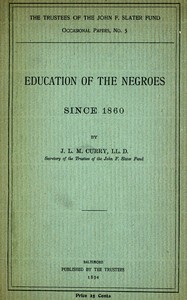
EDUCATION OF THE NEGROES SINCE 1860.
INTRODUCTION.
The purpose of this paper is to put into permanent form a narrative of what has been done at the South for the education of the negro since 1860. The historical and statistical details may seem dry and uninteresting, but we can understand the significance of this unprecedented educational movement only by a study of its beginnings and of the difficulties which had to be overcome. The present generation, near as it is to the genesis of the work, cannot appreciate its magnitude, nor the greatness of the victory which has been achieved, without a knowledge of the facts which this recital gives in connected order. The knowledge is needful, also, for a comprehension of the future possible scope and kind of education to be given to the Afro-American race. In the field of education we shall be unwise not to reckon with such forces as custom, physical constitution, heredity, racial characteristics and possibilities, and not to remember that these and other causes may determine the limitations under which we must act. The education of this people has a far-reaching and complicated connection with their destiny, with our institutions, and possibly with the Dark Continent, which may assume an importance akin, if not superior, to what it had centuries ago. The partition of its territory, the international questions which are springing up, and the effect of contact with and government by a superior race, must necessarily give an enhanced importance to Africa as a factor in commerce, in relations of governments, and in civilization. England will soon have an unbroken line of territorial possessions from Egypt to the Cape of Good Hope. Germany, France, Portugal, Italy, Spain, possibly Russia, will soon have such footholds in Africa as, whatever else may occur, will tend to the development of century-paralyzed resources.
What other superior races have done, and are doing, for the government and uplifting of the inferior races, which, from treaty or conquest, have been placed under their responsible jurisdiction, may help in the solution of our problem. Italy had a grand question in its unification; Prussia a graver one in the nationalization of Germany, taxing the statesmanship of Stein, Bismarck, and their co-laborers; Great Britain, in the administration of her large and widely remote colonial dependencies with their different races; but our problem has peculiar difficulties which have not confronted other governments, and therefore demands the best powers of philanthropist, sociologist, and statesman.
The emergence of a nation from barbarism to a general diffusion of intelligence and property, to health in the social and civil relations; the development of an inferior race into a high degree of enlightenment; the overthrow of customs and institutions which, however indefensible, have their seat in tradition and a course of long observance; the working out satisfactorily of political, sociological, and ethical problems—are all necessarily slow, requiring patient and intelligent study of the teachings of history and the careful application of something more than mere empirical methods. Civilization, freedom, a pure religion, are not the speedy outcome of revolutions and cataclysms any more than has been the structure of the earth. They are the slow evolution of orderly and creative causes, the result of law and preordained principles.
The educational work described in this paper has been most valuable, but it has been so far necessarily tentative and local. It has lacked broad and definite generalization, and, in all its phases, comprehensive, philosophical consideration. As auxiliary to a thorough study and ultimate better plans, the Slater Fund, from time to time, will have prepared and published papers bearing on different phases of the negro question.
I. The history of the negro on this continent is full of pathetic and tragic romance, and of startling, unparalleled incident. The seizure in Africa, the forcible abduction and cruel exportation, the coercive enslavement, the subjection to environments which emasculate a race of all noble aspirations and doom inevitably to hopeless ignorance and inferiority, living in the midst of enlightenments and noblest civilization and yet forbidden to enjoy the benefits of which others were partakers, for four years amid battle and yet, for the most part, having no personal share in the conflict, by statute and organic law and law of nations held in fetters and inequality, and then, in the twinkling of an eye, lifted from bondage to freedom, from slavery to citizenship, from dependence on others and guardianship to suffrage and eligibility to office—can be predicated of no other race. Other peoples, after long and weary years of discipline and struggle, against heaviest odds, have won liberty and free government. This race, almost without lifting a hand, unappreciative of the boon except in the lowest aspects of it, and unprepared for privileges and responsibilities, has been lifted to a plane of citizenship and freedom, such as is enjoyed, in an equal degree, by no people in the world outside of the United States.
Common schools in all governments have been a slow growth, reluctantly conceded, grudgingly supported, and perfected after many experiments and failures and with heavy pecuniary cost. Within a few years after emancipation, free and universal education has been provided for the negro, without cost to himself, and chiefly by the self-imposed taxes of those who, a few years before, claimed his labor and time without direct wage or pecuniary compensation.
II. Slavery, recognized by the then international law and the connivance and patronage of European sovereigns, existed in all the colonies prior to the Declaration of Independence, and was reinforced by importation of negroes from Africa in foreign and New England and New York vessels. In course of time it was confined to the Southern States, and the negroes increased in numbers at a more rapid rate than did the whites, even after the slave trade was abolished and declared piracy.
For a long time there was no general exclusion by law of the slaves from the privileges of education. The first prohibitory and punitive laws were directed against unlawful assemblages of negroes, and subsequently of free negroes and mulattoes, as their influence in exciting discontent or insurrection was deprecated and guarded against. Afterwards, legislation became more general in the South, prohibiting meetings for teaching reading and writing. The Nat Turner insurrection in Southampton County, Virginia, in 1831, awakened the Southern States to a consciousness of the perils, which might environ or destroy them, from combinations of excited, inflamed, and ill-advised negroes.
As documents and newspapers tending to inflame discontent and insurrection were supposed to have been the immediate provocation to this conspiracy for murder of whites and for freedom of the blacks, laws were passed against publishing and circulating such documents among the colored population, and strengthening the prohibitions and penalties against education.
Severe and general as were these laws, they rarely applied, and were seldom, if ever, enforced, against teaching of individuals or of groups on plantations, or at the homes of the owners. It was often true that the mistress of a household, or her children, would teach the house servants, and on Sundays include a larger number. There were also Sunday Schools in which black children were taught to read, notably the school in which Stonewall Jackson was a leader. It is pleasant to find recorded in the memoir of Dr. Boyce, a Trustee of this Fund from its origin until his death, that, as an editor, a preacher, and a citizen, he was deeply interested in the moral and religious instruction of the negroes.
After a most liberal estimate for the efforts made to teach the negroes, still the fact exists that, as a people, they were wholly uneducated in schools. Slavery doomed the millions to ignorance, and in this condition they were when the war began.
III. Almost synchronously with the earliest occupation of any portion of the seceding States by the Union Army, efforts were begun to give the negroes some schooling. In September, 1861, under the guns of Fortress Monroe, a school was opened for the “contrabands of war.” In 1862, schools were extended to Washington, Portsmouth, Norfolk, and Newport News, and afterwards to the Port Royal islands on the coast of South Carolina, to Newbern and Roanoke Island in North Carolina. The proclamation of emancipation, January 1, 1863, gave freedom to all slaves reached by the armies, increased the refugees, and awakened a fervor of religious and philanthropic enthusiasm for meeting the physical, moral, and intellectual wants of those suddenly thrown upon charity. In October, 1863, General Banks, then commanding the Department of the Gulf, created commissioners of enrollment, who established the first public schools for Louisiana. Seven were soon in operation, with twenty-three teachers and an average attendance of 1422 scholars. On March 22, 1864, he issued General Order, No. 38, which constituted a Board of Education “for the rudimental instruction of the freedmen” in the Department, so as to “place within their reach the elements of knowledge.”
The Board was ordered to establish common schools, to employ teachers, to acquire school sites, to erect school buildings where no proper or available ones for school purposes existed, to purchase and provide necessary books, stationery, apparatus, and a well selected library, to regulate the course of studies, and “to have the authority and perform the same duties that assessors, supervisors, and trustees had in the Northern States in the matter of establishing and conducting common schools.” For the performance of the duties enjoined, the Board was empowered to “assess and levy a school tax upon real and personal property, including crops of plantations.” These taxes were to be sufficient to defray expense and cost of establishing, furnishing, and conducting the schools for the period of one year. When the tax list and schedules should be placed in the hands of the Parish Provost Marshal, he was to collect and pay over within thirty days to the School Board. Schools previously established were transferred to this Board; others were opened, and in December, 1864, they reported under their supervision 95 schools, 162 teachers, and 9,571 scholars. This system continued until December, 1865, when the power to levy the tax was suspended. An official report of later date says: “In this sad juncture the freedmen expressed a willingness to endure and even petitioned for increased taxation in order that means for supporting their schools might be obtained.”