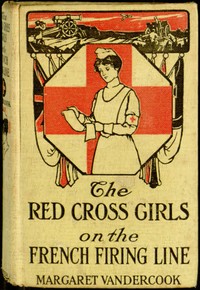
Not long after the beginning of the war in Europe four American girls set sail from New York City to aid in the Red Cross nursing.
When they boarded the “Philadelphia” they were almost strangers to one another. And never were girls more unlike.
Eugenia Peabody, the oldest of the four, hailed from Massachusetts and appeared almost as stern and forbidding as the rock-bound coasts. Privately the others insisted in the early part of their acquaintance that this same Eugenia must have been born an “old maid.”
Mildred Thornton was the daughter of a distinguished New York judge and her mother a prominent society woman. But Mildred herself cared little for a butterfly existence. With the call of the suffering sounding in her ears she had given up a luxurious existence for the hardships and perils of a Red Cross nurse.
The youngest of the four girls, Barbara Meade, was a very small person with a large store of energy and unexpectedness. And the last girl, Nona Davis, was a native of the conservative old city of Charleston, South Carolina. Although a mystery shadowed her mother’s history, Nona had been brought up by her father, a one-time Confederate general, with all the ideas and traditions of the old South.
Yet in spite of these contrasts in their natures and lives, the four American Red Cross girls had spent more than six months caring for the wounded British soldiers in the Sacred Heart Hospital in northern France.
With the closing of the last story the news had come that the headquarters of the hospital must be changed at once. At any hour the German invaders might swarm into the countryside.
There had been but little time to remove the wounded. So, not wishing to add to the responsibilities and finding themselves more in the way than of service, the four girls had escaped together to a small town in France farther away from the enemy’s line.
Here they concluded to offer their aid to the Croix de Rouge, or the Red Cross Society of France.
But this was in the spring, and now another autumn has come round.
One wonders what the four American girls are doing and where they are living.
Automobiles and carriages crowded with men and women, waving tri-colored flags, filled the streets. It was a warm October night with a brilliant canopy of stars overhead.
“Vive la France! Vive l’Armée!” the throng shouted, swaying backward and forward in its effort to draw closer to the great palace.
There must have been between five and ten thousand persons in the neighborhood, for tonight France was celebrating her greatest achievement of the war. At last the news had come that the victorious French army had driven the Germans back across the frontiers of Alsace-Lorraine. Once again the French flag was planted within their lost provinces.
“Allons, enfants, de la patrie, Le jour de gloire est arrivé.”
In the crowd a woman had started the singing of the Marseillaise. Immediately thousands of voices joined in the song, while thousands of feet kept time upon the paving stones to this greatest of all marching measures.
Six broad streets in Paris converge into a triangular square which is known as the Place de l’Opera. From here one looks upward to the opera house itself, a splendid building three stories in height and approached by a broad flight of stone steps.
Standing within the crowd, a little to the left of the opera, was a group of five persons, four of them girls, while the fifth was a young man whose coat was buttoned in such a fashion that he appeared to have but one arm. However, the other arm hung limp and useless underneath his coat.
Although their appearance and accents were those of foreigners, two of the girls in the little party were singing along with the French crowd. The other two were silent, although their faces expressed equal interest and animation.
Suddenly the singing of the street crowd ceased. The central door of the opera house had been thrown open and a young woman came out upon the portico. She was dressed in a clinging white robe and wore upon her head a diadem of brilliants, while in her hands she carried the French flag. So skilfully had the lights been arranged behind her that she could be seen for a great distance. To the onlookers she represented the symbolic female figure of the great French Republic, “Liberté, Egalité, Fraternité.”
For a moment after her appearance there was a breathless silence, then the next even more enthusiastic shouts resounded:
“Vive Chenel! Vive Chenel!” Hats were thrown into the air, thousands of flags waved, while myriads of handkerchiefs fluttered like white doves.
It was a night to be always remembered by the people who shared its rapture.
“Aux armes, citoyens, formez vos bataillons! Marchons! Marchons!”
With the closing of the final verse of the Marseillaise, in the midst of the wild applause, the smallest of the four girls in the little group placed her hand gently upon the armless sleeve of her young man companion.
“Tonight makes up for a good deal, doesn’t it, Dick?” she queried a little wistfully. As she spoke her blue eyes were shining with excitement, while a warm color flooded her cheeks.
The young fellow nodded. “It is the greatest spectacle I ever saw and one we shall never forget,” he replied. “Yet there will be a greater night to come when this war is finally over, though when that night will be no one can foretell.”
Dick Thornton spoke gravely and seemed weary from the evening’s excitement. But then something of what he had passed through in the last six months showed in other ways than in his empty coat sleeve.
Without his knowledge, the girl who had been speaking continued to study him for another moment. Then she turned to Mildred Thornton, who was on her other side, and whispered:
“Mill, Dick is tired, but would rather die than confess it. Can’t you think of some way to get us out of this crowd before the breaking up begins? The jam then will be awful and we may not be able to keep together.”
Up to the instant of Barbara Meade’s suggestion, Mildred had forgotten all personal matters in her interest in the music and the vivid beauty of the scene surrounding them. Now she too glanced toward her brother.
“Dick,” she suggested at once, “don’t you think we had best start back toward our pension? Madame Chenel is to sing an encore and I’m sorry we must miss it, but I really think it would be more sensible to go.”
With the closing of the Marseillaise the celebrated singer had disappeared. Now in the midst of Mildred’s remark she returned to the balcony of the Opera House. No longer was she wearing her crown of brilliants, nor carrying the immense French flag. Instead her head was uncovered, showing her dark hair and eyes and the flag she bore was British, not French.
Then she began singing in English, but with a delicious French accent:
“It’s a long way to Tipperary, It’s a long way to go.”
The crowd joined in the chorus. There were soldiers on the street, who had returned to Paris on leaves of absence, after learning English from the Tommies in the trenches. Others had only a faint knowledge of a few English words. But everybody sang, and because some of the voices were French and others English the effect was all the more thrilling and amusing.
Naturally Dick hesitated for a moment, then he remembered his own condition. Certainly he would be powerless to push their way through the great throng. Then if by chance rioting should break out from sheer excitement, it would be impossible for him to protect four girls. True, the American Red Cross girls were fairly well able to look after themselves in most emergencies. But Dick Thornton did not like the idea of having them put to the test at such a time and under the present circumstances.
“I am afraid you are right, Mildred,” he agreed reluctantly. “Let’s form a single file; I’ll go first and all of you follow me. Tell the others.”
Mildred at once put her arm inside a young woman’s who was standing near her, apparently oblivious of the past conversation. Yet one would have expected Eugenia Peabody to have been first to have made the sensible suggestion of the past few moments. Yet it was Barbara Meade with whom it had actually originated.
But Eugenia too had been swept off her feet with enthusiasm. Moreover, she could scarcely make up her mind now to agree to leave, although plainly appreciating the situation. Eugenia looked surprisingly handsome tonight.