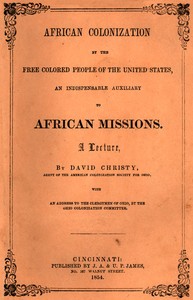
AFRICAN COLONIZATION BY THE FREE COLORED PEOPLE OF THE UNITED STATES, AN INDISPENSABLE AUXILIARY TO AFRICAN MISSIONS. A Lecture.
BY DAVID CHRISTY, AGENT OF THE AMERICAN COLONIZATION SOCIETY FOR OHIO.
CINCINNATI: PUBLISHED BY J. A. & U. P. JAMES, NO. 167 WALNUT STREET. 1854.
PREFATORY REMARKS.
In the course of his labors, as Colonization Agent for Ohio, the writer, at an early day, found it necessary to examine the subject of African Missions. It was zealously urged, by many, that the Colonies of the Society, instead of being auxiliaries to the evangelization of the natives, presented an almost insuperable barrier to the spread of the Gospel in Africa. The facts ascertained, during the investigations, have been used, from time to time, in the Lectures delivered in different parts of the State, with general satisfaction to the friends of Colonization. The events of the last year or two in Africa, however, have been so marked, and the superiority of the missions in Liberia over all the others, so fully demonstrated, that the publication of the results has been urged as an act of justice to the American Colonization Society and to the Missions in the Republic.
In the preparation of the Lecture, none but the best authorities have been consulted, and the greatest care has been taken to avoid error. References to the sources of information are given in a few instances. Should any wish to verify the whole range of the facts stated, they will find them, mostly, in the following works and periodicals: Choule’s History of Missions, Reports of American Board of Commissioners for Foreign Missions, Missionary Herald, African Repository, and the works occasionally quoted in foot notes in the Lecture.
[Expense of stereotyping paid by Dr. Alexander Guy, Cincinnati.]
STEREOTYPED BY C. F. O’DRISCOLL, 167 WALNUT STREET, CINCINNATI.
A LECTURE ON AFRICAN MISSIONS.
In temporal affairs, experience supplies the best rule for the guidance of man. In spiritual concerns, the word of God is the law by which his conduct must be governed. In relation to the spread of the Gospel, while the Saviour has given a few general directions, as to the mode of its propagation, he has left much to human wisdom, as to the measures by which it is to be extended. Pagan countries differ so widely in their civil relations, social customs, superstitions, and degrees of intelligence, that corresponding variations must be made in the plans for their evangelization. Africa, when first visited by the Missionary, was one broad field of ignorance and barbarism. Its condition differed so widely from that of any other country, where missions had been established, that the efforts made for its redemption, could be little else than experiments.
The time has arrived when we may safely proceed to contrast the results of the several classes of missions in Africa, ascertain what experience teaches, and determine the rule by which the greatest progress is to be made, in the extension of Civilization and Christianity, in that land of darkness and desolation. This task we now propose to execute, and shall take up the several missions in the following order:
1. The missions founded in Liberia.
2. Those in the English colonies of Recaptured Africans.
3. Those among native tribes, beyond the protection of the colonies.
4. Those to the natives of South Africa, within the English colonies of white men.
I. The Missions founded in Liberia.
Rev. SAMUEL J. MILLS is called the father of our Foreign Missionary scheme. His heart first received the Divine impress of the spirit of missions, and through him it was communicated to others. “I think I can trust myself in the hands of God, and all that is dear to me; but I long to have the time arrive, when the Gospel shall be preached to the poor Africans.” This language, entered in his diary, while a student at College,[1] proves that the thought of Africa was foremost in his mind. He beheld her captive children, dwelling in our midst, deeply degraded. From this condition they could not be elevated to the dignity of freemen. Christian philanthropy made the effort, but was unable to afford them relief.[2] Their country, too, was yet a bleeding victim, with few to pity and none to protect.
With the National Independence of our country, there arose higher conceptions of the individual man. This was a logical inference from the principles maintained. People found themselves capable of self-government; hence, the individual must possess the capacity for self-elevation. So reasoned the founders of our Republic; and, to this end, equal laws and privileges were secured to every citizen, that the improvement of all might be promoted. But in the case of the colored man, the National Government was powerless. It possessed neither the means, nor the constitutional authority, to change the relations in which he stood to the whites. It only remained, therefore, to make the colored man, himself, the instrument of his own redemption. No sooner had this thought sprung into existence, than it was seized by the Philanthropist; and, in his grasp, it suddenly expanded into the grand idea of making him also the agent for the deliverance of his country.
The time had come for SAMUEL J. MILLS to act. Five years had rolled away since his companions, whom he had enlisted in the cause—JUDSON, NEWELL, NOTT, HALL, and RICE—had gone to their fields of labor, in the East.[3] Africa, as well as Asia, was now remembered by the friends of Foreign Missions; and MILLS offered himself,[4] to open the pathway for the colored man’s return, with the Gospel of peace, to the home of his fathers. He accomplished his object, only to find his grave in the ocean, thus marking the way the captive must pursue to reach a land of freedom.
The exploration of Mr. MILLS, was made in company with the Rev. EBENEZER BURGESS, under a commission from the American Colonization Society. His death was deeply lamented by the friends of Foreign Missions, but the importance of the cause in which he fell, justified the sacrifice. The favorable report made by Mr. BURGESS, enabled the Society to proceed in its enterprise. The first emigrants, 86 in number, sailed for Africa, February, 1820; and the Colony was first planted at Monrovia, January, 1822. The pecuniary income of the Society being small,[5] the emigration was slow—only 1,232 persons having reached the Colony during the first 10 years. The average number of Colonists, up to the period when the Colony became independent, was only about 170 per annum: the average from the first of January, 1848, to the close of 1852, has been 540 per annum: and for 1853, alone, it has been 782: thus showing a rapid increase since the establishment of the Republic. Previous to that date, three-fourths of the emigrants had been emancipated slaves, who received their freedom on condition of going to Liberia; but, since its independence, a largely increased proportion have been freemen.
We shall not enter upon the history of the trials to which Liberia has been subjected, as the main facts are familiar to every one. Her extermination by war, on the one hand, has been thrice attempted by the slave traders, through the agency of the native Africans; and, on the other hand, her ruin has been sought, in the destruction of the Colonization Society, by an immense moral force, at the head of which stood men who are now the avowed enemies of the Bible. Good men, who, for a time, were arrayed in opposition to Colonization, finding themselves involved in a crusade against the introduction of the Gospel into Africa, have, mostly, given in their adhesion to the cause, and left the repudiators of Christianity and the traffickers in human flesh, as the only enemies to African Colonization. The prayer of SAMUEL J. MILLS, for the introduction of the Gospel into Africa, has been heard, and Ethiopia now stretches forth her hands unto God.
In proceeding to the missionary history of Liberia, we shall begin with the METHODIST EPISCOPAL CHURCH. The mission in the Republic of Liberia, is her oldest in the Foreign field. The nucleus of this mission, consisted of several members, and one or two local preachers, of the Methodist Church, who went out with the first emigrants. In March, 1833, the Rev. Melville B. Cox, the first ordained missionary, landed in Monrovia. To maintain this mission, has cost much treasure, and many precious lives; but the fruits of it are inestimable. It is now formed into a regular Annual Conference, composed of three districts, each with a presiding elder, and having its circuits, stations, and day and Sunday schools. The mission now covers the whole territory of Liberia and that of Cape Palmas.[6] The Conference consists of 21 members in full connection and on trial, all of whom are colored men. Its churches, according to the Agent’s Report, 1853, embrace 1,301 members, of whom 116 are natives, and there are 115 probationers. The Mission has 15 Sunday schools, with 839 pupils, of whom 50 are natives; and 20 week-day schools, with 513 scholars. There are also 7 schools among the natives, with 127 pupils.
The sums appropriated to sustain this mission were, for 1851, $22,000; for 1852, $26,000; for 1853, $32,957; and for 1854, $32,957. This liberality is sufficiently expressive of the confidence of the Methodist Church in Liberia. The Report of the Board of Managers, for 1851, says:
“All eyes are now turned toward this New Republic on the Western coast of Africa, as the star of hope to the colored people, both bond and free, in the United States. The Republic is establishing and extending itself; and its Christian population is in direct contact with the natives, both Pagans and Mohammedans. Thus the Republic has, indirectly, a powerful missionary influence, and its moral and religious condition is a matter of grave concern to the Church. Hence, the Protestant Christian missions in Liberia, are essential to the stability and prosperity of the Republic; and the stability and prosperity of the Republic are necessary to the protection and action of the missions. It will thus appear, (concludes the Report,) that the Christian education of the people, is the legitimate work of the missions.”
Governed by these considerations, the Methodists have erected a seminary building, in Monrovia, at a cost of $10,000, which is now affording instruction to youth in the higher departments of science and literature.
The Report for 1853,[7] speaks still more encouragingly of the mission in Liberia. It says:
“The value of this mission is, perhaps, inconceivable: it not only dispenses the word of life to the people, but it contributes largely to the maintenance of good morals and good order in the Republic, and thus strengthens and assists in preserving the State. In this way it indirectly contributes to make the Republic of Liberia a steady light, beckoning the free colored people of this country to a land where they can be truly free and equal, and where only they can be truly men and govern themselves. The mission is thus assisting the State to give a triumphant answer to our Southern States when they ask, If we set the slave population at liberty, where can they go and be free and prosperous? This is a result of immense value. It probably contains the solution of the question of American slavery—that great mystery of iniquity which dims the otherwise resplendent light of our glorious Republic. And yet, further, this African mission in the Republic of Liberia is a steady and shining light to the western portions of Africa, where now reign the most degrading, cruel, and destructive superstitions to be found in the world. Until within a quarter of a century past, many thousands of human victims have been sacrificed annually, in their cruel and dark religious rites, within sight of the coast; and not very far removed from the coast these sacrifices still continue, to an extent of which it makes one shudder to think, much less to behold. Can the Church waver in her support of such a mission on the Western coast of Africa? She will not.”