Public-domain ebook
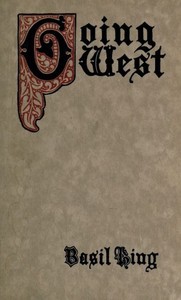
Going West
by Basil King
Language: en244 downloads on Project Gutenberg
Subjects
In: Historical Novels·Novels·American Literature
Public-domain ebook sourced from Project Gutenberg #60395.
Public-domain ebook
by Basil King
Language: en244 downloads on Project Gutenberg
Subjects
In: Historical Novels·Novels·American Literature
Public-domain ebook sourced from Project Gutenberg #60395.
The opening · free to read
He was not a born fighter, in spite of a big, husky frame through which the urge of physical life was strong. On the contrary, he was a civilian and a business man in every nerve of his body. Eight generations on American soil had bred a type essentially industrious, notwithstanding all the fighting in which the family had been engaged. His father had fought in the Spanish-American War; his grandfather in the Civil War; his great-great-grandfather in the Revolution; farther back, his ancestors in the Connecticut Valley had beaten off the French and Indians for nearly a hundred years.
All that, however, had been alien to the main purposes of life. It had been incidental, not professional. Its chief influence on Lester lay in the assumption that, men being called for on the borders of Texas and in Mexico, he had no choice but to go. True, he was just beginning, after certain wayward years, to see success as a broker ahead of him; and within the month he had become engaged to Molly Dove. But these considerations could not weigh against the appeal of country, nor annul those traditions of duty that had come to him from the past.
So in the course of time, and with the march of events, he found himself in the enemy trenches, facing a burly blue-eyed Teuton holding a rifle by the barrel and swinging the butt about his head, while he himself held a bayonet in his hand. Amid the wreckage, the carnage, the tumult, he was desperately trying to recall his instructions as to how to stick the weapon in.
Before telling what happened then, let us go back and follow rapidly the stages by which Lester found himself in a situation which two or three years earlier he would have laughed out of the list of possibilities.
The son of a well-to-do bookseller in a great Atlantic city, he was an instance of that reaction against the paternal bent with which we are all familiar. His father was a gentle, scholarly man who loved books as books. The Spanish-American campaign had left him with one leg slightly shorter than the other, and the air of a retired general. All his longings had once focused themselves into the hope that his son would enter into, and one day inherit, a business built up on years of diligence and judgment--only to be disappointed.
Lester had no interest in books. He was not only an open-air fellow with a zest for sports, but he had all the inclinations of a genial, jovial soul. Taking wine, women, and song as kindred joys, he chose brokerage as the profession that would give him closest touch with the merry give and take of life.
As a broker he could steal all the time he needed to "root" at games, after he had ceased to play them actively, while the same career rendered him more free to marry a girl like Molly Dove, a waitress in the café where he generally lunched, to whom his family bitterly objected.
His mother was a small, square-shouldered woman, with a smile so bright that it was difficult for the most penetrating eye to see behind it. Lester had inherited her dark color, her beetling brows, and her vigorous physique. A gay audacity, as real as it looked, was also not the least among the legacies she passed on to her son.
Of his two sisters, Cora resembled the father and Ethelind the mother. Ethelind, too, had that gay audacity, the most patent result of which was to involve her in conflicting love-affairs. A wild-eyed thing, she was formed on that permanent-seventeen model that came in with the second decade of the twentieth century and induced all women, whatever their time of life, to dress as school-girls. Cora, tall, dignified, reserved, was the graduate of a woman's college, in which it was her ambition one day to hold a professorship. To sisters as well as parents the stalwart, wilful boy would have been the king among young men had it not been for his entanglement with Molly Dove. They could pardon his "wildness," knowing that it would pass, but they found it hard to forgive his choice of a wife in a sphere so much below him. In fact, they did not pardon it at all. In spite of his announcement that the engagement had become definite, no one responded to his invitation to make the acquaintance of the girl.
In the matter of his "wildness" there were already stirrings of a change of heart, though they hardly rose to the level of active consciousness. Such reforms as he made were avowedly in deference to Molly Dove. In cutting out--the term was his--women, wine, and song, he made it clear to himself that he did it, not in obedience to a moral law, but because "Molly asked him to." Molly held the odd conviction that such indulgences were wrong, chiefly because they came in between him and a great mystery, of which he had heard vaguely all his life, but from which instinctively he turned his mind away.
"There's really no mystery at all," she asserted, in that pretty way of hers which he found at once tranquil and enthusiastic, "no more than there's a mystery about the sun. When we fill the atmosphere with smoke we can't see it; but that doesn't keep the sun from being there. Blow the smoke away, and you find the sunshine as bright as ever."
He liked to hear her talk in that way, though he was not won by her beliefs. Far in the future he saw days when he would have shot the bolt of his temptations and settled down with her into being the "good fellow" she hoped to make of him. In the mean time--
But in the mean time came the call. It was the kind of call against which his instincts and his interests both rebelled, but he took it with no more analysis than he gave to the necessity of getting out of bed on a winter's morning. There was no help for it; it was all in the day's work.
His family took it in the same way. It was as much a matter of course as when Ebenezer Lester shouldered his eighteenth-century musket to defend the stockade against the Iroquois stealing down from Canada. It was as much a matter of course as when Charles E. Lester, the bookseller, rallied to President McKinley against Spain.
It was also a matter of course to Molly Dove. It would postpone the wedding for which she had begun her simple preparations, but she had a curious, secret facility for renouncing her own will. Her right-about-face was made with smiling lips and glistening eyes, and no effort that any one could see. To Lester she whispered:
"It's going to be all right, dear. Whatever the clash of human wills, there's only one real Ruler in the universe. The closer we can keep in touch with Him the nearer we shall be to the usefulness and happiness which make up what we call our destiny."
"That's all very well." He smiled, patting her hand. "But suppose I'm shot--or die of a fever?"
Her reply would have staggered him if he had not put it down to the sweet and charming eccentricity which made her different from other girls.
"Well, suppose it does happen that in the course of doing your duty this mortal should 'put on immortality'--that's the way the Bible expresses it, you know--wouldn't that be a gain for you? And what's a gain for you couldn't be a loss for us."
He laughed with a great guffaw. "But perhaps we shouldn't be married."
"No; but marriage, after all, is only for time, whereas you and I are bound by all sorts of ties which really belong to eternity."
He took no stock in that, he told her; but he liked her gleaming earnestness in saying it. The aunt who had brought her up must have been a quaint, religious character, he said, to have filled her head with such other-worldly notions. Anyhow, they were different from the anxiety and fear which the family hid behind their stoic calmness, and of which he felt the twinges within himself as he wound up his affairs.
It was at the time when the possibility of a war with Mexico--or any war at all--struck the imagination of the country as a calamity too horrible to contemplate. There was no question as to the victory, but neither was there a question as to the price that would be paid for it. Men--young men--young Americans, O God!--would be killed--actually killed. Fellows whose places were in shops and offices and factories and banks, whose diversions were the stadium, the sea-shore, or the woods, would be called on to make the extreme sacrifice at a time when sacrifice of any kind was being pooh-poohed. It was not only monstrous, it was unnatural, a trend of events in the teeth of fate, and against what one might reasonably call the manifest will of God. Lester knew that his family were feeling this, though they never mentioned it; he was feeling it himself. Molly Dove alone seemed to ride on the wave of events like a sea-bird on a storm, cradled, rocked, at ease in her element, secure, serene, sure of both present and ultimate good, whatever might befall.
So there came a Sunday when, after a mid-day dinner, the family accompanied him to the station and he entrained for camp. He had said good-by to Molly Dove during the forenoon. As no advance had been made to her from the Lester side, she could make none on hers, and so judged it wisest to keep out of sight. Her sweet self-effacement in doing this made Lester swear that he would marry her at the first opportunity, as he steamed away on this opening stage of what was to prove his long, long, long way.
That way, at the beginning, struck many people as a tortuous, futile way, leading no-whither. There was talk of saluting the flag; there was the occupation of Vera Cruz; there was the withdrawal from Vera Cruz; there were months when the daily head-lines bore the names Huerta, Villa, Carranza; and few knew for what reason the young men did not come home.
Then home they began to come, chiefly on furlough, to be sent elsewhere. During one such interval Lester married Molly Dove. It meant a breach with his family, none of whom appeared at the simple ceremony or took any steps to acknowledge the bride. He was compelled to leave her within a month.
In the mean while greater wars than any possibility with Mexico had broken out, and the iron entered the whole world's soul. It was only then that the end of the road on which Lester had started out that Sunday when he had entrained came into sight--and he sailed for France.
His life after that could scarcely be distinguished from hundreds of thousands of other lives. One overruling need had bound the manhood of the race into a solidarity so tense that the individual was swallowed up in it. Lester was no longer a son, a brother, a husband, the father of a coming baby; he was an infinitesimal part of a huge machine, with no more to say in matters of his life and death than the wheel to the man who turns it round. He could only turn; he could only turn as he was told; he could only turn as millions of other wheels were turning, without volition, without knowledge, and, to a degree that surprised him, without much preference or choice.
In minutes when conscious of himself he could see how little he was the Lester of other days. When he woke up in the morning it was often with a strange, dull wonder as to what he had become, and how and why he had become it. It was like a rebirth--only it suggested a rebirth into hell. In fits of moral nausea, after some phase of a "good time," at any date within the past ten years, he had called down on himself some such fate as that; but he had never looked for it so literally, and right here on earth.
The book keeps going
Reading is free forever. Sign up and watch scenes appear while you read.



Scenes Storieta drew for other classics.
New illustrated classics
Once or twice a month: the latest books to get full character casts, scene art, and free comic editions. No account needed.