Public-domain ebook
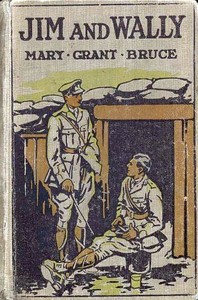
Jim and Wally
Language: en519 downloads on Project Gutenberg
Subjects
In: Adventure·Novels·History - Modern (1750+)
Public-domain ebook sourced from Project Gutenberg #60445.
Public-domain ebook
Language: en519 downloads on Project Gutenberg
Subjects
In: Adventure·Novels·History - Modern (1750+)
Public-domain ebook sourced from Project Gutenberg #60445.
The opening · free to read
“For one the laurel, one the rose, and glory for them all, All the gallant gentlemen who fight and laugh and fall.” MARGERY RUTH BETTS.
THE trench wound a sinuous way through the sodden Flanders mud. Underfoot were boards; and then sandbags; and then more boards, added as the mud rose up and swallowed all that was put down upon it. Some of the last-added boards had almost disappeared, ground out of sight by the trampling feet of hundreds of men: a new battalion had relieved, three nights before, the men who had held that part of the line for a week, and when a relief arrives, a trench becomes uncomfortably filled, and the ground underfoot is churned into deep glue. It was more than time to put down another floor; to which the only objection was that no more flooring material was available, and had there been, no one had time to fetch it.
It was the second trench. Beyond it was another, occupied by British soldiers: beyond that again, a mass of tangled barbed-wire, and then the strip of No-Man’s Land dividing the two armies—a strip ploughed up by shells and scarred with craters formed by the bursting of high explosives. Here and there lay rifles, and spiked German helmets, and khaki caps; but no living thing was visible save the cheeky Flemish sparrows that hopped about the quiet space, chirping and twittering as if trying to convince themselves and everybody else that War was hundreds of miles away. The sparrows carried out this pleasant deception every morning, abandoning the attempt as soon as the first German gun began what the British soldiers, disagreeably interrupted in frying bacon, termed “the breakfast hate.” Then they retreated precipitately to the sparrow equivalent to a dug-out, to meditate in justifiable annoyance on the curious ways of men.
In the second trench the men were weary and heavy-eyed, and even bacon had scant attractions for them. It was their first experience of trench-life complicated by shell-fire, and since their arrival the enemy had been “hating” with a vigour that seemed to argue on his part a peculiar sourness of temper. Now, after two days of incessant artillery din and three nights of the strenuous toil that falls upon the trenches with darkness, the new men bore evidence of exhaustion. Casualties had been few, considering the violent nature of the bombardment; but to those who had never before seen Death come suddenly, an even slighter loss would have been horrifying. The ceaseless nerve-shattering roar of the big guns pounded in their brains long after darkness had put an end to the bombardment; their brief snatches of sleep were haunted by the white faces of the comrades with whom they would laugh and fight and work no more. They were stiff and sore with crouching under the parapets and in the narrow dug-outs; dazed with noise, sullen with the anger of men who have been forced to endure without making any effort to hit back. But their faces had hardened under the test. A few were shrinking, “jumpy,” useless: but the majority had stiffened into men. When the time for hitting back came, they would be ready.
Dawn on the fourth morning found them weary enough, but, on the whole, in better condition than they had been two days earlier. They were getting used to it; and even to artillery bombardment “custom hath made a property of easiness.” The first sense of imminent personal danger had faded with each hour that found most of them still alive. Discipline and routine, making each officer and man merely part of one great machine, steadied them into familiar ways, even in that unfamiliar setting. And above all was satisfaction that after months of slow training on barrack-square and peaceful English fields they were at last in the middle of the real thing—doing their bit. It had been conveyed to them that they were considered to be shaping none too badly: a curt testimonial, which, passing down the line, had lent energy to a hard night of rebuilding parapets, mending barbed-wire, and cleaning up battered sections of trench. They were almost too tired to eat. But the morning—so far—was peaceful; the sunlight was cheery, the clean breeze refreshing. Possibly to-day might find the Hun grown weary of hating so noisily. There were worse things than even a trench in Flanders on a bright April morning.
Jim Linton sat on a small box outside his dug-out, drinking enormous quantities of tea, and making a less enthusiastic attempt to demolish the contents of an imperfectly heated tin of bully beef. He was bare-headed, owing to the fact that a portion of shrapnel had removed his cap the day before, luckily without damaging the head inside it. Mud plastered him from neck to heels. He was a huge boy, well over six feet, broad-shouldered and powerful; and the bronze which the sun of his native Australia had put into his face had been proof against the trench experiences that had whitened English cheeks, less deeply tanned.
Another second lieutenant came hastily round a traverse and tripped over his feet.
“There’s an awful lot of you in a trench!” said the new-comer, recovering himself.
“Sorry,” said Jim. “I can’t find any other place to put them; they will stick out. Never mind, the mud will bury them soon; it swallows them if I forget to move them every two minutes. Come and have breakfast.”
“I want oceans of tea,” said Wally Meadows, dragging a biscuit-tin from the dug-out, perching it precariously on a small board island in the mud, and seating himself with caution. He glanced with disfavour at the beef-tin. “Is that good?”
“Beastly,” Jim answered laconically. “Smith’s strong point is not cookery. It’s faintly warm and exceedingly tough; and something with moisture in it seems to have happened to the biscuits. But the tea is topping. I told Smith to bring another supply presently. Bacon’s a bit short, so I said we preferred bully.”
Wally accepted a tin mug of milkless tea with gratitude.
“That’s great,” he said, after a beatific pause, putting down the empty mug. He pushed his cap back from his tired young face, and heaved a great sigh of relief. “Blessings on whoever discovered tea! I don’t think I’ll have any beef, thanks.”
“Yes, you will,” Jim said, firmly. “I know it’s beastly, and one isn’t hungry, but it’s a fool game not to eat. If we have any luck there may be some work to-day; and you can’t fight if you don’t eat something. The first mouthful is the worst.”
His chum took the beef-tin meekly.
“I suppose you’re right,” he said. “If we only do get a chance of fighting, I should think we’d have enormous appetites afterwards; but one can’t get hungry hiding in this beastly hole and letting Brother Boche sling his tin cans at us. Wouldn’t you give something for a bath and twelve hours’ sleep?”
“By Jove, yes!” Jim agreed. “But I don’t mind postponing them if only we get a smack at those gentry across the way first. Did you see Anstruther?”
“Yes—he’s better. He dodged the R.A.M.C. men—said he wasn’t going to be carted back because of a knock on the head. He’s tied up freshly and looks awfully interesting, but he declares he’s quite fit.”
Captain Anstruther was the company commander, a veteran of one-and-twenty, with eight months’ service. The two Australian boys, nineteen and eighteen respectively, and fully conscious of their own limitations, regarded him with great respect in his official capacity, and, off duty, had clearly demonstrated their ability to dispose of him, with the gloves on, within three rounds. They were exceedingly good friends. Anstruther could tell stories of the Marne, of the retreat from Mons, of the amazing tangle of the first weeks of war, which had left him, then a second lieutenant, in sole command of the remnant of his battalion. To the two Australians he was a mine of splendid information. They were mildly puzzled at what he demanded in return—bush “yarns” of their own country, stories of cattle musterings, of aboriginals, of sheep-shearing by machinery, of bush-fire fighting; even of football as played at their school in Melbourne. To them these things, interesting enough in peacetime and in their own setting, were commonplace and stale in the trenches, with Europe ablaze with battle all round them. Anstruther, however, looked on war with an eye that saw little of romance: willing to see it through, but with no illusions as to its attractions. He greatly preferred to talk of bush-fires, which he had not seen.
Yesterday a shell which had wrecked far too much of a section of trench to be at all comfortable had provided this disillusioned warrior with a means of escape, had he so wished, by knocking him senseless, with a severe scalp-wound. Counselled to seek the dressing-station at the rear, when he had recovered his senses, however, he had flatly declined; all his boredom lost in annoyance at his aching head, and a wild desire to obtain enemy scalps in vengeance. Jim and Wally had administered first-aid with field dressings, and the wounded one, declaring himself immediately cured, had hidden himself and his bandages from any intrusive senior who might be hard-hearted enough to insist on his retirement.
“It was a near thing,” Jim said reflectively.
“So was yours,” stated his chum.
“Oh—my old cap?—a miss is as good as a mile,” said Jim. “I’m glad it wasn’t a bit nearer, though; it would be a bore to be put out of business without ever having seen a German, let alone finding out which of us could ‘get his fist in fust.’” He rose, feeling for his pipe. “Have you eaten your whack of that stuff?”
“I’ve done my best,” said Wally, displaying the tin, nearly empty. “Can’t manage any more. Let’s have a walk along the trench and see what’s happening.”
“Well, keep your silly head down,” Jim said. “The parapet is getting more and more uneven, and you never remember you’re six feet.”
Wally grinned. Each of the friends suffered under the belief that he was extremely careful and the other destined to sudden death from unwittingly exposing himself to a German sniper.
“If you followed your own advice, grandmother,” he said; “you being three inches taller, and six times more careless! I always told your father and Norah that you’d be an awful responsibility.”
“I’ll put you under arrest if you’re not civil,” Jim threatened. “Small boys aren’t allowed to be impertinent on active service!”
They floundered along in the mud, ducking whenever the parapet was low: sandbags had run short, and trench-repairing on the previous night had been like making bricks without straw. The men were finishing breakfast, keeping close to the dug-outs, since at any moment the first German shell might scream overhead. The line was very thin; reinforcements, badly enough wanted, were reported to be coming up. Meanwhile the battalion could only hope that the shells would continue to spare them, and that when the enemy came the numbers would be sufficiently even to enable them to put up a good fight.
Captain Anstruther, white-faced under a bandage that showed red stains, nodded to them cheerily.
“Ripping morning, isn’t it?” he said. “Hope you’ve had a pleasant night, Linton!”
The book keeps going
Reading is free forever. Sign up and watch scenes appear while you read.



Scenes Storieta drew for other classics.
New illustrated classics
Once or twice a month: the latest books to get full character casts, scene art, and free comic editions. No account needed.