Public-domain ebook
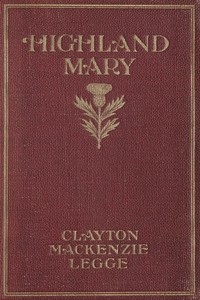
Highland Mary: The Romance of a Poet A Novel
Language: en349 downloads on Project Gutenberg
Subjects
In: Historical Novels·Romance·Novels
Public-domain ebook sourced from Project Gutenberg #60455.
Public-domain ebook
Language: en349 downloads on Project Gutenberg
Subjects
In: Historical Novels·Romance·Novels
Public-domain ebook sourced from Project Gutenberg #60455.
The opening · free to read
In the “but” or living-room (as it was termed in Scotland) of a little whitewashed thatched cottage near Auld Ayr in the land of the Doon, sat a quiet, sedate trio of persons consisting of two men and a woman. She who sat at the wheel busily engaged in spinning was the mistress of the cot, a matronly, middle-aged woman in peasant’s cap and ’kerchief.
The other two occupants of the room for years had been inseparable companions and cronies, and when not at the village inn could be found sitting by the fireside of one of their neighbors, smoking their pipes in blissful laziness. And all Ayrshire tolerated and even welcomed Tam O’Shanter and his cronie, “Souter Johnny.”
Tam was an Ayrshire farmer, considered fairly well-to-do in the neighborhood, while Souter (shoemaker) Johnny was the village cobbler, who seldom, if ever, worked at his trade nowadays. All the afternoon had they sat by the open fireplace, with its roomy, projecting chimney, watching the peat burn, seldom speaking, smoking their old smelly pipes, and sighing contentedly as the warmth penetrated their old bones.
Mrs. Burns glanced at her uninvited guests occasionally with no approving eye. If they must inflict their presence on her, why couldn’t they talk, say something, tell her some of the news, the gossip of the village? she thought angrily; their everlasting silence had grown very monotonous to the good dame. She wished they would go. It was nearing supper time, and Gilbert would soon be in from the field, and she knew that he did not approve of the two old cronies hanging around monopolizing the fireplace to the exclusion of everyone else, and she did not want any hard words between them and Gilbert. Suddenly with a final whirl she fastened the end of the yarn she was spinning, and getting up from her seat set the wheel back against the whitewashed wall.
Then going to the old deal dresser, she took from one of the drawers a white cloth and spread it smoothly over the table, then from the rack, which hung above it, she took the old blue dishes and quickly set the table for their evening meal. At these preparations for supper the old cronies looked eagerly expectant, for none knew better than they the excellence of the Widow Burns’ cooking, and a look of pleasant anticipation stole over their sober faces as they perceived the platter of scones on the table ready to be placed on the hot slab of stone in the fireplace.
Knocking the ashes from his pipe, Tam rose unsteadily to his feet, and standing with his back to the fire, he admiringly watched the widow as she bustled to and fro from table to dresser. “Ah, Mistress Burns, ye’re a fine housekeeper,” he remarked admiringly. “An’ ye’re a fine cook.”
Mrs. Burns turned on him sharply. “So is your guidwife,” she said shortly, glancing out through the low, deep, square window to where her second son could be seen crossing the field to the house. She hoped he would take the hint and go.
“Aye, Mistress, I ken ye’re recht,” replied Tam, meekly, with a dismal sigh. “But it’s a sorry bet o’ supper I’ll be gang hame to this night, an’ ye ken it’s a long journey, too, Mistress Burns,” he insinuated slyly.
“Sure it’s a lang, weary journey, Tam,” said Souter Johnny, commiseratingly. “But think o’ the warm welcome ye’ll be haein’ when ye meet your guidwife at the door,” and a malicious twinkle gleamed in his kindly but keen old eyes.
“How is your guidwife, Tam O’Shanter?” inquired Mistress Burns, as she placed some scones on the hot hearthstone to bake.
“She’s a maist unco woman, Mistress,” replied Tam sorrowfully. “There’s no livin’ wi’ her o’ late. She’s no a help or comfort to a mon at a’!” he whined. Here Tam got a delicious whiff of the baking scones, and his mouth as well as his eyes watered as he continued pathetically, “If she could only cook like ye, Mistress. Oh, ’twas a sorry day for Tam O’Shanter when he took such a scoldin’ beldame for wife,” and Tam sat down, the picture of abject distress.
Souter regarded his cronie with a grim smile. He had no pity for Tam, nor for any man, in fact, who would not or could not rule his own household. (Souter, by the by, had remained a bachelor.) However, he did his best to console Tam whenever his marital troubles were discussed.
“Never mind, Tam,” he said sympathetically, helping himself to a scone while Mistress Burns’ back was turned. “Ye ken where ye can find all the comfort and consolation ye can hold, if ye hae the tippence.”
Tam wiped away a tear (tears came easily to the old tyke in his constant state of semi-intoxication) and gave a deep, prolonged sigh. “Aye, Souter, an’ I feel mair at home in the Inn than I do with my guidwife,” he answered mournfully. “I dinna mind telling ye, she’s driven me to the Deil himsel’, by her daur looks an’ ways. The only friend I hae left is Old John Barleycorn,” and he wailed in maudlin despair.
“He’s your best enemy, ye mean,” retorted Souter dryly, relighting his pipe, after having demolished, with evident relish, the last of his stolen scone.
“Waesucks, mon,” he continued, assuming the tone of Dominie Daddy Auld, who had tried in vain to convert the two old sinners, much to their amusement and inward elation. “Your guidwife told ye weel. Ye’re a skellum, Tam, a blethering, blustering, drunken blellum,” and the old rogue looked slyly at Mistress Burns to note the effect of his harangue.
“Aye, ye’re right, Souter Johnny,” said the good dame, nodding approval to him, and going up to Tam, who was still sitting groaning by the fireside, she shook him vigorously by the shoulder. “Stop your groaning and grunting, ye old tyke, and listen to me,” she said sharply. “Take your friend’s advice and gi’ old John Barleycorn a wide berth.” Here her voice dropped to a whisper, “or some day ye’ll be catched wi’ warlocks in the mire, Tam O’Shanter.” He stopped his noise and straightened up in his chair.
“Aye, and ghosties and witches will come yelpin’ after ye as ye pass the auld haunted kirk at Alloway,” added Souter sepulchrally, leaning over Tam with fixed eyes and hand outstretched, clutching spasmodically at imaginary objects floating before Tam’s suspicious, angry eyes. Tam, however, was not to be so easily frightened, and brushing Souter aside, he jumped to his feet. “Souter Johnny, dinna ye preach to me, mon,” he roared menacingly. “Ye hae no reght. Let Daddy Auld do that! I dinna fear the witches or ghosties, not I.” He staggered to the window and pointed to an old white horse standing meekly by the roadside.
“Do ye see any auld faithful Maggie standin’ out there?” he cried triumphantly. Not waiting for their answer, he continued proudly, “Nae witches can catch Tam O’Shanter when he’s astride his auld mare’s back, whether he is drunk or sober,” and he glared defiantly at his listeners. At that moment the door from the “ben” opened, and Gilbert Burns entered the room. An angry frown wrinkled his forehead as his gaze fell upon the two old cronies. A hard worker himself, he could not abide laziness or shiftlessness in another. He strode swiftly up to Tam, who had suddenly lost his defiant attitude, but before he could speak the bitter, impatient words which rushed to his lips, his mother, knowing his uncertain temper, shook her head at him remonstratingly. “Ah, lad, I’m fair ye hae come in to rest a while, an’ to hae a bit o’ supper,” she hurriedly said. “Set ye doon. I hae some scones for ye, an’ Mollie has some rabbit stew. Noo gie me your bonnet and coat, laddie,” and taking them from him she hung them on the peg behind the door, while Gilbert with a look of disgust at the two old cronies sat down and proceeded to butter his scones in moody silence. Tam and Souter, however, did not appear in any wise abashed, and perceiving they were not to be invited to eat with Gilbert, they resumed their seats each side of the fireplace and heaved a disconsolate sigh.
Mrs. Burns, who had left the room for a moment, now entered bearing a large bowl of the steaming stew, which she set before her son, while directly after her appeared old Mollie Dunn, the half-witted household drudge. The time was when Mollie had been the swiftest mail carrier between Dumfries and Mauchline, but she was now content to have a home with the Burns family, where, if the twinges of rheumatism assailed her, she could rest her bones until relief came. She now stood, a pleased grin on her ugly face, watching Gilbert as he helped himself to a generous portion of the stew which she had proudly prepared for the evening meal.
“Molly,” said her mistress sharply, “dinna ye stand there idle; fetch me some hot water frae the pot.”
Molly got a pan from the rack and hurried to the fireplace, where Tam was relighting his pipe with a blazing ember, for the dozenth time. Molly had no love for Tam, and finding him in her way, she calmly gave a quick pull to his plaidie, and Tam, who was in a crouching position, fell backward, sprawling on the hearth in a decidedly undignified attitude. With the roar of a wounded lion, he scrambled to his feet, with the assistance of Souter, and shaking his fist at the laughing Molly, he sputtered indignantly, “Is the Deil himsel’ in ye, Molly Dunn? Ye’re an impudent hussy, that’s what ye are.” Molly glared at him defiantly for a moment, then calmly proceeded to fill her pan with hot water, while the old man, bursting with indignation, staggered over to the dresser where Mistress Burns was brewing some tea.
“Mistress Burns,” he remonstrated almost tearfully, “ye should teach your servants better manners. Molly Dunn is a——” but he never finished his sentence, for Molly, hurrying back with the hot water, ran into him and, whether by design or accident it was never known, spilled the hot contents of the pan over Tam’s shins, whereupon he gave what resembled a burlesque imitation of a Highland fling to the accompaniment of roars of pain and anger from himself and guffaws of laughter from Souter and Molly. Even Mrs. Burns and Gilbert could not resist a smile at the antics of the old tyke.
“Toots, mon,” said Molly, not at all abashed at the mischief she had done, “ye’re no hurt; ye’ll get mair than that at hame, I’m tellin’ ye,” and she nodded her head sagely.
“Molly, hold your tongue,” said Mistress Burns reprovingly, then she turned to Tam. “I hope ye’re nae burnt bad.” But Tam was very angry, and turning to Souter he cried wrathfully, “I’m gang hame, Souter Johnny. I’ll no stay here to be insulted; I’m gang hame.” And he started for the door.
“Dinna mind Molly; she’s daft like,” replied Souter in a soothing voice. “Come and sit doon,” and he tried to pull him toward the fireplace, but Tam was not to be pacified. His dignity had been outraged.
“Nay, nay, Souter, I thank ye!” he said firmly. “An’ ye, too, Mistress Burns, for your kind invitation to stay langer,” she looked at him quickly, then gave a little sniff, “but I ken when I’m insulted,” and disengaging himself from Souter’s restraining hand, he started for the door once more.
“An’ where will ye be gang at this hour, Tam?” insinuated Souter slyly. “Ye ken your guidwife’s temper.”
The book keeps going
Reading is free forever. Sign up and watch scenes appear while you read.



Scenes Storieta drew for other classics.
New illustrated classics
Once or twice a month: the latest books to get full character casts, scene art, and free comic editions. No account needed.