AFTER-EFFECTS AND CYRIL.
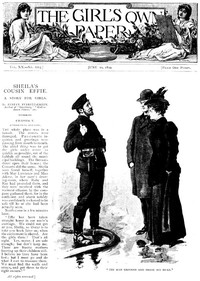
The whole place was in a tumult. The streets were thronged. Passionate inquiries and greetings were passing from mouth to mouth. The chief thing was to get the girls under cover as quickly as possible, out of the hubbub all round the municipal buildings. The Bensons threw open their house; the Cossarts did the same. Sheila soon found herself, together with May Lawrence and Miss Adene, in her aunt’s drawing-room, where Raby and Ray had preceded them, and they were received with the warmest effusion by the company gathered there, for in the confusion and alarm nobody was confidently reckoned to be safe till he or she had been actually seen.
North came in a few minutes later.
“Effie has been taken straight home in our uncle’s carriage. We could not get at you, Sheila, so Oscar is to take you back later on, when the excitement is abated. Are the girls there? That’s all right. Yes, mater, I am safe enough; but don’t keep me. There are frantic mothers hunting up their children still. I believe no lives have been lost; but I must go and do what I can to reassure them. We must find the waifs and strays, and get them to their right owners!”
He kissed his mother and swung himself off; and then a little more quiet fell upon the room, whilst those who had been eye-witnesses of the catastrophe were eagerly called upon to relate their experiences.
Mrs. Cossart had not been at the hall that afternoon, being fatigued by her exertions the two previous days; and her husband, having let all the boys off, had had to keep to the office himself, and only came hurrying home in alarm and consternation when the news reached him that the Town Hall was on fire!
Sheila, listening breathlessly whilst some ladies who had been in the lower hall related their experiences, thought that they had escaped the worst of the terror by being in the upper room. Several of the children’s frocks had caught fire, and it seemed at one time as though the whole place and the hapless people would be in a blaze; but there were plenty of exits, and the police at the doors kept their heads, and passed the children out with great rapidity; and the firemen were on the scene almost at once. The flames got firm hold upon the temporary structures of stalls and so forth, but the building itself never took fire, being of solid stone.
There had been fearful screams, and wild panic; but on the whole the people had behaved exceedingly well, and though there was some inevitable crushing, there had been no actual block, and it was believed that no lives had been lost.
“The only man I saw who behaved really badly,” said one lady, who had evidently been instrumental in saving several children, and whose dress was much burnt in consequence, “was one of the actors from upstairs, who came flying down, and pushed and fought his way out without heeding anything or anybody. He overturned several little children, and one of them would have been trampled to death had not a policeman snatched it up. I was really glad to see another man—a fireman, I believe—give the young man a sound cuff on the side of his head that sent him reeling out into the open. I won’t say that nobody else hustled or pushed—at a time like that one cannot observe everything—but I saw no one else disgrace his manhood in that way.”
“Shameful,” said Mr. Tom sternly. “One of the actors, you say. One ought to be able to find out who it was.”
“He had on a white satin suit—that made him the more conspicuous. I suppose he had completely lost his head. One must not be too hard on people who do that; but one rather hates to see it.”
At that moment the door opened and Cyril came airily in. His cheek was very red, as though from some sort of injury, and his mother sprang forward exclaiming—
“Oh, my boy, did you get burned?”
Cyril put up his hand and laughed.
“Did I? I did not notice. One has not time to think of that sort of thing at such a time. Besides, I was out of it sooner than many. I was afraid the people in the council room, which was the theatre, would be cut off from help. I made a dash for it to get the fire-escape brought round to them at the windows. One could not tell at the outset how fast the fire would spread. I was horribly afraid they would all be suffocated up there, whilst the energies of the rescuers were directed to the larger hall. I’m afraid I was rather unceremonious in my flight, but, at any rate, I accomplished my purpose, and that’s the great thing.”
Sheila and May exchanged quick glances. Was that really Cyril’s motive in making that wild bolt? Certainly it had not been the impression produced upon those who had heard and seen him at the time. His father looked at him steadily, and said—
“I hope you were not the man in white satin, who overturned little children and pushed aside women and girls in his determination to get out. Whatever your motive, nothing could excuse conduct like that.”
Cyril’s face flushed, but he answered airily—
“In such confusion I think nobody can quite say what it is that happens. I am quite willing to bear any odium my townspeople like to put upon me, so long as I know that I was in time to accomplish my errand, and send the escape to the windows where my sisters and cousins were waiting.”
Nobody spoke for a few minutes, and then Raby remarked slowly—
“It was Lionel Benson who went for the escape and brought it.”
“Yes; Lionel came up in time to escort it. I was hardly in the costume for that part of the business. Well, he is quite welcome to the honour and glory. So long as you are all safe, I care for nothing else.”
A carriage presently drew up at the door, and one of May’s brothers came in, saying that the streets were getting quiet, and she could drive back safely now. Miss Adene and May were now the only guests left in the Cossarts’ drawing-room, and they bade a very warm adieu to their entertainers, drawn together by that common bond of sympathy which an experience such as had just been passed through quickly establishes.
“You must come and see us very soon,” said May to Sheila, “and tell us how Effie is. I’m afraid she will feel the shock.”
Sheila kissed her and Miss Adene affectionately, promised to ride over as soon as she could, and soon afterwards started off on foot with Oscar for Cossart Place, he having leave from his uncle to remain there over the Sunday if he were invited.
“For I don’t think any of you will be much good to-morrow,” said he, with a hand on Oscar’s shoulder. “It has been a bit of a shock to us all. Take a day off, and come back like a giant refreshed on Monday. Let us have word of poor little Effie. I hope it won’t throw her into a fever.”
Brother and sister went off contentedly together, and they could not but take a look into the open space round the Town Hall before starting out into the country.
The crowd was still large about it, but it was known now that no serious harm had been done to the building, and that there had been no loss of life, though a few persons had been injured, and many were suffering from the effects of fright and burns.
As they passed by the fire-station they saw the grimy face of the man who had come with the escape, and he, recognising them, put up his hand in salute, and said—
“The young lady none the worse, sir?”
“Not a bit,” answered Sheila, answering for herself; “you came and took us away before there was any real danger. Who was it told you about us up at the windows?”
“Mr. Benson, miss—Mr. Lionel, I should say. We might not have known about it but for him. We thought as everybody had come down and were getting out by the doors.”
“Was it not Mr. Cyril Cossart who first gave the alarm?”
The man grinned and shook his head.
“Bless you, miss, that young gentleman lost his head quite. They say he fought his way out like a madman, and lots of people saw him flying home in his white finery like a cat with a cinder on its back! No, no, missie, it was Mr. Lionel as brought us news of the folks at the windows. We musn’t be too hard on the people as loses their heads at such a time; but we likes better to see them behaving themselves rational like. It was fine the way the ladies in the hall behaved! They thought nothing of themselves, but all was for getting the little ’uns safely out. If they’d gone and lost their heads and made a rush, it would have been a terrible nasty business, and some of ’em had bound to be killed; but what with them behind and the police at the doors, it all went off beautiful, one might say.”
They talked a little more to the man and then went their way.
Sheila’s face wore an indignant flush. She said in a low voice to Oscar—
“I think I could have forgiven him the panic; he mightn’t be able to help that. But to tell that mean lie afterwards! Oh, I can never respect him again.”
Oscar was silent a few minutes, and then said slowly—
“I think, Sheila, that we had better try to forget it, and not to say anything to anybody else about it. It hurts people’s feelings if their next-of-kin are proved unworthy, and Cyril has been thought so much of at home. Perhaps in the confusion nobody will think much more about it. You know it is often the nearest relatives who do not hear the exact truth about a bit of a failure like that. We won’t be the people to talk of it. Our uncle and aunt have been very kind to us. We must remember that, and I think it would be a terrible trouble to Aunt Tom if she were to think——”