Public-domain ebook
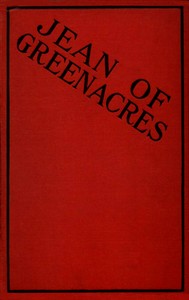
Jean of Greenacres
English414 downloads on Project GutenbergDownload EPUB
Public-domain ebook sourced from Project Gutenberg #60526.
Public-domain ebook
English414 downloads on Project GutenbergDownload EPUB
Public-domain ebook sourced from Project Gutenberg #60526.
The opening · free to read
It was Monday, just five days before Christmas. The little pink express card arrived in the noon mail. The girls knew there must be some deviation from the usual daily mail routine, when the mailman lingered at the white post.
Jean ran down the drive and he greeted her cheerily.
“Something for you folks at the express office, I reckon. If it’s anything hefty you’d better go down and get it today. Looks like we’d have a flurry of snow before nightfall.”
He waited while Jean glanced at the card.
“Know what it is?”
“Why, I don’t believe I do,” she answered, regretfully. “Maybe they’re books for Father.”
“Like enough,” responded Mr. Ricketts, musingly. “I didn’t know. I always feel a little mite interested, you know.”
“Yes, I know,” laughed Jean, as he gathered up his reins and jogged off down the bridge road. She hurried back to the house, her head sideways to the wind. The hall door banged as Kit let her in, her hands floury from baking.
“Why on earth do you stand talking all day to that old gossip? Is there any mail from the west?”
“He only wanted to know about an express bundle; whether it was hefty or light, and where it came from and if we expected it,” Jean replied, piling the mail on the dining-room table. “There is no mail from Saskatoon, sister fair.”
“Well, I only wanted to hear from Honey. He promised me a silver fox skin for Christmas if he could find one.”
Kit’s face was perfectly serious. Honey had asked her before he left Gilead Center just what she would like best, and, truthful as always, Kit had told him a silver fox skin. The other girls had nicknamed it “The Quest of the Silver Fox,” and called Honey a new Jason, but Kit still held firmly to the idea that if there was any such animal floating around, Honey would get it for her.
Jean was engrossed in a five-page letter from one of the girl students at the Academy back in New York where she had studied the previous winter. The sunlight poured through the big semicircular bay window at the south end of the dining-room. Here Doris and Helen maintained the plant stand, a sort of half-moon pyramid, home-made, with rows of potted ferns, geraniums, and begonias on its steps. Helen had fashioned some window boxes too, covered with birchbark and lined with moss, trying to coax some adder’s tongue and trailing ground myrtle, with even some wild miniature pines, like Japanese dwarfs, to stay green.
“It has turned bleak and barren out of doors so suddenly,” said Helen. “One day it was all beautiful yellow and russet and even old rose, but the next, after that heavy frost, it was all dead. I’m glad pines don’t mind frost and cold.”
“Pines are the most optimistic, dearest trees of all,” Kit agreed, opening up an early spring catalogue. “If it wasn’t for the pines and these catalogues to encourage one, I’d want to hunt a woodchuck hole and hiberate.”
“Hibernate,” Jean corrected absently.
Now, one active principle in the Robbins family was interest in each other’s affairs. It was called by various names. Doris said it was “nosing.” Helen called it “petty curiosity.” But Kit came out flatly and said it was based primarily on inherent family affection; that necessarily every twig of a family tree must be intensely and vitally interested in every single thing that affected any sister twig. Accordingly, she deserted her catalogues with their enticing pictures of flowering bulbs, and, leaning over Jean’s chair, demanded to know the cause of her absorption.
“Bab Crane is taking up expression.” Jean turned back to the first page of the letter she had been reading. “She says she never fully realized before that art is only the highest form of expressing your ideals to the world at large.”
“Tell her she’s all wrong.” Kit shook her mop of boyish curls decidedly. “Cousin Roxy told me the other day she believes schools were first invented for the relief of distressed parents just to give them a breathing spell, and not for children at all.”
“Still, if Bab’s hit a new trail of interest, it will make her think she’s really working. Things have come to her so easily, she doesn’t appreciate them. Perhaps she can express herself now.”
“Express herself? For pity’s sake, Jeanie. Tell her to come up here, and we’ll let her express herself all over the place. Oh! Just smell my mince pies this minute. Isn’t cooking an expression of individual art too?” said Kit teasingly as she made a bee line for the oven in time to rescue four mince pies.
“Who’s going to drive down after the Christmas box?” Mrs. Robbins glanced in at the group in the sunlight. “I wish to send an order for groceries too and you’ll want to be back before dark.”
“I’m terribly sorry, Mother dear,” called Kit from the kitchen, “but Sally and some of the girls are coming over and I promised them I’d go after evergreen and Princess pine. We’re gathering it for wreaths and stars to decorate the church.”
“And I promised Father if his magazines came, I’d read to him,” Helen added. “And here they are, so I can’t go.”
“Dorrie and I’ll go. I love the drive.” Jean handed Bab’s letter over to Kit to read, and gave just a bit of a sigh. Not a real one, only a bit of a one. Nobody could possibly have sustained any inward melancholy at Greenacres. There was too much to be done every minute of the day. Kit often said she felt exactly like “Twinkles,” Billie’s gray squirrel, whirling around in its cage.
Still, Bab’s letter did bring back strongly the dear old times last winter at the Art Academy. Perhaps the girl students did take themselves and their aims too seriously, and had been like that prince in Tennyson’s “Princess,” who mistook the shadow for the substance. Yet it had all been wonderfully happy and interesting. Even in the hills of rest, she missed the companionship of girls her own age with the same tastes and interests as herself.
Shad harnessed up Princess and drove around to the side porch steps. It seemed as if he grew taller all the time. When the minister from the little white church had come to call, he had found Shad wrapping up the rose bushes in their winter coats of sacking. Shad stood up, six feet of lanky, overgrown, shy Yankee boy, and shook hands.
“Well, well, Shadrach, son, you’re getting nearer heaven sooner than most of us, aren’t you?” laughed Mr. Peck. And he was. Grew like a weed, Shad himself said, but Doris told him pines grew fast too, and she thought that some day he’d be a Norway spruce which is used for ship-masts.
Mrs. Robbins came out carrying her own warm fur cloak to wrap Doris in, and an extra lap robe.
“Better take the lantern along,” advised Shad, in his slow drawling way. “Looks like snow and it’ll fall dark kind of early.”
He went back to the barn and brought a lantern to tuck in under the seat. Princess, dancing and side stepping in her anxiety to be off, took the road with almost a scamper. Her winter coat was fairly long now, and Doris said she looked like a Shetland pony.
It was seven miles to Nantic, but the girls never tired of the ride. It was so still and dream-like with the early winter silence on the land. They passed only Jim Barlow, driving his yoke of silver gray oxen up from the lumber mill with a load of logs to be turned into railroad ties, and Sally’s father with a load of grain, waving his whipstock in salute to them.
Sally herself was at the “ell” door of the big mill house, scraping out warm cornmeal for her white turkeys. She saluted them too with the wooden spoon.
“I’m going after evergreen as soon as I get my dishes washed up,” she called happily. “Goodbye.”
Along the riverside meadows they saw the two little Peckham boys driving sheep with Shep, their black and white dog, barking madly at the foot of a tall hickory tree.
“Got a red squirrel up there,” called Benny, proudly.
“Sally says they’re making all their Christmas presents themselves,” said Doris, thinking of the large family the mill house nested. “They always do, every year. She says she thinks presents like that are ever so much more loving than those you just go into a store and buy. She’s got them all hidden away in her bureau drawer, and the key’s on a ribbon around her neck.”
“Didn’t we make a lot of things too, pigeon? Birchbark, hand-painted cards, and pine pillows, and sweet fern boxes. Mother says she never enjoyed getting ready for Christmas so much as this year. Wait a minute.” Jean spied some red berries in the thicket overhanging the rail fence.
She handed Doris the reins, and jumping from the carriage, climbed the fence to reach the berries. Down the road came the hum of an automobile, a most unusual sound on Gilead highways. Princess never minded them and Doris turned out easily for the machine to pass.
The driver was Hardy Philips, the store keeper’s son at Nantic. He swung off his cap at sight of Jean. She surely made an attractive picture with the background of white birches against red oak and deep green pine, and over one shoulder the branches of red berries. The two people on the back seat looked back at her, slim and dark as some wood sprite, with her home crocheted red cap and scarf to match, with one end tossed over her shoulder.
The book keeps going
Reading is free forever. Sign up and watch scenes appear while you read.



Scenes Storieta drew for other classics.
New illustrated classics
Once or twice a month: the latest books to get full character casts, scene art, and free comic editions. No account needed.