Public-domain ebook
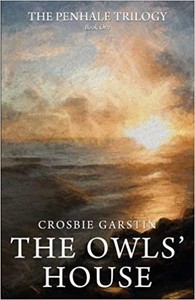
The Owls' House
Language: en437 downloads on Project Gutenberg
Subjects
Public-domain ebook sourced from Project Gutenberg #60528.
Public-domain ebook
Language: en437 downloads on Project Gutenberg
Subjects
Public-domain ebook sourced from Project Gutenberg #60528.
The opening · free to read
It was late evening when John Penhale left the Helston lawyer’s office. A fine drizzle was blowing down Coinage Hall Street; thin beams of light pierced the chinks of house shutters and curtains, barred the blue dusk with misty orange rays, touched the street puddles with alchemic fingers, turning them to gold. A chaise clattered uphill, the horses’ steam hanging round them in a kind of lamp-lit nimbus, the post-boy’s head bent against the rain.
Outside an inn an old soldier with a wooden leg and very drunk stood wailing a street ballad, both eyes shut, impervious to the fact that his audience had long since left him. Penhale turned into “The Angel,” went on straight into the dining-room and sat down in the far corner with the right side of his face to the wall. He did so from habit. A trio of squireens in mud-bespattered riding coats sat near the door and made considerable noise. They had been hare hunting and were rosy with sharp air and hard riding. They greeted every appearance of the ripe serving maid with loud whoops and passed her from arm to arm. She protested and giggled. Opposite them a local shop-keeper was entertaining a creditor from Plymouth to the best bottle the town afforded. The company was made up by a very young ensign of Light Dragoons bound to Winchester to join his regiment for the first time, painfully self-conscious and aloof, in his new scarlet. Penhale beat on the table with his knife. The maid escaped from the festive sportsmen and brought him a plate of boiled beef and onions. As she was about to set the plate before him one of the hare hunters lost his balance and fell to the ground with a loud crash of his chair and a yell of delight from his companions.
The noise caused Penhale to turn his head. The girl emitted an “ach” of horror, dropped the plate on the table and recoiled as though some one had struck her. Penhale pulled the plate towards him, picked up his knife and fork and quietly began to eat. He was quite used to these displays. The girl backed away, staring in a sort of dreadful fascination. A squireen caught at her wrist calling her his “sweet slut,” but she wrenched herself free and ran out of the door.
She did not come near Penhale again; the tapster brought him the rest of his meal. Penhale went on eating, outwardly unmoved; he had been subject to these outbursts, off and on, for eighteen years.
Eighteen years previously myriads of birds had been driven south by the hard winter upcountry. One early morning, after a particularly bitter snap, a hind had run in to say that the pond on Polmenna Downs, above the farm, was covered with wild duck. Penhale took an old flintlock fowling piece of his father’s which had been hanging neglected over the fireplace for years, and made for Polmenna, loading as he went.
As the hind had said, the pool was covered with duck. Penhale crouched under cover of some willows, brought the five-foot gun to his shoulder, and blazed into the brown.
An hour later a fisherman setting rabbit snares in a hedge above the Luddra saw what he described as “a red man” fighting through the scrub and bramble that fringed the cliff. It was John Penhale; the gun had exploded, blowing half his face away. Penhale had no intention of throwing himself over the Luddra, he was blind with blood and pain. The fisherman led him home with difficulty, and then, being of a practical mind, returned to the pond to pick up the duck.
An old crone who had the reputation of being a “white witch” was summoned to Bosula and managed to stop the bleeding by means of incantations, cobwebs and dung—principally dung. The hind was sent on horseback to Penzance to fetch Doctor Spargo.
Doctor Spargo had been making a night of it with his friend the Collector of Customs and a stray ship captain who was peculiarly gifted in the brewing of rum toddies. The doctor was put to bed at dawn by his household staff, and when he was knocked up again at eleven he was not the best pleased. He bade his housekeeper tell the Bosula messenger that he was out—called out to a confinement in Morvah parish and was not expected back till evening—and turned over on his pillow.
The housekeeper returned, agitated, to say that the messenger refused to move. He knew the doctor was in, he said; the groom had told him so. Furthermore if Spargo did not come to his master’s assistance without further ado he would smash every bone in his body. Doctor Spargo rolled out of bed, and opening the window treated the messenger to samples from a vocabulary enriched by a decade of army life. The messenger listened to the tirade unmoved and, as Doctor Spargo cursed, it was borne in on him that he had seen this outrageous fellow before. Presently he remembered when; he had seen him at Gwithian Feast, a canvas jacket on, tossing parish stalwarts as a terrier tosses rats. The messenger was Bohenna, the wrestler. Doctor Spargo closed both the tirade and the window abruptly and bawled for his boots.
The pair rode westwards, the truculent hind cantering on the heels of the physician’s cob, laying into it with an ash plant whenever it showed symptoms of flagging. The cob tripped over a stone in Bucca’s Pass and shied at a goat near Trewoofe, on each occasion putting its master neatly over its head. By the time Spargo arrived at Bosula he was shaking worse than ever. He demanded more rum to steady his hand, but there was none. He pulled himself together as best he could and set to work, trembling and wheezing.
Spargo was a retired army surgeon; he had served his apprenticeship in the shambles of Oudenarde and Malplaquet among soldiers who had no option but to submit to his ministrations. His idea was to patch men up so that they might fight another day, but without regard to their appearance. He sewed the tatters of John Penhale’s face together securely but roughly, pocketed his fee and rode home, gasping, to his toddies.
John Penhale was of fine frame and hearty. In a week or two he was out and about; in a month he had resumed the full business of the farm, but his face was not a pleasant sight. The left side was merely marked with a silvery burn on the cheek bone, but the right might have been dragged by a harrow; it was ragged scars from brow to chin. The eye had gone and part of an ear, the broken jaw had set concave and his cheek had split into a long harelip, revealing a perpetual snarl of teeth underneath. He hid the eye socket with a black patch, but the lower part of his face he could not mask.
Three months after his accident he rode into Penzance market. If one woman squeaked at the sight of him so did a dozen, and children ran to their mothers blubbering that the devil had come for them. Even the men, though sympathetic, would not look him in the face, but stared at their boots while they talked and were plainly relieved when he moved away. John never went in again, unless driven by the direst necessity, and then hurried out the moment his affairs were transacted. For despite his bulk and stoic bearing he was supersensitive, and the horror his appearance awoke cut him to the raw. Thus at the age of twenty-three he became a bitter recluse, a prisoner within the bounds of his farm, Bosula, cared for by a widow and her idiot daughter, mixing only with his few hinds and odd farmers and fishermen that chance drove his way.
He had come to Helston on business, to hear the terms of his Aunt Selina’s will, and now that he had heard them he was eager to be quit of the place. The serving girl’s behavior had stung him like a whip lash and the brawling of the drunken squires jarred on his every nerve. He could have tossed the three of them out of the window if he liked, but he quailed at the thought of their possible mockery. They put their heads together and whispered, hiccoughing and sniggering. They were, as a fact, planning a descent on a certain lady in Pigs Street, but John Penhale was convinced that they were laughing at him. The baby ensign had a derisive curl in his lip, John was sure . . . he could feel the two shop-keepers’ eyes turned his way . . . it was unbearable.
Sneers, jeers, laughter . . . he hated them all, everybody. He would get out, go home to Bosula, to sanctuary. He had a sudden longing for Bosula, still and lonely among the folding hills . . . his own place. He drank off his ale, paid the score and went out to see what the weather was like.
The wind had chopped around easterly and the rain had stopped. The moon was up breasting through flying ridges of cloud like a naked white swimmer in the run of surf. Penhale found an ostler asleep on a pile of straw, roused him and told him to saddle his horse, mounted and rode westwards out of town.
He passed a lone pedestrian near Antron and a string of pack horses under Breage Church, but for the rest he had the road to himself. He ambled gently, considering the terms of his aunt’s will. She had left him her strong farm of Tregors, in the Kerrier Hundred, lock, stock and barrel, on the one condition that he married within twelve months. In default of his marrying it was to pass to her late husband’s cousin, Carveth Donnithorne, ship chandler of Falmouth.
John Penhale paid silent tribute to his aunt’s cleverness. She disliked the smug and infallible Donnithorne intensely, and in making him her next heir had passed over four nearer connections with whom she was on good terms. Her reasons for this curious conduct were that she was a Penhale by birth with intense family pride and John was the last of her line. A trivial dispute between John and Carveth over a coursing match she had fostered with all the cunning that was in her till the men’s dislike of each other amounted to plain hatred. She knew John would do anything in his power to keep Donnithorne out of the Tregors’ rents. She would drive him into matrimony, and then, with reasonable luck, the line would go on and Penhales rule at Bosula forever and ever.
John laughed grimly at the thought of his aunt—sly old devil! She had married and left home before he was born, and he had not seen her a score of times in his life, but she was a vivid memory. He could see her now riding into Bosula, a-pillion behind one of her farm hands, her cold blue eyes taking in every detail of the yard, and hear her first words of greeting to her brother after a year’s separation.
“Jan, thou mazed fool, the trash wants cutting back down to Long meadow, and there’s a cow coughing—bring her in to once and I’ll physick her.”
The cow came in at once; everybody obeyed Selina without question or delay both at Bosula and Tregors. Her husband, Jabez Donnithorne, was the merest cipher whose existence she barely acknowledged.
On one occasion Jabez, returning very drunk from Helston market, having neglected to buy the heifers he was sent after, Selina personally chastised him with a broom handle and bolted him in the pig-sty for the night, where he was overlaid by a sow and suffered many indignities. That cured Jabez.
Selina never stopped long at Bosula—three days at the most—but in that time she would have inspected the place from bound to bound, set everybody to rights, and dictated the policy of the farm for twelve months to come. As she had ruled her brother in boyhood she ruled him to the day of his death. She was fond of him, but only because he was head of the family. His wife she looked on merely as a machine for producing male Penhales. She would see to it that on her death Tregors fell to her family, and then, doubly endowed, the Penhales of Bosula would be squires and gentlefolk in the land.
The book keeps going
Reading is free forever. Sign up and watch scenes appear while you read.



Scenes Storieta drew for other classics.
New illustrated classics
Once or twice a month: the latest books to get full character casts, scene art, and free comic editions. No account needed.