Public-domain ebook
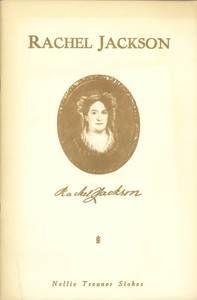
Rachel Jackson
Language: en242 downloads on Project Gutenberg
Subjects
In: Biographies·History - American
Public-domain ebook sourced from Project Gutenberg #60853.
Public-domain ebook
Language: en242 downloads on Project Gutenberg
Subjects
In: Biographies·History - American
Public-domain ebook sourced from Project Gutenberg #60853.
The opening · free to read
Rachel Jackson was born at the Virginia home of her parents in June, 1767. Thus her distinguished husband preceded her into the world by only a few months in the same year. She was the tenth child and fourth daughter of Col. John Donelson and Rachel Stockley, his wife. She was given the name of her mother. There was another son born after Rachel, making four daughters and seven sons, eleven children in all.
Rachel’s parentage was not only substantial but also distinguished. On the paternal side she was the granddaughter of Catherine Davies who was the sister of Rev. Samuel Davies, the eminent Presbyterian Minister who succeeded Jonathan Edwards as President of Princeton University. “Her mother,” quoting from Mary French Caldwell, “came from Accomac County on the Eastern shore of Virginia and the story of her people goes back to the earliest days of the colony.”
For thirty-five years the family of Rachel lived on the Bannister River in Pittsylvania County, Virginia. Col. Donelson was a surveyor, the owner and master of a large plantation, and the owner of an iron furnace in the vicinity. He was a vestryman in the Church, and an important member of the Virginia House of Burgesses, Where he held membership in the Trade Committee which dealt with many of the serious and delicate questions of the day between the Colony and the Mother Country. He helped frame and sign the “treasonable protest” adopted in adjourned sessions following dissolution of the Burgesses by order of the Crown. By doing so he may have placed his liberty in jeopardy in the event of a British victory in the subsequent war for independence, in which he served with modest distinction. But most noteworthy was his service by appointment of the Governor, Lord Botetourt, to assist John Stuart in negotiating the treaty of Lochaber with the Cherokee Indians. The report of his superior contains the following reference: “... I arrived here (Lochaber) the 15th where I found the Cherokee Chiefs with their followers ... about a thousand in number.... I had also the pleasure of finding Col. Donelson here; he was exactly punctual to the time appointed.... I beg leave to return to your Lordship my most sincere thanks for having sent a gentleman of Col. Donelson’s Discernment and Probity to assist me.... I beg leave to refer your Lordship to him in every particular....” William Nelson, temporary successor to Lord Botetourt, deceased, wrote to the Crown: “I have by the advice of the Council appointed Col. Donelson to execute the running of the line in May next, as I think he may be confided in....”
The assignment referred to is significant in the development of the epic story of Rachel because it gave to her father an intimate view of and an undying interest in the great undeveloped country lying to the Westward. Mrs. Caldwell has well said: “He had formally accepted the commission to run the line specified in the Treaty of Lochaber and he went out, not as a nomadic hunter or adventurer, but as the official representative of the British Government. He was a man of fifty-two years, mature in judgment and experience and clothed with the authority which his fortune and prominence in colonial affairs had given him....”
We may fairly conclude that it is not surprising that with such parentage and amid the pleasant surroundings of the Bannister plantation Rachel grew in education and understanding far beyond the average for the young women of her day. Many were the advantages afforded her.
When Rachel was born some of the older brothers and sisters were already married. There were slaves to tend the crops, and cloth was woven on the place from cotton and wool grown there. It was a busy, self contained, happy household. So it is not remarkable that the baby Rachel was a happy and contented little girl, racing her pony over the hills with her brothers, and hearing stories from an adoring father of the pomp and circumstance of life at the seat of the government, as well as thrilling tales of the Cherokees. Her mother saw to it that this youngest daughter was taught her lessons of reading and writing, as well as to cook, spin, weave and sew a fine seam, so that when she had a house of her own she could train her servants in the way they should go. An authority says: “She was proficient in the household arts, she played the harpsichord, she danced, was an accomplished horsewoman, and was trained in the little courtesies and graces of life....” She was bright and quick to learn and beautiful to look upon. It did seem that this united household should have lived on there by the smooth flowing Bannister.
Perhaps the prospect of more room for the ever growing family, and a first hand knowledge of the beauty and richness to be found farther west tempted Col. Donelson and his sons and daughters, some of whom had families of their own, to risk leaving Virginia and move out to what is now Tennessee.
In 1779 Captain James Robertson set out to establish a colony on the banks of the Cumberland at Fort Nashboro, then a part of North Carolina. His friend, Col. John Donelson of Virginia, was asked to bring the families of those venturesome men who had cast their lot with his. He accepted this great responsibility. They were to travel two thousand almost unknown miles by water, as that mode of travel was deemed safer than overland through the forests and over the mountains where only a path marked the way, an impossible task for wagons and women and children. Even so the chosen route was beset with savages, as well as all manner of hindrances to be overcome.
This band of pioneers planned to start the journey after the crops were “laid by” in the autumn, and for that purpose they were assembled in a commodious block house on the banks of the Holston River; but there had been a drouth and the water was not high enough to float the boats which were ready and waiting. In early November a terrible freeze took place. These and other factors delayed the departure until just before Christmas. Finally on December twenty-second, 1779, with all families aboard and well provisioned, they set sail. “The Good Ship Adventure” bearing the Donelsons and Mrs. Robertson and family led the way. Other boats followed, each with one or more families aboard protected by a complement of able men to come to the rescue in case of attack.
Thus the twelve-year-old Rachel turned her youthful face toward the land of promise in the setting sun, happily unaware of the web of romance and love, lonely tears and poignant grief, which the unseen hand of fate would weave for her there. But for the present there was only the priceless zest of a trip into the unknown, laden with hope of high adventure. Her stout hearted father was by her side, so she knew no evil could befall her. We may be sure she was a busy little girl, and that her talents and sprightly bearing added greatly to the happiness and morale of the company.
The winter was one of unusual severity. Progress was difficult. They had sometimes to land and wait for the frozen waters to thaw; there were rapids and water falls to conquer; and after a while terrible floods and swift currents laden with trees and drift wood to be avoided. Sickness and attacks by the Indians, who were armed with rifles as well as bow and arrows, beset them; food was scarce because much of the wild life had suffered that winter, and the game which was found was too starved to be of good quality. Even smallpox developed on one of the boats. Among such difficulties it was inevitable that examples of great heroism would arise.
Witness the stoic fortitude of Nancy Gower. She was wounded while steering her boat when the Indians attacked from both river banks. Although she bled profusely she remained at her post of duty; and not until the party was beyond the reach of the savages did her companions know that she was wounded. In that sort of stern school did the child Rachel learn fortitude in bearing the uses of adversity.
After four months of hardship mingled with bright intervals of sunshine the Donelson party arrived on the twenty-fourth of April at the “Big Salt Lick” near the small settlement of log houses surrounded by a stockade which was called Fort Nashboro, and which is now Nashville.
Captain James Robertson with other heads of families had gone through the country on horseback, and preceded the boat party in time to build cabins for the expected families. Picture the meeting when the boats arrived and families were reunited; imagine the joy of Rachel at reaching the end of a long, tired journey and exploring a new home in a strange and beautiful land. Even now she did not dream that already the invisible figure of history held her firmly by the hand.
Here Col. Donelson prospered; accumulated acres, negroes, cattle and horses. Rachel grew into a beautiful and spirited young woman. On one of her father’s trips to Kentucky she was allowed to go with him. It chanced that they went to Harrodsburg, where she met Lewis Robards, the handsome son of one of the leading families. A courtship ensued, and he asked her to be his wife. She had other suitors but none so fascinating as this young man. Her father approved the marriage and after a while he went home alone, leaving Rachel with her husband there at his mother’s house in Harrodsburg. There was every reason why they should have prospered in their love together, but Lewis Robards proved to be of an insanely jealous disposition. In the very unpleasant scenes to which the jealousy of Robards subjected Rachel, her part was taken by all the members of the Robards household. She was then only eighteen. Her brother, Samuel, was despatched to bring her home, which he did much to the regret of Mrs. Robards who held a deep affection for Rachel and who never at any time blamed her for the son’s fiery outbursts. No sooner had she gone than Robards wanted her back again and made all manner of promises to persuade her to return.
While Rachel suffered this sorrow her father was killed mysteriously in the woods, and her presence at home was a bulwark to the bereaved family. But this was not for long.
John Overton, a young law student who resided in Mrs. Robards’ Kentucky home, planned to come to Tennessee to open a law office. He was prevailed upon to try to bring about a reconciliation. When he arrived in Nashville he took a room at Mrs. Donelson’s and was successful in persuading Rachel to make a new trial with Robards. In due time Robards arrived and was welcomed by the entire family. It was not long, though, before jealousy again manifested itself. This time it was Andrew Jackson of whom he was jealous.
Jackson had come out from North Carolina with a commission to be prosecuting attorney for the Mero District. He, with Mr. Overton, occupied one of the smaller cabins at Mrs. Donelson’s. The unpleasant scenes to which Rachel was subjected by her husband’s jealousy roused a just indignation in the breast of the young prosecuting attorney. Mr. Overton suggested that they move their boarding place, which they did, going to Manskers, near the boundary between Davidson and Sumner Counties. This also was a group of log houses close together for common protection. But Robards was still very unhappy, and finally he decided to go back to Kentucky, much to the relief of all. Jackson did not move back to the Donelson home but continued to live at Manskers. He had the highest ideals of womanhood, and he did not wish for any act on his part to cast the slightest shadow on the bereft Rachel.
The book keeps going
Reading is free forever. Sign up and watch scenes appear while you read.



Scenes Storieta drew for other classics.
New illustrated classics
Once or twice a month: the latest books to get full character casts, scene art, and free comic editions. No account needed.