Public-domain ebook
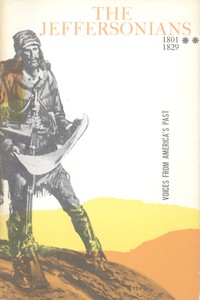
The Jeffersonians, 1801-1829
Language: en347 downloads on Project Gutenberg
Subjects
In: History - American·History - Modern (1750+)·History - Royalty
Public-domain ebook sourced from Project Gutenberg #60854.
Public-domain ebook
Language: en347 downloads on Project Gutenberg
Subjects
In: History - American·History - Modern (1750+)·History - Royalty
Public-domain ebook sourced from Project Gutenberg #60854.
The opening · free to read
The early part of the last century was an exciting time to live in America. The signers of the Declaration of Independence and the framers of the Constitution, mostly old men by now, saw that their experiment in republican government had turned out to be a success. The nation was flourishing in these years like a healthy adolescent. There were growing pains, to be sure, but no one doubted now that the youngster would reach manhood. The question was: What is he going to be like?
The party battles of John Adams’ administration left the Federalist Party in ruins, and Thomas Jefferson succeeded to the presidency with an overwhelming popular mandate. During his first term, Jefferson increased his popularity through buying from France the enormous Louisiana Territory which doubled the size of the United States. By the time the Lewis and Clark Expedition returned from exploring the new land, people began to realize the immense possibilities that the Louisiana Purchase held for the future of the United States.
Jefferson’s second term was beset by foreign problems that culminated eventually in the War of 1812, during James Madison’s administration. Despite George Washington’s advice in his Farewell Address to stay out of entangling foreign alliances, America could not avoid being affected by events abroad. She was caught between the hammer and the anvil during Napoleon’s wars with the rest of Europe. The War of 1812 settled no issues but, soon afterward, the main Anglo-American problems left over from the Revolution were adjusted. Napoleon’s downfall at Waterloo removed France as an obstacle to American development.
The period known as the “Era of Good Feeling” followed the War of 1812. During the two terms of James Monroe, internal matters were the main concern of the country: tariffs, banking, domestic improvements, the admission of new states into the Union. With the Monroe Doctrine, which warned Europe to respect the independence of Latin America, the United States began to emerge as a power in the world. Even more important was the appearance of storm warnings heralding the eventual coming of the Civil War. The Missouri Compromise, which drew a line between slave and free territory, established an uneasy truce between the North and the South.
By the time John Quincy Adams became the sixth President, sectionalism was rapidly developing, and the balance of power between the East and the West, the industrial North and the agricultural South, was beginning to shift. The two-party system, which had largely disappeared with the collapse of the Federalists in 1800, was revived. In 1828 the long monopoly that Virginia and Massachusetts had enjoyed in supplying American Presidents came to an end with the election of Andrew Jackson of Tennessee and a new era began.
The selections in this booklet reflect most of the significant events of these years from 1801 to 1829. The Louisiana Purchase, the Lewis and Clark Expedition, the War of 1812, the Missouri Compromise, all are represented. In addition we have included accounts of some small events and background descriptions which give the flavor of the age. A proper notion of this period requires not only a knowledge of the major issues, such as understanding the Embargo Act or the significance of the Marbury vs. Madison decision, but also an appreciation of the quality of the experience of being an American in the first quarter of the nineteenth century. Hence we have used such documents as Lorenzo Dow’s diary describing the life of a frontier preacher and Morris Birkbeck’s account of settling in Illinois.
In editing the manuscripts in this booklet, we have followed the practice of modernizing punctuation, capitalization, and spelling only when necessary to make the selections clear. We have silently corrected misspelled words and typographical errors. Wherever possible we have used complete selections, but occasionally space limitations have made necessary cuts in the original documents. Such cuts are indicated by spaced periods. In general, the selections appear as the authors wrote them.
On election day in 1800, Thomas Jefferson won a clear victory over John Adams but almost did not became President. The Constitution required that presidential electors cast two ballots; the winner became President and the runner-up became Vice-President. Jefferson’s running mate, Aaron Burr, who had been nominated for Vice-President, received 73 electoral votes, the same number as Jefferson. This strange situation occurred because the Constitutional Convention had not anticipated the rise of party politics. When John Adams had defeated Jefferson in 1796, Jefferson, as the runner-up, was elected Vice-President. If parties had not developed by 1800, Adams, as Jefferson’s opponent, would surely have become Vice-President. But because parties had arisen, all of Jefferson’s electors gave Burr their second vote. (A repetition of this kind of deadlock was avoided for future elections by the Twelfth Amendment.)
The Constitution stated that if the two leading candidates were tied, the election should be decided by the House of Representatives. The trouble was that in 1800 the House was controlled by the Federalists and not by Jefferson’s party. The Federalists nearly elected Burr President because they disliked him less than they disliked Jefferson.
Margaret Bayard Smith Describes the Election and Inauguration
Fortunately for the country, Federalist Alexander Hamilton, who knew Burr was unfit to be President, opposed his party’s plan to defeat Jefferson. But while this crucial decision was being made, the nation waited breathlessly. The excitement in Washington is recorded in the following selection from the notebook of Margaret Bayard Smith, wife of the editor of the National Intelligencer.
It was an awful crisis. The people, who with such an overwhelming majority had declared their will, would never peaceably have allowed the man of their choice to be set aside and the individual they had chosen as Vice-President to be put in his place. A civil war must have taken place, to be terminated in all human probability by a rupture of the Union. Such consequences were at least calculated on and excited a deep and inflammatory interest. Crowds of anxious spirits from the adjacent county and cities thronged to the seat of government and hung like a thunder cloud over the Capitol, their indignation ready to burst on any individual who might be designated as President in opposition to the people’s known choice. The citizens of Baltimore, who from their proximity were the first apprised of this daring design, were with difficulty restrained from rushing on with an armed force, to prevent—or if they could not prevent, to avenge this violation of the people’s will and in their own vehement language to hurl the usurper from his seat.
Mr. Jefferson, then President of the Senate, sitting in the midst of these conspirators, as they were then called, unavoidably hearing their loudly whispered designs, witnessing their gloomy and restless machinations, aware of the dreadful consequences which must follow their meditated designs, preserved through this trying period the most unclouded serenity, the most perfect equanimity. A spectator who watched his countenance would never have surmised that he had any personal interest in the impending event. Calm and self-possessed, he retained his seat in the midst of the angry and stormy, though half-smothered passions that were struggling around him, and by this dignified tranquility repressed any open violence. Though insufficient to prevent whispered menaces and insults, to these, however, he turned a deaf ear and resolutely maintained a placidity which baffled the designs of his enemies.
The crisis was at hand. The two bodies of Congress met, the Senators as witnesses, the Representatives as electors. The question on which hung peace or war, nay, the union of the states was to be decided. What an awful responsibility was attached to every vote given on that occasion. The sitting was held with closed doors. It lasted the whole day, the whole night. Not an individual left that solemn assembly; the necessary refreshment they required was taken in rooms adjoining the Hall. They were not like the Roman conclave legally and forcibly confined; the restriction was self-imposed from the deep-felt necessity of avoiding any extrinsic or external influence. Beds, as well as food, were sent for the accommodation of those whom age or debility disabled from enduring such a long-protracted sitting. The balloting took place every hour—in the interval men ate, drank, slept or pondered over the result of the last ballot, compared ideas and persuasions to change votes, or gloomily anticipated the consequences, let the result be what it would.
With what an intense interest did every individual watch each successive examination of the ballot-box; how breathlessly did they listen to the counting of the votes! Every hour a messenger brought to the editor of the National Intelligencer the result of the ballot. That night I never lay down or closed my eyes. As the hour drew near its close, my heart would almost audibly beat, and I was seized with a tremour that almost disabled me from opening the door for the expected messenger....
For more than thirty hours the struggle was maintained, but finding the Republican phalanx impenetrable, not to be shaken in their purpose, every effort proving unavailing, the Senator from Delaware [_James A. Bayard—actually a Representative_], the withdrawal of whose vote would determine the issue, took his part, gave up his party, for his country, and threw into the box a blank ballot, thus leaving to the Republicans a majority. Mr. Jefferson was declared duly elected. The assembled crowds, without the Capitol, rent the air with their acclamations and gratulations, and the conspirators, as they were called, hurried to their lodgings under strong apprehensions of suffering from the just indignation of their fellow citizens.
The dark and threatening cloud which had hung over the political horizon rolled harmlessly away, and the sunshine of prosperity and gladness broke forth and ever since, with the exception of a few passing clouds, has continued to shine on our happy country.
As the author of the Declaration of Independence and many memorable state papers, Thomas Jefferson was, with Abraham Lincoln, one of our two greatest presidential writers. The following speech, which he delivered on March 4, 1801, is an eloquent statement of democratic principles. Jefferson approached the office of President with humility and a conciliatory attitude towards his opponents. The simplicity and directness of his prose contrast greatly with the flowery and lengthy eloquence of most speakers in his day.
Called upon to undertake the duties of the first executive office of our country, I avail myself of the presence of that portion of my fellow citizens which is here assembled to express my grateful thanks for the favor with which they have been pleased to look towards me, to declare a sincere consciousness that the task is above my talents and that I approach it with those anxious and awful presentiments which the greatness of the charge and the weakness of my powers so justly inspire.
The book keeps going
Reading is free forever. Sign up and watch scenes appear while you read.



Scenes Storieta drew for other classics.
New illustrated classics
Once or twice a month: the latest books to get full character casts, scene art, and free comic editions. No account needed.