Public-domain ebook
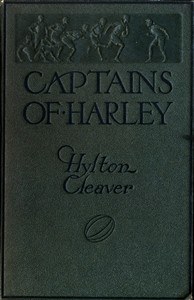
Captains of Harley: A School Story
Language: en340 downloads on Project Gutenberg
Subjects
In: Children & Young Adult Reading·Novels·British Literature
Public-domain ebook sourced from Project Gutenberg #60926.
Public-domain ebook
Language: en340 downloads on Project Gutenberg
Subjects
In: Children & Young Adult Reading·Novels·British Literature
Public-domain ebook sourced from Project Gutenberg #60926.
The opening · free to read
A wiry, grave-faced youngster sat in the corner of the railway carriage watching a stupid parent saying good-bye to a stupid boy.
He was glad that nobody had come to see him off, for he had now the satisfaction of knowing that his own father was a father more worth having than any other he had seen yet. Also he could look upon the pitiable scene now being enacted before him from the standpoint of one who at least could be trusted to get into the right carriage without leaping out by the other door to see if it were really labelled “Harley” on both sides. This fat boy had done that, and afterwards he had sat down very heavily on a packet of sandwiches and was unaware of it. The boy in the corner wondered if they would be sticking to him when he stood up. As for the parent of the fat boy, he stood outside looking nervously towards the engine, and his raincoat, which was unbuttoned, blew this way and that in the breeze; once it had somewhat foolishly knocked some buns off a push-cart. He wore a hat poised far forward over his nose, and he had flat feet.
Whilst the boy in the corner sat watching with thoughtful eyes, the man broke suddenly into a rapid clog dance and beckoned to his son. Above the rat-a-tat of his feet upon the platform could be heard his voice plaintively upraised:
“Arthur! Arthur! Come here! Jump out as quickly as you possibly can. I have something to say to you.”
Arthur took just one glad leap into the open, landing upon his father’s foot. Then, clapping his ear against his father’s lips, he listened with a coy interest to his urgent whispers, until he was suddenly gripped by the elbow and spun upon his heel.
“Get in at once, my boy, get in at once!” his parent was commanding. “At once, I say. The train is about to go. Get in quickly ... quickly.”
Arthur fell in head-first, and arrived limply half on the seat and half on the floor. Then he slowly clawed his way on to the cushions and subsided. But now once again there sounded that terrible parent’s staccato voice. The unhappy boy was hooked by the arm with an umbrella.
“It is not going yet after all,” he was told. “Come out again. Come out for a moment. I have something to say to you.”
The wiry boy in the corner began to feel sorry for Arthur: he was perspiring so very freely. However, there followed confidence after confidence until, finally and for the last time, the father threw his son bodily into the carriage like a sack of potatoes.
The blast of a whistle had reached his expectant ears.
“Get in! Get in!” he was crying. “For goodness’ sake do get in! What a foolish boy you are. You will certainly miss the train. Be sure to write. Good-bye ... good-bye ... good-bye!”
Then the train was really moving out of the station at last. Numberless boys in Harley caps were scrambling into carriages, and as the little man with the goatee beard gave one final wave of his glove to his departing son, two young men cannoned into him from behind, and his hat flew violently forwards and outwards, causing him to make a somewhat ludicrous exit from the boy in the corner’s field of view. Next the foremost of his assailants had sprung for the carriage door and they had tumbled in.
One of the two seemed a little embarrassed at the diversion they had caused, and sat down modestly in a corner. The other wiped his forehead, and then turned and beheld Arthur with both interest and delight.
The portly Arthur was sitting stiffly upright and staring at his ticket with wide protuberant eyes, the while he trembled like unto one smitten with ague. He looked up at the boy in the corner and gaped. He tried to speak. Words failed him. At last a low moan escaped his lips.
“My ticket! My ticket! Father has taken it away with him and he—” he paused and collected himself for a bellow of despair—“he has given me his own return ticket to Ealing!”
The boy in the corner looked at him as if one might have expected something like this would have occurred after all that palaver, and the brief silence that followed his sensational news was only broken by a peculiar grunt that would not be stifled. Then up spoke one of the late arrivals. Both were evidently boys of some seniority and wore bowler hats. The one who spoke now had a lean and humorous countenance lit by strangely bright eyes.
“Nick,” said he to his companion, “look out of the window. Do you see anyone coming?”
The young gentleman addressed as Nick was beaming thoughtfully as if to himself, and he did not at once obey.
“I will look myself,” said the other, rising impatiently and leaning far out. “Yes, I can see a cloud of dust. Right in the middle of it there is the figure of a man bounding along the road at such a break-neck speed that his feet are scarcely touching the ground at all. It appears,” he added, turning to Arthur, “to be your sportsmanlike father.” He coughed. “His chances of catching us are somewhat small, of course. The train is now going at full speed. Your father is certainly making a very fine effort indeed ... his movements are not unlike those of a good-class cat ... but he will, I fear, be outdistanced by the puff-puff. Your father——”
The fat boy could stand this no longer. He pushed his head fiercely out of the window under the other’s arm.
“Where?” he demanded. “Where’s my father?” He looked harder still. “Why,” said he, “we’re only just out of the station. There’s no cloud of dust at all.”
“No,” confessed the other. “Now that I come to look with my other eye I must admit that I do not see it so clearly myself. Still there might have been. It is a pretty picture to conjure up—your father absolutely running himself to a standstill to get back his ticket to Ealing.”
After this there was silence for a little while. The bright-eyed youth resumed his seat and appeared to be thinking things over. He threw his bowler on to the rack and passed a hand thoughtfully over his hair.
At last he leaned forward, resting his elbows upon his knees, and faced Arthur.
Then he inclined his head sideways towards his fair-haired comrade.
“That robust-looking fellow over there is known as Terence Nicholson,” said he, weighing his words. “He has been three years in the Harley Cricket Eleven, and now he’s in the Rugger side, so be careful what you say. His brother’s called ‘Old Nick,’ and he’s a master at school. Very likely you’ll see him walking along the footboards on his hands if you look outside. My own name,” he paused, in order to give added emphasis to the noble word, “is Rouse.”
He did not care to introduce himself as the probable captain of Rugby football during the coming term, for Rouse was not conceited about the things that he could do. Oddly enough he was only conceited about the things that he could not.
“A beak called Mould,” he announced, “once told me when I was construing Latin that I had a very inventive brain.” He tapped his forehead significantly. “He was entirely correct. You see in me a man who thinks for exercise rather than for profit, and it will comfort you to know that I have already devised a way of escape for you in your astounding dilemma. I ask myself: ‘Now how is this poor misguided creature ever going to pass through the iron barriers of Harley with only a silly little ticket to Ealing in his hand?’ And the answer is this: ‘I will ask him to give that ticket to me.’”
The fat boy reached out a trembling hand and gave over his ticket somewhat fearfully.
Rouse took it and solemnly tore it into a hundred pieces. The fat boy screamed.
“Oh, you’ve spoilt it!”
“Certainly,” admitted Rouse, “it is a trifle bent. But why? Because now nobody knows whether it is a ticket to Harley or the Federated Malay States. Will they, however, suppose that you would be such an ass as to buy a ticket to Ealing when you intended proceeding to Harley? I think not. You have to give up your ticket at the other end, and you’ll give it up, that’s all. It will be in pieces, but there’s no law against that. The warden at the gate will say: ‘Hi, here you! What’s this?’ and you’ll say: ‘That, sir, is my ticket,’ and you’ll pour it generously into his open hands. He’ll never know. He’ll think it’s a practical joke, scowl at you, and pass you through with the toe of his boot.”
There was an awed silence. Rouse was well satisfied with the effect of his words. Suddenly however there spoke up Terence Nicholson from his corner. It was the first time that he had been able to get a word in and he spoke modestly.
“Yes,” said he, “that’s all very well; only the ticket to Harley is green and his ticket to Ealing’s red. That’s all.”
There came a silence of several moments, whilst those present considered this point with new interest, and at last Terence shook his head regretfully.
“There’s always something wrong with your schemes,” said he. “You don’t grow any older. You don’t improve a bit.”
And thereupon there came a rush of air and a roar and the train had entered a tunnel. The light spluttered hopefully for a moment and then died a natural death. They were plunged into darkness.
At last the melancholy voice of Rouse was again uplifted in a sonorous protest that came heavily through the darkness as if in pleading:
“Well, you’re always very clever at picking holes,” said he. “In common with the rest of Harley’s populace you cherish that silly notion that except for a certain knack in playing footer I am one of the most useless and incapable creatures ever built. Let me hear you make a suggestion, my lad.”
“Well, if you ask me,” said Terence, “I should say, let him tell the truth.”
The book keeps going
Reading is free forever. Sign up and watch scenes appear while you read.



Scenes Storieta drew for other classics.
New illustrated classics
Once or twice a month: the latest books to get full character casts, scene art, and free comic editions. No account needed.