Public-domain ebook
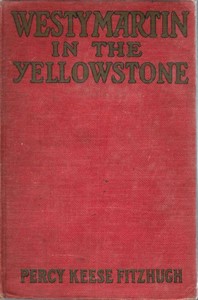
Westy Martin in the Yellowstone
Language: en361 downloads on Project Gutenberg
Subjects
In: Children & Young Adult Reading·Adventure·Novels
Public-domain ebook sourced from Project Gutenberg #61114.
Public-domain ebook
Language: en361 downloads on Project Gutenberg
Subjects
In: Children & Young Adult Reading·Adventure·Novels
Public-domain ebook sourced from Project Gutenberg #61114.
The opening · free to read
When Westy Martin and his two companions, Warde Hollister and Ed Carlyle, were on their long journey to the Yellowstone National Park, they derived much amusement from talking with a man whose acquaintance they made on the train.
This entertaining and rather puzzling stranger caused the boys much perplexity and they tried among themselves to determine what business he was engaged in.
For a while they did not even know his name. Then they learned it was Madison C. Wilde. And because he kept a cigar tilted up in the extreme corner of his mouth and showed a propensity for “jollying” them they decided (and it was a likely sort of guess) that he was a traveling salesman.
Mr. Wilde had the time of his life laughing at the good scouts, and, moreover, he humorously belittled scouting, seeming to see it as a sort of pretty game for boys, like marbles or hide-and-seek.
He had his little laugh, and then afterward the three boys had their little laugh. And he who laughs last is said to have somewhat the advantage in laughing.
Mr. Wilde told the three scouts that Yellowstone Park was full of grizzlies. “Oh, hundreds of them,” he said. “But they’re not as savage as the wallerpagoes. The skehinkums are pretty wild too,” he added.
“Is that so?” laughed Westy.
“You didn’t happen to see any killy loo birds while you were there, did you?”
Mr. Madison C. Wilde worked his cigar over to the corner of his mouth, contemplating the boys with an expression of cynical good humor. “Do they let you use popguns in the Boy Scouts?” he asked. “Because it isn’t safe to go in the woods without a popgun.”
“Oh, yes,” said Warde Hollister, “and we carry cap pistols too to be on the safe side. Scouts are supposed to be prepared, you know.”
“Some warriors,” laughed Mr. Wilde. “You’ll see the real thing out here, you kids,” he added seriously. “No running around and getting lost in back yards. If you get lost out here you’ll come pretty near knowing you’re lost.”
“What could be sweeter?” Ed Carlyle asked.
The foregoing is a fair sample of the kind of banter that had passed back and forth between Mr. Wilde and the boys ever since they had struck up an acquaintance. They had told him all about scouting, tracking, signaling and such things, and he had derived much idle entertainment in poking fun at them about their flaunted skill and resourcefulness.
“I’d like to see some boy scouts up against the real thing,” he said. “I’d like to see you get really lost in the mountains out west here. You’d all starve to death, that’s what would happen to you—unless you could eat that wonderful handbook manual, or whatever you call it, that you get your stunts out of.”
“We eat everything,” said Westy.
“Yes?” laughed Mr. Wilde. “Well, I’m pretty good at eating myself, but there’s one thing I can’t swallow and that’s the stories I hear about scouts saving drowning people and finding kidnapped children and all that kind of stuff. You kids seem to have the newspapers hypnotized. I read about a kid that put out a forest fire and saved a lot of lives at the risk of his own life. How much do you suppose the scout people pay to get that kind of stuff into the papers?”
“Oh, vast sums,” said Warde.
Mr. Wilde contemplated the three of them where they sat crowded on the Pullman seat opposite him. There was great amusement twinkling in his eyes, but approval too. He did not take them too seriously as scouts, real scouts, but just the same he liked them immensely.
“I bet you’ve been to the Yellowstone a lot of times,” said Ed Carlyle.
“Oh, a few,” said Mr. Wilde. “I’ve been up in woods off the trails where little boys don’t go—without their nurse girls.”
“I’ve heard there are bandits in the park,” said Westy.
“Millions of them,” said Mr. Wilde. “But don’t be afraid, they don’t hang out at the hotels where you’ll be.”
“Is it true there are train robbers out this way?” Westy asked.
“Getting scared? Why, I thought boy scouts could handle train robbers.”
“We can’t even handle you,” Warde said.
“Well,” said Westy, rather disgusted, “we wouldn’t be the first boy scouts to help the authorities. Some boy scouts in Philadelphia helped catch a highway robber.”
This seemed greatly to amuse Mr. Wilde. He screwed his cigar over from one corner of his mouth to the other and looked at the boys good-naturedly, but seriously.
“Well, I’ll tell you just how it is,” he said. “There are really two Yellowstone Parks. There’s the Yellowstone Park where you go, and there’s the Yellowstone Park where I go. There’s the tame Yellowstone Park and the wild Yellowstone Park.
“The park is full of grizzlies and rough characters of the wild and fuzzy West, but they don’t patronize the sightseeing autos. They’re kind of modest and diffident and they stay back in the mountains where you won’t see them. You know train robbers as a rule are sort of bashful. You kids are just going to see the park, and you’ll have your hands full, too. You’ll sit in a nice comfortable automobile and the man will tell you what to look at and you’ll see geysers and things and canyons and a lot of odds and ends and you’ll have the time of your lives. There’s a picture shop between Norris and the Canyon; you drop in there and see if you can get a post card showing Pelican Cone. That’ll give you an idea of where I’ll be. You can think of me up in the wilderness while you’re listening to the concert in the Old Faithful Inn. That’s where they have the big geezer in the back yard—spurts once an hour, Johnny on the spot. I suppose,” he added with that shrewd, skeptical look which was beginning to tell on the boys, “that if you kids really saw a grizzly you wouldn’t stop running till you hit New York. I think you said scouts know how to run.”
“We wouldn’t stop there,” said the Carlyle boy. “We’d be so scared that we’d just take a running jump across the Atlantic Ocean and land in Europe.”
“What would you really do now if you met a bandit?” Mr. Wilde asked. “_Shoot him dead_, I suppose, like Deadwood Dick in the dime novels.”
“We don’t read dime novels,” said Westy.
“But just the same,” said Warde, “it might be the worse for that bandit. Didn’t you read——”
Mr. Wilde laughed heartily.
“All right, you can laugh,” said Westy, a trifle annoyed.
Mr. Wilde stuck his feet up between Warde and Westy, who sat in the seat facing him, and put his arm on the farther shoulder of Eddie Carlyle, who sat beside him. Then he worked the unlighted cigar across his mouth and tilted it at an angle which somehow seemed to bespeak a good-natured contempt of Boy Scouts.
“Just between ourselves,” said he, “who takes care of the publicity stuff for the Boy Scouts anyway? I read about one kid who found a German wireless station during the war——”
“That was true,” snapped Warde, stung into some show of real anger by this flippant slander.
“I suppose you don’t know that a scout out west in Illinois——”
“You mean out east in Illinois,” laughed Mr. Wilde. “You’re in the wild and woolly West and you don’t even know it. I suppose if you were dropped from the train right now you’d start west for Chicago.”
The book keeps going
Reading is free forever. Sign up and watch scenes appear while you read.



Scenes Storieta drew for other classics.
New illustrated classics
Once or twice a month: the latest books to get full character casts, scene art, and free comic editions. No account needed.