These Reflections being made in the Country, where the Book that occasion’d them came but late to Hand, the Reader is desir’d to excuse their Unseasonableness as well as other Faults; and to believe, that they have no other Design than to Correct some Abuses, which are not the less because Power and Prescription seem to authorize them. If any is so needlesly curious as to inquire from what Hand they come, they may please to know, that it is not good Manners to ask, since the Title Page does not tell them: We are all of us sufficiently Vain, and without doubt, the celebrated Name of Author, which most are so fond of, had not been avoided but for very good Reasons: To name but one; Who will care to pull upon themselves an Hornet’s Nest? ’Tis a very great Fault, to regard rather Who it is that speaks, than What is spoken; and either to submit to Authority, when we should only yield to Reason; or if Reason press too hard, to think to ward it off by Personal Objections and Reflections. Bold Truths may pass while the Speaker is Incognito, but are seldom endur’d when he is known; few Minds being strong enough to bear what contradicts their Principles and Practices, without recriminating when they can. And though to tell the Truth be the most Friendly Office, yet whoever is so hardy as to venture at it, shall be counted an Enemy for so doing.
The PREFACE in the last Edition being extended to an uncommon Length, is now printed at the latter End, as an APPENDIX.
ERRATA.
Page 12. line 15. read your; p. 14. l. 5. r. sufficient; p. 21. l. 10. dele in that; p. 97. l. 10. after oppose add to; p. 130. 1. 6. r. Adulterer;—l. 23. r. humbled; p. 131. l. 2. for than read as; p. 156. l. 14. for was r. is.
Books Sold by W. PARKER.
Archbishop _Sharp_’s Sermons. 4 Vols.
Bishop _Moor_’s Sermons. 2 Vols.
A Collection of above three hundred Receipts in Cookery, Physick, and Surgery, for the Use of all good Wives, tender Mothers, and careful Nurses. By several Hands. The Fourth Edition: To which is added, a second Part, containing a great Number of excellent Receipts, for Preserving and Conserving of Sweet-Meats, &c.
A Dissertation of the Extreme Folly and Danger of Infidelity; occasioned by a late virulent Book, intitled, A Discourse on the Grounds and Reasons of the Christian Religion. By Thomas Curteis, Rector of Wrotham in Kent. Second Edition. Pr. 2_s._
An Inquiry whether a general Practice of Virtue tends to the Wealth or Poverty, Benefit or Advantage of a People? In which the Pleas offered by the Author of the Fable of the Bees, or, Private Vices, Publick Benefits, for the Usefulness of Vice and Roguery, are considered; with some Thoughts concerning a Toleration of Publick Stews. By the late Mr. Bluett. Pr. 2s. 6d.
The History of the Life and Sufferings of the Reverend and Learned John Wickliff, D. D. Warden of Canterbury Hall, and Publick Professor of Divinity in Oxford, and Rector of Lutterworth in Leicestershire, in the Reign of King Edward III. and Richard the II.; together with a Collection of Papers relating to the said History, never before Printed. By John Lewis, M. A. Minister of Margate in Kent.
The Church Catechism explained for the Use of the Diocese of St. Asaph. By the Right Reverend Father in God Will. Beveridge, D. D. late Bishop of St. Asaph. Sixth Edition.
The Faith and Practice of the Church of England-Man. The Ninth Edition. Price 4d.
Principles of the Cyprianic Age, with Regard to Episcopal Power and Jurisdiction, asserted and recommended from the genuine Writings of St. Cyprian himself, and his Contemporaries.
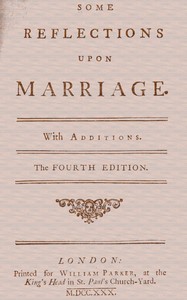
SOME REFLECTIONS UPON MARRIAGE.
Curiosity, which is sometimes an Occasion of Good, but more frequently of Mischief, by disturbing our own or our Neighbours Repose, having induc’d me to read the Account of an unhappy Marriage, I thought an Afternoon would not be quite thrown away in pursuing such Reflections as it occasion’d. I am far from designing a Satire upon Marriage, as some pretend, either unkindly or ignorantly, through want of Reflection in that Sense wherein I use the Word.
One wou’d have thought that Cardinal Mazarine, whose Dignity, Power and Riches, render’d him so considerable in the Eyes of all Europe; and who, like most great Ministers, aim’d at nothing so much as the aggrandizing himself and his Family, and who wanted no Opportunities of doing it, should have taken his Measures so justly as not to be disappointed: At least, that a Fabrick rais’d with as much Art and Cost, founded in the Oppression, and cemented with the Blood of the People, should not so quickly have tumbled into the Dust after him. But so it is, Providence, whether we think of it or no, overrules our Actions and baffles our best-concerted Projects: So that unless we wilfully shut our Eyes, we cannot but discern, that when Men in Power and Honour leave GOD out of their Schemes, they have no Understanding, though their natural Genius be ever so bright, but are justly compared to the Beasts that perish. The Ignorant and Foolish succeed quite as well as the Worldly-wise, who carry nothing away with them when they die, neither will their Riches and Glory descend as they intended. It is only by generous and worthy Actions that we are rescued from Oblivion, or from what is worse, being remembred with Contempt and Execrations: So little Reason is there to envy any Man’s Wealth and Greatness, but much to emulate their Wisdom and Vertue whose Views extend to a more durable Felicity.
’Tis natural to well-turn’d Minds, when they hear of any Person eminent in Wit and Beauty, adorn’d with Politeness and Address, to wish these may be accompanied and supported by what is more valuable and lasting, solid Sense and real Vertue. One grieves at any Imputation on such an engaging Character, and if one cannot always find the favourite Person fortunate, one labours for the Consolation of finding them discreet; and even where their Conduct is not wholly blameless, Compassion and Good-nature will take Place of Censure in a Noble, as well as in a Christian Heart. We find out something to excuse, something to regret, lamenting that such a Treasure should fall into unworthy Hands, insensible of its Value, unskilful to preserve and improve it: We sigh, we grieve, that any Person capable of being an Ornament to a Family, and Blessing to the Age, should only serve as an unhappy Shipwreck to point out the Misfortune of an ill Education and unsuitable Marriage, and the inexpressible Danger of seeking Consolation and Relief, in any thing but Innocence and Vertue.
They only who have felt it, know the Misery of being forc’d to marry where they do not love; of being yok’d for Life to a disagreeable Person and imperious Temper, where Ignorance and Folly (the Ingredients of a Coxcomb, who is the most unsufferable Fool) tyrannizes over Wit and Sense: To be perpetually contradicted for Contradiction-sake, and bore down by Authority, not by Argument; to be denied one’s most innocent Desires, for no other Reason but the absolute Will and Pleasure of a Lord and Master, whose Follies a Wife, with all her Prudence, cannot hide, and whose Commands she cannot but despise at the same Time that she obeys them.
Or, suppose on the other Hand, she has married the Man she loves, heap’d upon him the highest Obligations, by putting into his Power the Fortune he coveted, the Beauty he profess’d to adore; how soon are the Tables turn’d? It is her Part now to court and fawn; his real or pretended Passion soon cools into Indifference, Neglect, or perhaps Aversion. ’Tis well if he preserves a decent Civility, takes a little care of Appearances, and is willing to conceal his Breach of Faith.
But shall a Wife retaliate? GOD forbid! no Provocation, though ever so great, can excuse the Sin, or lessen the Folly: It were indeed a revenging the Injury upon herself in the most terrible Manner. The Italian Proverb shews a much better Way, If you would be revenged of your Enemies, live well.
Devotion is the proper Remedy, and the only infallible Relief in all Distresses; when this is neglected or turn’d into Ridicule, we run, as from one Wickedness, so from one Misfortune, to another. Unhappy is that Grandeur which is too great to be good, and that which sets us at a Distance from true Wisdom. Even Bigotry, as contemptible as it is, is preferable to profane Wit; for that requires our Pity, but this deserves our Abhorrence.
A Woman who seeks Consolation under Domestick Troubles from the Gaieties of a Court, from Gallantry, Gaming, rambling in Search of odd Adventures, childish, ridiculous and ill-natur’d Amusements, such as we find in the unhappy Madam _M_——’s Memoirs, the common Methods of getting rid of Time, that is, of our very Being, and keeping as much as we can at a Distance from ourselves, will find these are very insignificant Applications; they hardly skin the Wound, and can never heal it, they even hurt, they make it fester, and render it almost incurable.
What an ill Figure does a Woman make, with all the Charms of her Beauty, and Sprightliness of her Wit, with all her good Humour and insinuating Address, though she be the best Oeconomist in the World, the most entertaining Company, if she remit her Guard, abate in the Severity of her Caution, and Strictness of her Vertue? If she neglects those Methods which are necessary to keep her, not only from a Crime, but from the very Suspicion of one? She justifies the Injury her Husband has done her, by publishing to the World, that whatever good Qualities she may possess, Discretion, the Mistress of all the rest, is wanting: Though she be really guiltless, she cannot prove her Innocence, the Suspicions in her Prejudice are so strong. When she is censur’d, Charity, that thinks no Evil, can only be silent; though it believes and hopes the best, it cannot engage in her Defence, nor apologize for irregular Actions.
An ill Husband may deprive a Wife of the Comfort and Quiet of her Life, give occasion of exercising her Vertue, try her Patience and Fortitude to the utmost, which is all he can do; it is herself only that can accomplish her Ruin.
In vain we seek for Colours to varnish faulty Manners. An Advocate shews the best Side of his Wit, but the worst of his Integrity when he has an ill Cause to manage: But to what Purpose? He cannot impose on the Judicious, his Colouring vanishes before their Eyes, and a good deal of Malice, with a very little Sense, will find the Weakness of his Arguments; so much the more suspected, by how much the more labour’d: For Truth is plain and forcible, depending on her own Strength; she requires no more than to be placed in a proper Light, nor condescends to Art or Insinuations, unless in Compassion to the Weakness and Prejudice of Mankind. Nor are they less mistaken in regard of Wit, which consists not meerly in saying what is odd and out of the way; Fools do this pretty often; but Wit consists in expressing good Sense in a surprising, yet natural and agreeable Manner.
There are some Reasons, (for the Laws of GOD and Man allow Divorces in certain Cases) though not many, that authorize a Wife’s leaving her Husband, but if any Thing short of absolute Necessity, from irreclaimable Vice and Cruelty, prevails with her to break these sacred and strongest Bonds, how is she expos’d to Temptations and Injuries, Contempt, and the just Censure of the World. A Woman of Sense, one shou’d think, could take but little Pleasure in the Courtship and Flatteries of her Adorers, even when she is single: But for a married Woman to admit of Love Addresses, is worse than Folly; it is a Crime so ridiculous, that I will never believe a Woman of Sense can be guilty of it. For what does a Man pretend when he whines and dangles after a married Woman? Would he have her think he admires her, when he is treating her with the last Contempt? or that he loves her, when he is trying his Arts to gratify his brutal Passion, at the Price of all that is dear to her? His fine Speeches have either no Meaning, or a reproachful one; he affronts her Understanding as well as her Vertue, if he fancies she cannot discern, or wants Spirit to resent the Insults. She can look on him no otherwise than as the worst of Hypocrites, who flatters to betray, and fawns that he may ruin; who is laying Snares to entangle her in a Commerce founded on Injustice, and Breach of the most sacred Vows, carried on by Dissimulation, Treachery, Lyes, and Deceit, attended with Fear and Anxiety, Shame, Remorse, the bitter Stings of Guilt, whose fatal Consequences cannot be foreseen, the least of which is the blasting of her Honour. And why all this Mischief? Why, because he professes to think her amiable, and with the blackest Treachery takes Advantage of her Weakness, and the too good Opinion she has entertained of him, to render her odious! to render her contemptible to himself, as well as to the World.