Public-domain ebook
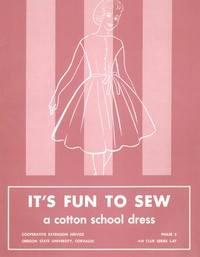
It's Fun to Sew Aprons and Skirts
Language: en342 downloads on Project Gutenberg
Subjects
In: Children & Young Adult Reading·Fashion·How To ...
Public-domain ebook sourced from Project Gutenberg #61260.
Public-domain ebook
Language: en342 downloads on Project Gutenberg
Subjects
In: Children & Young Adult Reading·Fashion·How To ...
Public-domain ebook sourced from Project Gutenberg #61260.
The opening · free to read
You will want to talk about your project with your mother and leader. This will help you to understand your project. Study the project outline and your record book. Take your mother with you to your first 4-H club meeting.
You will need your mother’s cooperation in selecting equipment and cloth.
Plan to do all your shopping at one time. Buy the cloth for your apron or skirt and slippers or scarf at the time you buy your sewing equipment. This will save you time.
Before you go shopping make a list of all of the things you will need. Think about the blouses or dresses you have when you plan the colors for your skirt or apron. You may want to wear your scarf and skirt together—if you do, plan the colors to go together.
This project is more than just sewing. You will study health and good grooming and how to care for your clothes.
Get off to a good start by learning how to care for your shoes and how to sew on buttons.
Daily care will improve the looks of your shoes and will help make them wear longer. Clean and polish your shoes. Wipe them off with a clean (wool) cloth and brush away the loose dirt before you put them away. When they need polishing, use one of the many good polishes that are on the market. Select the kind that is best for the leather in your shoes. Follow the directions given with the polish.
Shoes become damp from perspiration when you wear them. Wearing socks will protect the lining. Allow your shoes to dry thoroughly between wearings. Filling the toes of your shoes with tissue paper will help absorb the moisture.
Examine your shoes for signs of wear. Keep the heels straight and do not wear the sole through before having it repaired. Have all rips mended as soon as they appear.
Do not place wet shoes near heat or in the sun to dry. When they are dry, clean and polish them to make them look like new.
Your dress is only as pretty as the shoes you wear with it. Are you proud of the care you give your shoes? Keep a record of the care you give your shoes in your record book.
To help mother care for the family clothing, why don’t you take the responsibility of replacing buttons on shirts and blouses for the family. Make a game of it with other members of your club. Have a button contest. Give yourself a point for each button you sew on. The club could plan to give a prize to the girl who sews on the most buttons during the club year.
Keep a record of the buttons you sew on, something like this:
Date Article of clothing Points—or number of buttons
___________ __________________ ____________________ ___________ __________________ ____________________ ___________ __________________ ____________________ ___________ __________________ ____________________ ___________ __________________ ____________________ ___________ __________________ ____________________
Record the total in your record book.
Use buttons to trim your bedroom slippers. Select one flat, medium-sized one or three small ones. Arrange them on the toes of your slippers to make an attractive trim.
1. Make a small knot in double thread (15 inches long). Fasten to article where center of the button is to be placed. Take two or three stitches over the knot.
2. Sew the button in place with one or two stitches. See that the stitches run in the same direction as the buttonhole.
3. Place a pin on top of buttons under the first stitches. This makes a shank. Continue to sew on the button. Take as many stitches as necessary to hold the button securely. When the stitches are in place, remove the pin. Lift the button away from the article. Wind the thread tightly around the stitches, as shown, and fasten the thread on the back by taking three or four stitches, one on top of the other.
You will need a sewing box or basket and good sewing tools. Obtain a small box to hold your tools and another one large enough to hold your small box plus your apron or skirt. A small suitcase makes an ideal sewing box.
_Needles_—A package of needles, assorted sizes of 7 to 9 sharps, will give you the various sizes needed. Use as fine a needle as will carry the thread you are using.
_Thread_—White mercerized thread No. 50 is used for basting. Match other thread to your fabric.
_Pins_—Select smooth fine dressmaker pins so they will not leave a dark spot on your cloth. These usually come in a box.
_Pin cushion_—Plan for a pin cushion that can be worn on the wrist. You may make or buy this.
_Scissors and shears_—Scissors have short blades and are used for snipping threads and cutting small pieces of material. Seven-inch blades are a good length. Shears have one long handle for the fingers and one short one for the thumb. Scissors with bent handles are handy because the cutting blade rests flat on the table. Use plain scissors to cut out your articles. Do not use pinking shears.
_Tape measure_—Select a tape measure that will wear well and one that is numbered with “1” on each end on opposite sides.
_Measuring gauge_—You can cut a gauge from cardboard or buy a 4-inch metal one. From the start, learn to measure accurately. On a tape or measuring gauge, locate the 1-inch, ½-inch, and ¼-inch marks.
When you start to sew, it is most important that you have a fine, firm piece of cotton cloth. The best fabric for your scarf, skirt, or apron is percale, either plain or crease resistant. Percale is soft and firm, and comes in figured and plain colors. Select a small all-over pattern in colors that you will enjoy wearing. Avoid plain colors, plaids, or large designs. Also avoid cloth which feels stiff. Crush several pieces of cloth in your hand. You will be able to tell the difference. Select the one that wrinkles the least.
When you buy your fabric, be sure it is preshrunk and colorfast. Also find out if it is crease-resistant and how to wash it. Is it hand washable or machine washable? You will find most of this information on the end of the bolt of fabric or on attached labels. Study these and also ask the clerk to tell you about the fabrics.
WASH & WEAR LITTLE or NO IRONING MACHINE WASH—DRIP DRY CREASE RESISTANT
Good percale has the same number of threads in the warp as in the filling. The warp threads are those that run the long way of the fabric. The filling threads go back and forth across the warp threads. The filling threads are softer than the warp threads but not as strong. Examine the edge of the fabric. The edge is called selvage. It is stronger than the rest of the cloth because it has more threads in it. This may also cause it to shrink more during washing.
Percales should be torn, not cut, from the bolt. This leaves a straight line or shows one thread for the entire width of the cloth. Before you buy any fabric, lay the folded cloth on the counter and examine the torn end. Are both sides even or is one side an inch or so shorter than the other? Select a piece which is reasonably even. Do not select fabric if one side is more than ½-inch shorter.
Border prints make interesting skirts. Study the design on the cloth and buy enough cloth so you can match the design on the side seam. Make sure the fabric is straight. Crooked fabric will give you a curved side seam.
Percale may be used for all the articles you will make in this year’s project. Other fabrics that may be used are chambray, broadcloth, poplin, and novelty fabrics.
Plan a shopping tour with your club before buying your fabric. After studying the different cotton fabrics, have your leader and mother help you select the fabric for your scarf, apron, or skirt. If you plan to make a double scarf, buy ½ yard additional fabric like your skirt and the same amount of a contrasting color.
You will need two washcloths if you plan to make the TV slippers. Select medium weight washcloths either with or without border trim.
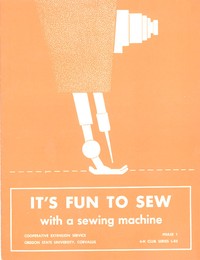
Many of you learned to use the sewing machine in Phase 1 of It’s Fun to Sew. You will find this section of your bulletin to be a good review.
For those of you who are starting with this phase, this section will help you become acquainted with the parts of the machine and will tell you how to use it.
_The needle_—Notice that it has an eye near the point instead of at the top like the one you use for hand sewing.
The book keeps going
Reading is free forever. Sign up and watch scenes appear while you read.



Scenes Storieta drew for other classics.
New illustrated classics
Once or twice a month: the latest books to get full character casts, scene art, and free comic editions. No account needed.