Public-domain ebook
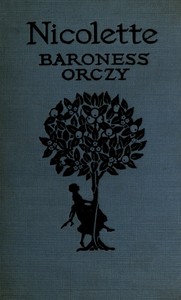
Nicolette: a tale of old Provence
English399 downloads on Project GutenbergDownload EPUB
Public-domain ebook sourced from Project Gutenberg #61484.
Public-domain ebook
English399 downloads on Project GutenbergDownload EPUB
Public-domain ebook sourced from Project Gutenberg #61484.
The opening · free to read
Midway between Apt and the shores of the Durance, on the southern slope of Luberon there stands an old château. It had once been the fortified stronghold of the proud seigneurs de Ventadour, who were direct descendants of the great troubadour, and claimed kinship with the Comtes de Provence, but already in the days when Bertrand de Ventadour was a boy, it had fallen into partial decay. The battlemented towers were in ruin, the roof in many places had fallen in; only the square block, containing the old living-rooms, had been kept in a moderate state of repair. As for the rest, it was a dwelling-place for owls and rooks, the walls were pitted with crevices caused by crumbling masonry, the corbellings and battlements had long since broken away, whilst many of the windows, innocent of glass, stared, like tear-dimmed eyes, way away down the mountain slope, past the terraced gradients of dwarf olives and carob trees, to the fertile, green valley below.
It is, in truth, fair, this land of Provence; but fair with the sad, subtle beauty of a dream—dream of splendour, of chivalry and daring deeds, of troubadours and noble ladies; fair with the romance of undying traditions, of Courts of Love and gallant minstrels, of King René and lovely Marguerite. Fair because it is sad and silent, like a gentle and beautiful mother whose children have gone out into the great world to seek fortunes in richer climes, whilst she has remained alone in the old nest, waiting with sorrow in her heart and arms ever outstretched in loving welcome in case they should return; tending and cherishing the faded splendours of yesterday; and burying with reverence and tears, one by one, the treasures that once had been her pride, but which the cruel hand of time had slowly turned to dust.
And thus it was with the once splendid domaine of the Comtes de Ventadour. The ancient family, once feudal seigneurs who owed alliance to none save to the Kings of Anjou, had long since fallen on evil days. The wild extravagance of five generations of gallant gentlemen had hopelessly impoverished the last of their line. One acre after another of the vineyards and lemon groves of old Provence were sold in order to pay the gambling debts of M. le Comte, or to purchase a new diamond necklace for Madame, his wife. At the time of which this chronicle is a faithful record, nothing remained of the extensive family possessions, but the château perched high up on the side of the mountain and a few acres of woodland which spread in terraced gradients down as far as the valley. Oh! those woods, with their overhanging olive trees, and feathery pines, and clumps of dull-coloured carob and silvery, sweet-scented rosemary: with their serpentine paths on the edge of which buttercups and daisies and wild violets grew in such profusion in the spring, and which in the summer the wild valerian adorned with patches of purple and crimson: with their scrub and granite boulders, their mysterious by-ways, their nooks and leafy arbours, wherein it was good to hide or lie in wait for imaginary foes. Woods that were a heaven for small tripping feet, a garden of Eden for playing hide-and-seek, a land of pirates, of captive maidens and robbers, of dark chasms and crevasses, and of unequal fights between dauntless knights and fierce dragons. Woods, too, where in the autumn the leaves of the beech and chestnut turned a daffodil yellow, and those of oak and hazel-nut a vivid red, and where bunches of crimson berries fell from the mountain ash and crowds of chattering starlings came to feed on the fruit of the dwarf olive trees. Woods where tiny lizards could be found lying so still, so still as the stone of which they seemed to form a part, until you moved just a trifle nearer, and, with a delicious tremor of fear, put out your little finger, hoping yet dreading to touch the tiny, lithe body with its tip, when lo! it would dart away; out of sight even before you could call Tan-tan to come and have a look.
Tan-tan had decided that lizards were the baby children of the dragon which he had slain on the day when Nicolette was a captive maiden, tied to the big carob tree by means of her stockings securely knotted around her wee body, and that the patch of crimson hazel-bush close by was a pool of that same dragon’s blood. Nicolette had spent a very uncomfortable half-hour that day, because Tan-tan took a very long time slaying that dragon, a huge tree stump, decayed and covered with fungi which were the scales upon the brute’s body; he had to slash at the dragon with his sword, and the dragon had great twisted branches upon him which were his arms and legs, and these had to be hacked off one by one. And all the while Nicolette had to weep and to pray for the success of her gallant deliverer in this unequal fight. And she got very tired and very hot, and the wind blew her brown curls all over her face, and they stuck into her mouth and her eyes and round her nose; and Tan-tan got fiercer and fiercer, and very red and very hot, until Nicolette got really sorry for the poor dragon, and wept real tears because his body and legs and arms had been a favourite resting-place of Micheline’s when Micheline was too tired for play. And now the dragon had no more arms and legs, and Nicolette wept, and her loose hair stuck to her eyes, and her stockings were tied so tightly around her that they began to hurt, whilst a wasp began buzzing round her fat little bare knees.
“Courage, fair maiden!” Tan-tan exclaimed from time to time, “the hour of thy deliverance is nigh!”
But not for all the world would Nicolette have allowed Tan-tan to know that she had really been crying. And presently when the dragon was duly slain and the crimson hazel-bush duly testified that he lay in a pool of blood, the victorious knight cut the bonds which held Nicolette to the carob tree, and lifting her in his arms, he carried her to his gallant steed, which was a young pine tree that the mistral had uprooted some few years ago, and which lay prone upon the ground—the most perfect charger any knight could possibly wish for.
What mattered after that, that old Margaï was cross because Nicolette’s stockings were all in holes? Tan-tan had deigned to say that Nicolette had a very good idea of play, which enigmatic utterance threw Nicolette into a veritable heaven of bliss. She did not know what it meant, but the tiny, podgy hand went seeking Tan-tan’s big, hot one and nestled there like a bird in its nest, and her large liquid eyes, still wet with tears, were turned on him with the look of perfect adoration, which was wont to bring a flush of impatience into his cheek.
“Thou art stupid, Nicolette,” he would say almost shamefacedly, when that look came into her eyes, and with a war-whoop, he would dart up the winding path, bounding over rocks and broken boughs like a young stag, or swarming up the mountain ash like a squirrel, shutting his manly ears to the sweet, insidious call of baby lips that called pathetically to him from below:
“Tan-tan!”
Then, when outside it rained, or the mistral blew across the valley, it meant delicious wanderings through the interminable halls and corridors of the old château—more distressed maidens held in durance in castellated towers, Nicolette and Micheline held captive by cruel, unseen foes: there were walls to be scaled, prisons to be stormed, hasty flights along stone passages, discovery of fresh hiding-places, and always the same intrepid knight, energetic, hot and eager to rescue the damsels in distress.
And when the distressed damsels were really too tired to go on being rescued, there would be those long and lovely halts in the great hall where past Comtes and Comtesses de Ventadour, vicomtes and demoiselles looked down with silent scorn from out the mildewed canvases and tarnished gold frames upon the decayed splendour of their ancient home. Here, Tan-tan would for the time being renounce his rôle of chivalrous knight-errant, and would stand thoughtful and absorbed before the portraits of his dead forbears. These pictures had a strange fascination for the boy. He never tired of gazing on them and repeating to his two devoted little listeners the tales which for the most part his grandmother had told him about these dead and gone ancestors.
There was Rambaud de Ventadour, the handsome Comte of the days of the Grand Monarque, who had hied him from his old château in Provence to the Court of Versailles, where he cut a gallant figure with the best of that brilliant crowd of courtiers, stars of greater and lesser magnitude that revolved around the dazzling central sun. There was Madame la Comtesse Beatrix, the proud beauty whom he took for wife. They were rich in those days, the seigneurs of Ventadour, and Jaume Deydier, who was Nicolette’s ancestor, was nothing but a lacquey in their service; he used to take care of the old château while M. le Comte and Mme. la Comtesse went out into the gay and giddy world, to Paris, Versailles or Rambouillet.
’Twas not often the old lands of Provence saw their seigneurs in those days, not until misfortune overtook them and Geoffroy, Comte de Ventadour, Tan-tan’s great-grandfather, he whose portrait hung just above the monumental hearth, returned, a somewhat sobered man, to the home of his forbears. Here he settled down with his two sons, and here Tan-tan’s father was born, and Tan-tan himself, and Micheline. But Nicolette’s father, Jaume Deydier, the descendant of the lacquey, now owned all the lands that once had belonged to the Comtes de Ventadour, and he was reputed to be the richest man in Provence, but he never set foot inside the old château.
Nicolette did not really mind that her ancestor had been a lacquey. At six years of age that sort of information leaves one cold; nor did she quite know what a lacquey was, as there were none in the old homestead, over on the other side of the valley, where Margaï did the scrubbing, and the washing and the baking, put Nicolette to bed, and knitted innumerable pairs of woollen stockings. But she liked to hear about her ancestor because Tan-tan liked to talk about him, and about those wonderful times when the Comtes de Ventadour had gilded coaches and rode out on gaily caparisoned horses, going hawking, or chasing, or fishing in the Durance, the while old Jaume Deydier, the lacquey, had to stay at home and clean boots.
“Whose boots, Tan-tan?” Nicolette would venture to ask, and a look of deep puzzlement would for a moment put to flight the laughter that dwelt in her hazel eyes.
“Thou art stupid, Nicolette,” Tan-tan would reply with a shrug of his shoulders. “Those of the Comte and Comtesse de Ventadour, of course.”
“All the day ... would he clean boots?” she insisted, in her halting little lisp. Then, as Tan-tan simply vouchsafed no reply to this foolish query, she added with a sigh of mixed emotions: “They must have worn boots and boots and boots!”
After which she dismissed the subject of her ancestor from her mind because Tan-tan had gone on talking about his: about the Comte Joseph-Alexis, and the Vicomtesse Yolande, the Marquis de Croze (a collateral), and Damoysella Ysabeau d’Agoult, she who married the Comte Jeanroy de Ventadour, and was Lady-in-waiting to Mme. de Maintenon, the uncrowned Queen of France, and about a score or more of others, all great and gallant gentlemen or beautiful, proud ladies. But above all he would never weary of talking about the lovely Rixende, who was known throughout the land as the Lady of the Laurels. They also called her Riande, for short, because she was always laughing, and was so gay, so gay, until the day when M. le Comte her husband brought her here to his old home in Provence, after which she never even smiled again. She hated the old château, and vowed that such an owl’s nest gave her the megrims: in truth she was pining for the gaieties of Paris and Versailles, and even the people here, round about, marvelled why M. le Comte chose to imprison so gay a bird in this grim and lonely cage, and though he himself oft visited the Court of Versailles after that, went to Paris and to Rambouillet, he never again took his fair young wife with him, and she soon fell into melancholia and died, just like a song-bird in captivity.
The book keeps going
Reading is free forever. Sign up and watch scenes appear while you read.



Scenes Storieta drew for other classics.
New illustrated classics
Once or twice a month: the latest books to get full character casts, scene art, and free comic editions. No account needed.