THE NIGHT OF THE 10TH OF MAY.
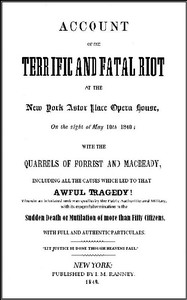
On the night of the 10th of May, 1849, the Empire City, the great metropolis of the Union, was the scene of one of those horrors of civilization, which for a time make the great heart of humanity stop in its beatings. In the darkness of night, thousands of citizens were gathered in a central square of the most aristocratic quarter of New York—gathered around one of its most conspicuous and magnificent edifices, the Astor-Place Opera House.
This Opera House was built expressly for the performance of the Italian Opera, but has been used at intervals for the legitimate drama, for vaudevilles, and for balls and concerts. It is fitted up and decorated with taste and magnificence, and in the opera seasons has been attended by the most wealthy and fashionable people, who have made extravagant displays of luxurious adornment. While the private boxes were taken by the season, by those who wished to enjoy the music, liked the display, and could afford the expenditure, the other seats were let at a dollar admission, and the upper tier or amphitheatre was reserved for people of humbler means or more modest pretensions, at twenty-five cents a ticket.
Around this edifice, we say, a vast crowd was gathered. On the stage the English actor Macready was trying to play the part of Macbeth, in which he was interrupted by hisses and hootings, and encouraged by the cheers of a large audience, who had crowded the house to sustain him. On the outside a mob was gathering, trying to force an entrance into the house, and throwing volleys of stones at the barricaded windows. In the house the police were arresting those who made the disturbance—outside they were driven back by volleys of paving-stones.
In the midst of this scene of clamor and outrage, was heard the clatter of a troop of horse approaching the scene. “The military—the military are coming!” was the exclamation of the crowd. Further on was heard the quick tramp of companies of infantry, and there was seen the gleam of bayonets. A cry of rage burst from the mob. The appearance of an armed force seemed to inspire them with a sudden fury. They ceased storming the Opera House, and turned their volleys against the horsemen. Amid piercing yells and execrations, men were knocked from their horses, the untrained animals were frightened, and the force was speedily routed, and could not afterwards be rallied to perform any efficient service.
Now came the turn of the infantry. They marched down the sidewalk in a solid column; but had no sooner taken up a position for the protection of the house, than they were assailed with volleys of missals. Soldiers were knocked down and carried off wounded. Officers were disabled. An attempt to charge with the bayonet was frustrated by the dense crowd seizing the muskets, and attempting to wrest them from the hands of the soldiers. At last the awful word was given to fire—there was a gleam of sulphurous light, a sharp quick rattle, and here and there in the crowd a man sank upon the pavement with a deep groan or a death rattle. Then came a more furious attack, and a wild yell of vengeance! Then the rattle of another death-dealing volley, far more fatal than the first. The ground was covered with killed and wounded—the pavement was stained with blood. A panic seized the multitude, which broke and scattered in every direction. In the darkness of the night yells of rage, screams of agony, and dying groans were mingled together. Groups of men took up the wounded and the dead, and conveyed them to the neighboring apothecary shops, station-houses, and the hospital.
The horrors of that night can never be described. We looked over the scene that misty midnight. The military, resting from their work of death, in stern silence were grimly guarding the Opera House. Its interior was a rendezvous and a hospital for the wounded military and police. Here and there around the building, and at the corners of the streets were crowds of men talking in deep and earnest tones of indignation. There were little processions moving off with the dead or mutilated bodies of their friends and relations. A husband, uttering frenzied curses, followed his mortally wounded wife to the hospital. An aged mother found her only son, the sole support of her declining years, in the agonies of death. Many a wife sat watching at home, in terror and alarm for her absent husband. It was an evening of dread—and it became a night of horror, which on the morrow, when the awful tragedy became more widely known, settled down upon the city like a funeral pall.
The result of that night’s work was the death of twenty-two victims, either shot dead upon the spot or mortally wounded, so that they died within a few days; and the wounding of some thirty more, many of whom will be maimed for life. Into the causes which led to a result so fatal, and all the circumstances attending it, it will now be our duty to inquire.
MR. EDWIN FORREST, the American Tragedian, was born, some forty-five years ago, in the city of Philadelphia. He was born in humble life, and worked his way up from poverty and obscurity to wealth and fame, by the power of genius. When a boy, he made his first histrionic efforts in an amateur company; afterwards, he made a professional tour at the west.
After various adventures, young Forrest found himself in the city of New York, in the year 1826, when Gilfert was about to open the Bowery Theatre. He wanted a star of powerful attraction, and his experienced eye fell on Forrest. He was engaged—puffed in all the papers as the Native Tragedian—the patriotism of New-Yorkers was appealed to—Forrest used his mental gifts and great personal advantages with discretion and effect, and became a star of the first magnitude; so that, in a short time, he demanded and received two hundred dollars a night for his performances; and, with energy and temperate habits, has been able to accumulate an ample fortune.
After his first successes—determined to shine alone as a star of the first magnitude—he offered a prize of five hundred dollars for the best tragedy—suiting his powers as the hero; and the result was, Mr. Stone’s “Metamora.” Soon after, he secured the “Gladiator,” written by Dr. Bird. These have been his most successful performances, and in them he has had no competitor, nor is it likely that he would find an equal.
Mr. William C. Macready is an English actor of great eminence. He was born in the city of Cork, (Ireland,) and must now be nearly seventy years old. In the early part of his theatrical career, he was most distinguished in such parts as “Virginius,” “William Tell,” “Pierre,” “Carwin,” &c.; but of late, he has given his chief attention to the plays of Shakspeare—in which he has shown himself a thorough artist.
In 1827—one year after the successful commencement of Mr. Forrest’s career as a star of the first magnitude—Mr. Macready visited the United States. In a fit of petulance, in which such actors are too apt to indulge, Mr. Macready came near fomenting a disturbance in Baltimore, which, but for his adroit management, might have caused him then to have been driven from the American stage. In playing “William Tell,” the property-man had forgotten to furnish the arrow to be broken; and Macready was obliged to break one of his shooting arrows. In his anger at the offending party, he said—“I can’t get such an arrow in your country, sir!” or, as it was reported—“I can’t get wood to make such an arrow in your country!” This was construed into an insult to the country. Anonymous letters were sent to the newspapers; but, as these were sent to Mr. M., he had an opportunity to make an explanation, and avoid a row.
Macready and Forrest were starring through the country, playing alternate engagements—but not, so far as we know, developing any very decided feelings of rivalry. Their roles of characters, and spheres of action, were quite apart; and when they met each other, their intercourse—as it was many years afterward—was of the most gentlemanly character.
About the year 1835, Mr. Forrest went to Europe, and spent some time in travelling on the continent; after which, he returned to America for a short time; and then went back to England, to fulfil professional engagements—in which he was so highly successful, that on his return, he was honored with a public dinner in Philadelphia; and about this time, he was tendered a nomination to Congress by the Democracy of New York—before whom he delivered a Fourth of July oration.
In 1844, Mr. Macready visited the United States. He and Mr. Forrest had become intimate in England; and here, Mr. F. tendered him the courtesies due to so distinguished a professional brother; but it so happened, that in most of the cities where Macready was engaged, there were more theatres than one—and, of consequence, rival managers. Where one of these had secured Mr. Macready, the other was anxious to get the best talent to be found to run against him; and there was no one so available as Mr. Forrest—who is not the man to refuse a profitable engagement, nor did any rule of courtesy require that he should do so.
The result was, that the constant rivalry of Forrest, though carried on in the most friendly manner, could not fail to injure the success of Macready. A certain degree of partizanship was everywhere excited—for Forrest was everywhere placarded as the “_American_ Tragedian,”—and the tour of Mr. Macready was comparatively a failure. A sensitive man could not but feel this; and whether he made any complaint or not, his friends saw what the difficulty was, and felt not a little chagrined about it; and when Mr. Forrest made his next and last professional visit to England, this feeling among the friends of Macready, in the theatrical press and the play-going public, found its vent. The opposition to him was, from the first, marked and fatal; and, so far as the metropolis was concerned, his tour was a failure. It was only in the provinces—away from London influence—that he met with any degree of success.
There was no need of Mr. Macready taking any active part in this matter; and there is no proof that he did so, but much to the contrary; but Mr. Forrest hastily and indignantly, and, we doubt not, sincerely, charged it upon Mr. Macready; and one night, when the latter was playing in “Hamlet,” at the Theatre in Edinburgh, Mr. Forrest, who was seated in a private box, had the bad taste, as well as bad feeling, to hiss a portion of his performance in the most marked and offensive manner.
The following letter from Mr. Forrest gives his own account of this affair, which differs somewhat from the statements of Mr. Macready’s friends, as will be seen hereafter.
To the Editor of the London Times,—SIR,—Having seen in your journal of the 12th instant, an article headed “Professional Jealousy,” a part of which originally appeared in The Scotsman published in Edinburgh, I beg leave, through the medium of your columns, to state, that at the time of its publication, I addressed a letter to the Editor of The Scotsman upon the subject, which, as I then was in Dumfries, I sent to a friend in Edinburgh, requesting him to obtain its insertion; but as I was informed, The Scotsman refused to receive any communication upon the subject. I need say nothing of the injustice of this refusal. Here then I was disposed to let the matter rest, as upon more mature reflection, I did not deem it worth further attention; but now, as the matter has assumed “a questionable shape” by the appearance of the article in your journal, I feel called upon, although reluctantly, to answer it.