Public-domain ebook
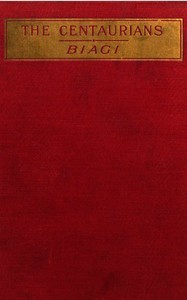
The Centaurians: A Novel
by Biagi
Language: en341 downloads on Project Gutenberg
Subjects
Public-domain ebook sourced from Project Gutenberg #61609.
Public-domain ebook
by Biagi
Language: en341 downloads on Project Gutenberg
Subjects
Public-domain ebook sourced from Project Gutenberg #61609.
The opening · free to read
Twelve long years of European travel had failed to stale the beauties of my own country. I compared the exquisite, restful view, to the garish expansiveness of foreign panorama. Though fagged and frayed with experience it was a tingling delight to gaze once again upon this fair, smiling, home country, whose mountain-lined distance of vivid heliotrope formed superb contrast to waving fields of deep yellow corn.
I flung aside the book I was reading with its repellant thoughts; the dewy freshness of a bright July morning weaned me from poppy-drugged ideas. I faltered at the grand finale of this wonderful collection of moods and wandered out in the glorious sunshine and fields beyond. Upon a huge mound of hay I lolled, enjoying the delicate fragrance of roses mingled with the heavy, pungent scent of carnations, and lazily watched blue butterflies flitting above, while black field reptiles ventured close, wondering what species I might be, then vanishing at the least movement. The hum of insects seemingly swelled to the city’s roar; all nature was active with industry, I alone was the drone, though master of this rural, enchanting, warm, lazy scene, which, like a veil, spread over the vast area of my possessions.
Powerfully wealthy, I gloat in enjoyment and exist merely to squander the fabulous riches inherited from ancestors who worshipped at the shrine of Accumulation, that I, the culminating period, should revel in Profligacy. Value has no significance and to me there is naught under the blue heavens that is priceless, except perhaps—a new experience. I came from a queer clan, we could date our premier back to the twelfth century; a Florentine dealer in precious stones, whose interesting history filled one of the documents handed to me when I reached the age of supposed discretion. Originality was our motto. All were gifted with keenness and enterprise, though dotted periodically with mania—just a dash, you understand, to aid personality and create distinction. Avarice was strongly developed, dulling fear forcing us to brave many perils, and we scorned the warning contained in the great chest of documents which even I failed to unseal. We had survived many disasters and twice narrowly escaped oblivion. We possessed a doubtful legend and closely guarded a buried tomb of foulness, yet with all our cunning two fools nearly snuffed the name out of existence during the fifteenth, and again at the close of the seventeenth century.
My thoughts often dwelt upon these afflicted kinsmen; both had been mad, of course, their chameleon brains merely reflected the brilliant glints of their rare collection of gems. One coveted the green light flaring in the crown of Isis, and early mastered the knowledge that all men perfect when they are too old to profit by it—anticipation is the nectar of realization. He was radiant in longing for the mystic green he could never possess, and existed in a daring dreamland that all men desire but never contemplate. His marvelous collection of emeralds formed the foundation of our almost fabulous wealth. It was a similar malady that afflicted the later kinsman, who closed his career with a rabidness that slanted a muddy shade consuming centuries of gigantic endeavor to clear. His madness lacked reverence, but keenness, determination proved talent had he not been abnormal. He conceived a frenzied desire to possess a famous jewel with a rich setting of superstition and priceless value. The cutting fascinated him, he jeered at warnings and made offers of purchase with a persistency equal his mania; when realizing the wealth of the world contained not the value of the stone he called it fate and stole the gem. Years later he was found murdered, horribly mutilated. Aware of the fate destined for him, he reasoned a life forfeited justly covered all debts—the stone was our property. He feared to trust it out of his keeping, however, and when the final, awful moment arrived, his insane cunning outwitted the assassins—he swallowed the stone. I have it sunk in a broad band of gold.
After the exploit of this fanatic we scattered over the world, and though our name suffered torturing abbreviation, we were easily traced by our wealth. Luck followed us in all undertakings, riches accumulated, but doubting the truth of the superstition surrounding the stone it is indisputable that from the date it entered our possession love departed. We were known as a cold, calculating, heartless people, with the doubtful intellect usually accompanying wealth. We purchased affection as we would any saleable bauble, and lived the life of indifference and final dislike the purchased article always brings. The curse was a short, loveless existence, crowned with intangible longings.
I recollect very little of my parents, both having passed away during my infancy, but I am liberally supplied with relatives who are disagreeably vivid, treacherous, small, scheming, gifted with a keen eye for profit—just relatives.
It was a kind providence, chiefly law, that placed me under the protection of Middleton & Co., a trio of the ablest and shrewdest of lawyers. They sent me to college, where I passed some years, though really it was not necessary. The intellect of a millionaire is generally accredited heavy with metal, though when backed with distinction, a most desirable bric-a-brac. I early discovered nothing was expected of me except good-nature and generosity. The commonest attributes were denied me, and though of a sunny temperament, eventually I grew bitter, scorning the mercenary. To be constantly striving to force a measure above companionable appendage was a cruel trial. However, my college life was not so difficult when I crushed the romantic nobility of youth. I became resigned to my value and easily tolerated the adulation my wealth inspired. I was extravagantly generous and considered a rare good fellow, who gave rare good times. Occasionally I indulged in spasms of ambition, and when controlled by this feverish sensation, vowed to out-class the associates who imposed upon me. I had a vague idea of Fame, Worth gained through merit, not purchased. These attacks invariably visited me after an evening passed with Professor Saxlehner, the only individual in the wide world who understood me and honestly believed in my possession of brains, and who pronounced my name always with full entirety—Virgillius Salucci. Saxlehner was a man of brilliant mind, quiet, simple, seeking solitude and delving deep in all manner of mysteries.
My gold carried little weight with him, he was sincerely fond of me and consequently rated me soundly for all indiscretions, declaring I would regret wasting the best years of my life and deadening my vast talents—though he failed to state in what particular line my genius lay, I believed him. Frequently I sought him, weary and in need of sympathy, but he regularly refrained giving any, telling me I was simply suffering the dissatisfaction of inferior association and he could not understand my persistence in such a course. He begged me to cultivate seriousness and avoid flattering clowns, frivolity was altogether out of my line, I was born for greater, higher things.
Young and fond of pleasure, I ignored most of his advice, yet his words vividly impressed me, and in after years, profiting by his counsel, I became known as a man of many ideas, a trifle eccentric, and notoriously willing to fling away a fortune for a new experience. Saxlehner and I became great friends, yet with the ending of my college days we drifted apart. I plunged into the social gayety that awaits all rich young men, and learned more in one month of idleness than in all the years passed at college. I became wild, fast, yet deceived all with assumed unsophisticatedness and was a great trial to Middleton & Co., who kept a sharp lookout for squalls, remonstrating and warning me of disasters they could not steer me out of. Maliciously I parried with them, while debauchery fostered ennui and the dormant characteristics of my people roused to activity impregnating my system with the pessimist’s germ. Much encountered subtlety and unscrupulousness ceased causing anxiety. I developed an impenetrable armor of caution and sought diversion in heartless analysis—the world is money-mad. Lovelessness, the curse of my people, was upon me. It caused no unhappiness, we had all lived through it, but I alone discovered and realized—it developed with mature reason, we were not born with it. Vaguely I dreamed of congeniality and calm affection but craved neither, and anything deeper seemed annoying. I was incapable of passion, consequently could not inspire it. Iron against all sensations, my callousness astounded even me. I scorned the temptations other men embraced. Contact with the world robbed me of all romance. I lived my life in a few months. In demeanor I was simplicity itself, jovial, gullible as ever, but where formerly I sought enjoyment I was now indifferent, content to bask in the supreme delight of proving my convictions correct. I never committed an error. Disinterestedness, gratitude, are chimeras. Through my reduced expenses Middleton & Co. figured, and honestly believed the gradual change meant matrimony; in no other way could they comprehend my sudden respectability. Middleton harped continually on the subject, Rollins made it the topic of conversation every time I visited his home, and Burke smiled suggestively, but refrained from remarks—he was not the orator of the firm.
As daughters did not ornament any of the three homes I became partially convinced of my duty, and following Middleton’s advice began a series of inspection of my numerous cousins.
With the kind assistance of Rollins’s wife (who believed herself too young for Rollins, but wasn’t), I finally selected a tall, thin young woman, with rolling blue eyes, red cheeks, and rather pretty brown hair. Accustomed to quasi-fresh-wilted buds, I was attracted to the youth and apparent innocence of the girl. She was Carolyn, nineteen, with old age upon her at twenty-five. She was languid, insipid, and possessed the stereotyped conversation of nearly all girls of her age, who arrange their hair and dress all alike. She sang two songs in Italian, without knowing anything about it, and worried through four instrumental solos with murderous skill; also, she painted some, but Mamma gave it great importance and became a nuisance in her persistence that all should inspect the awful attempts, which were merely daubs even after the teacher had “gone over them.” This was the extent of Carolyn’s accomplishments, which opened preliminaries every time I ventured near her, and wise people versed in prediction aided by Mamma, had us married early in the skirmish. But Mamma was difficult, Carolyn impossible, and both possessed an omnivorous appetite for courtesy. Like boa-constrictors, they swallowed and swallowed and were always famished; and suddenly an unaccountable chill came upon me and I discovered the right was mine to live my own life. I could see no reason why I should burden myself with this great nonentity, this Carolyn, for the sole purpose of permitting her to inherit my wealth when she became my widow. It was an unnaturally cold conclusion and Middleton’s pointedness became annoying. I advised him to get the matrimonial “bug” out of his head and quit bothering me. I did not regret Carolyn, but the affair was rather unfortunate, and she was young to be afflicted with the disappointment that all girls find so bitter and take so hard. Actuated by profound selfishness I renounced every inclination toward matrimony; martyr-like I vowed the lasciviousness of my race would end with me. I would live to squander this vast wealth and lead the ideal existence the poor imagine the wealthy enjoy. Possibly I would experience happiness, but in a superficial way, the intense I abhorred. Middleton & Co. were dumbfounded at my strange behavior, their consternation was rather interesting because unnecessary, but eventually the three kindly gentlemen greatly bored me, and to oust all unpleasant association I stated my long-contemplated intention of touring the world. No objections were offered. I was to send news regularly of my doings and the firm was to be notified at once should anything unusual occur.
The book keeps going
Reading is free forever. Sign up and watch scenes appear while you read.



Scenes Storieta drew for other classics.
New illustrated classics
Once or twice a month: the latest books to get full character casts, scene art, and free comic editions. No account needed.