The opening · free to read
The German Press
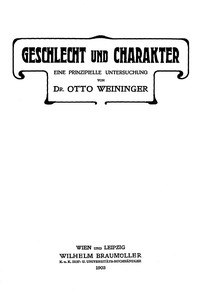
ON “SEX AND CHARACTER.”
_Die Umschau._--“Dr. Otto Weininger’s book is destined to place the relation of the sexes in a new light. He traces the contrast between man and woman to a single principle, and makes an attempt to reduce the spiritual differences of the sexes to a system.”
_Allgemeine Wiener Medizinische Zeitung._--“An extraordinary book, that called forth the learned criticism of two faculties, and had appeared in a third edition a few months after its publication, before the scientific world had been able to pronounce upon it seriously, not to say finally.... A book that will henceforth be in the hands of every doctor who has occasion to study the antithetical character of the two sexes.”
_Der Volkserzieher._--“There is no aspect of modern thought which he (Weininger) has not touched upon in the course of his investigations, no recess of the labyrinthine modern soul into which he does not invite us to glance with him, no question on which he has not touched, or to which he has not, indeed, offered a solution in accordance with his own philosophy.”
_Allgemeine Zeitung._--“This book... is a sensational work, both by reason of its contents and of the tragic fate of its author. Weininger, as is commonly known, shot himself in the autumn of 1903 at the early age of twenty-three, in the house in Vienna where Beethoven had died.... But it is the book itself, even more than its author’s individuality, which is abnormal. It is nothing less than an attempt to construct a system of sexual characterology on the broadest scientific basis, with all the resources of the most modern philosophy.”
_Münchener Neueste Nachrichten._--“‘Sex and Character,’ by Dr. Weininger, has none of the character of a youthful work. The learning revealed in this book, and indeed its whole conception, are such that we might take it for the strenuous achievement of a lifetime.”
_Neues Wiener Tageblatt._--“A great philosophical, biological, and social question is here treated by a gifted and learned author with perfect freedom and breadth, yet with a seriousness, a wealth of scientific knowledge, that would ensure the book a place in the front rank, even were the style less excellent, vivacious, and individual than it is.”
_Die Wage._--“The author is a brilliant stylist. On every page I find aphorisms, in which the form fits the thought like a veil of silver. And these thoughts are no ordinary ones. The writer goes his own way, he knows secret paths which no man has yet trodden, and he shrinks from no obstacles. He lets himself down cautiously into the abyss, for he has determined to sound the deepest depths; from time to time, however, he looks up from the pit and rejoices in the light of the eternal stars, even though they lie hid from his mortal vision. He carries his arguments to their ultimate conclusion. We rebel against these conclusions, but we admire the uncompromising logic of the thinker.”
The book keeps going
Keep reading, and see it illustrated
Reading is free forever. Sign up and watch scenes appear while you read.
Scenes Storieta drew for other classics.