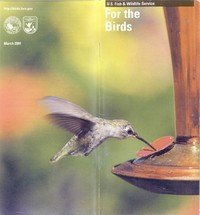
Public-domain ebook
For the Birds
by U.S. Fish and Wildlife Service
English333 downloads on Project GutenbergDownload EPUB
Public-domain ebook sourced from Project Gutenberg #61796.
Public-domain ebook
by U.S. Fish and Wildlife Service
English333 downloads on Project GutenbergDownload EPUB
Public-domain ebook sourced from Project Gutenberg #61796.
The opening · free to read
Among the fondest and most memorable moments of childhood are the discoveries of songbirds nesting in the backyard. The distinctive, mud-lined nests of robins and their beautiful blue eggs captivate people of all ages. Likewise, the nesting activities of house wrens, cardinals, chickadees and other common birds can stimulate a lifelong interest in nature.
As you learn to enjoy the beauty of birdlife around their home, you may wish to improve the “habitat” in your yard so that more birds will visit your property. You can attract birds by placing bird feeders, nest boxes, and bird baths in your yard, and by planting a variety of trees, shrubs, and flowers. These can provide good nesting sites, winter shelter, places to hide from predators and natural food supplies that are available year-round.
Backyard bird feeding is a convenient way to enjoy wildlife. More than 65 million Americans of all ages watch, feed and landscape for birds.
It doesn’t matter where you live—in an apartment, townhouse or single family dwelling, in the city, suburbs or country. Just stand still and you’ll hear them: wild birds. It is hard to imagine life without them.
Bird watching is one of the fastest growing forms of outdoor recreation in the country. Each year millions of people discover for the first time the joys of birdwatching. It’s easy to understand why. Birds are fun to watch.
And you can watch them just about everywhere. The most convenient place to start is right in your own backyard. All it takes to get their attention is food or water, a place to build a nest and appropriate vegetation.
When you want to attract a particular bird species and keep it coming back to your backyard, what you do will be determined by where you live, and the time of year. For example, on any winter day, you are likely to see a cardinal at a sunflower feeder in Virginia, a goldfinch at a thistle feeder in Massachusetts and hummingbirds at a nectar feeder in southern California.
A bird field identification book has pictures of different birds and will help you find the names for the birds you’re likely to see and the time of year you’re most likely to see them. So, first determine what birds are likely to occur in your area.
When the ground is covered with snow and ice, it’s hard to resist just tossing seed out the door. But it’s healthier for the birds to get their handouts at a feeding station, rather than off the ground. Regardless of the season, food that sits on the ground for even a short time is exposed to contamination by dampness, mold, bacteria, animal droppings, lawn fertilizers and pesticides.
You can start simply with a piece of scrap wood elevated a few inches above the ground. Add a few holes for drainage and you’ve built a platform feeder. It won’t be long before the birds find it.
There are several factors to consider after you’ve decided to feed birds in your backyard.
Where do you want to watch your birds? From a kitchen window ... a sliding glass door opening onto a deck ... a second-story window?
Pick a location that is easy to get to. When the weather is bad and birds are most vulnerable, you may be reluctant to fill a feeder that is not in a convenient spot near a door or an accessible window. Also, pick a site where discarded seed shells and bird droppings won’t be a cleanup problem.
Put your feeder where the squirrels can’t reach. Squirrels become a problem when they take over a bird feeder, scaring the birds away and tossing seed all over. Squirrels have been known to chew right through plastic and wooden feeders.
If you’ve seen squirrels in your neighborhood, it is safe to assume they will visit your feeder. Think long and hard before you hang anything from a tree limb. Squirrels are incredibly agile, and any feeder hanging from a tree is likely to become a squirrel feeder.
In the long run, a squirrel-proof feeder or any feeder on a pole with a baffle is the least aggravating solution. The most effective squirrel-proof feeder is the pole-mounted metal “house” type.
If you must hang a feeder, select a tube protected with metal mesh. Most plastic “squirrel-proof” feeders, despite manufacturers’ claims, may eventually succumb to the squirrels. Any wood or plastic feeder can be effective when mounted on a pole with a plastic or metal baffle, if the pole is at least 10 feet or more from a tree limb or trunk (squirrels can jump great distances).
Bird feeders are made from a variety of materials. You can buy disposable plastic bag feeders; feeders made of cloth, nylon, vinyl and metal netting; clear, lexan, colored and PVC plastic tubes; ceramic and terra cotta; redwood, western cedar, birch, pine and plywood; sheet metal and aluminized steel; glass tubes and bottles.
How long a feeder lasts depends on how well you maintain it, the effects of weather, and whether squirrels can get to it. Water can get into any feeder regardless of how carefully you protect it. Cloth, vinyl, nylon and metal netting feeders are inexpensive, but they do not protect your seed from spoiling in damp or wet weather. Improve them by adding a plastic dome.
Most wood, plastic, ceramic and solid metal feeders keep seed dry, but water can get into the feeding portals. Look for feeders with drainage holes in the bottoms of both the feeder hopper and the seed tray.
Even bowl-type feeders and trays with drainage holes will clog with seed and bird droppings that can mix with rainwater and be unhealthy for any animal. Look for shallow plate-like seed trays to catch dropped seeds while allowing spent seed shells to blow away.
When you feed birds, expect bird droppings and a leftover food mess. While you do not have to wash the feeder daily, you should clean it at least every few weeks. Diseases like salmonella can grow in moldy, wet seed and bird droppings in your feeder tray and on the ground below. Move your feeder a few feet each season to give the ground underneath time to assimilate the seed debris and bird droppings.
The maintenance required to keep your feeder clean varies according to the type of feeder. A thistle feeder for goldfinches should be cleaned about once a month depending on how often it rains. Feeding hummingbirds requires cleaning at the very least weekly, but preferably two or three times a week. Sunflower and suet feeders need to be cleaned only once a month.
Plastic, ceramic and glass feeders are easy to clean. Wash them in a bucket of hot, soapy water fortified with a capful or two of chlorine bleach. Use the same regimen with wood feeders, but substitute another disinfectant for the bleach so your wood won’t fade.
The ideal feeder capacity varies with your situation, and the types of birds you want to attract. If you feed hummingbirds, big feeders are not always better. One hummingbird will drink about twice its body weight (less than an ounce) a day. Early in the season, hummers are territorial and won’t share a feeder. A sixteen-ounce feeder can be wasteful, or even lethal, because artificial nectar (sugar water) can ferment in the hot summer sun. A two-ounce feeder is more than enough for one hummer. Increase the size of your feeder depending on your location and how many hummers you see in your yard.
If you opt for a large-volume seed feeder, protect it from the weather and keep it clean. If after months of use, the birds suddenly abandon your feeder full of seed, it’s time for a cleaning.
If too many birds at your feeder become a problem, you can control their numbers by putting out smaller amounts of seed, or by using specialty seeds or restrictive feeders that will attract only certain species. If you fill your feeder only when it’s empty, the birds will look for food elsewhere.
You can encourage small birds and discourage large birds with feeders that restrict access. Wood feeders with vertical bars and feeders covered with wire mesh frustrate larger birds.
The most non-selective feeders are the tray, platform or house feeders because they allow easy access by all birds.
Tube feeders without trays also restrict access to only small birds. Remove the perches, and you’ve further restricted the feeder to only those birds that can easily cling—finches, chickadees, titmice and woodpeckers.
If starlings are a problem at your suet feeder, discourage them by using a suet feeder with access only from the bottom. Starlings are reluctant to perch upside down. Chickadees and woodpeckers don’t find that a problem.
You can virtually eliminate visits by birds you would rather not see by offering seeds they won’t eat. If you use more than one type of seed, put them in separate feeders. This will reduce wasted seeds, as birds will toss unwanted seeds out of a feeder to get to their favorites.
Watch a feeder filled with a seed mix and you’ll see the birds methodically drop or kick out most of the seeds to get to their favorite—sunflower.
Many birds prefer sunflower. Some prefer millet. A few prefer peanuts. Sparrows, blackbirds, doves and juncos will eat the other grains used in pre-made mixes: corn, milo, red millet, oats, wheat and canary seed. Birds will also kick out artificial “berry” pellets, processed seed flavored and colored to look like real fruit.
Black oil sunflower is the hands-down favorite of all the birds that visit tube and house feeders. Birds who visit platform feeders (doves and sparrows) favor white proso millet. Ducks, geese and quail will eat corn. Many cereal grains (corn, milo, oats, canary, wheat, rape, flax and buckwheat) in mixed bird seeds are NOT favorites of birds that visit tube feeders.
The most effective way to attract the largest variety of birds to your yard is to put out separate feeders for each food:
a starling-resistant suet feeder a house feeder for sunflower a bluebird feeder a wire mesh cage feeder for peanut a nectar feeder a tube feeder for thistle a stationary or tray fruit feeder a house or platform feeder for millet
Birds Attracted by Various Feeders and Foods
Tube Feeder with Black Oil Sunflower goldfinches chickadees woodpeckers nuthatches titmice redpolls pine siskins ... Adding a Tray to the Tube Feeder Will Also Attract cardinals jays crossbills purple finches house finches white-throated sparrows white-crowned sparrows Tray or Platform Feeder—with Millet doves house sparrows blackbirds juncos cowbirds towhees white-throated sparrows tree sparrows white-crowned sparrows chipping sparrows Tray or Platform Feeder—with Corn starlings house sparrows grackles jays juncos bobwhite quail doves ring-necked pheasants white-throated sparrows Platform Feeder or Tube Feeder and Tray—with Peanuts cardinals grackles titmice starlings jays Niger Thistle Feeder with Tray goldfinches house finches purple finches redpolls pine siskins doves chickadees song sparrows dark-eyed juncos white-throated sparrows Nectar Feeder hummingbirds orioles cardinals tanagers woodpeckers finches thrushes Fruit orioles tanagers mockingbirds bluebirds thrashers cardinals woodpeckers jays starlings thrushes cedar waxwings yellow-breasted chats Hanging Suet Feeder woodpeckers wrens chickadees nuthatches kinglets thrashers creepers cardinals starlings Peanut Butter Suet woodpeckers goldfinches juncos cardinals thrushes jays kinglets bluebirds wrens starlings Hanging Peanut Feeder woodpeckers chickadees titmice
The book keeps going
Reading is free forever. Sign up and watch scenes appear while you read.



Scenes Storieta drew for other classics.
New illustrated classics
Once or twice a month: the latest books to get full character casts, scene art, and free comic editions. No account needed.