“It’s really the most horrible thing!” said Mrs. Wyndham. “I don’t know what to do about it; and your father is so determined! I can’t shake his confidence that he is right, do as I will.”
“But what is it, mother? Whatever can be the matter?” asked Molly Wyndham, a sweet, gentle-looking girl of about fifteen years of age.
“Yes, what is it?” chimed in Jessie, another daughter, one year Molly’s senior.
“Why, it’s this, my dears. I assure you it has quite prostrated me, and it’s all on your account.”
Jessie, brimful of curiosity, wanted to ply her mother with questions; but Molly took a wiser course.
“Jess,” she said, “can’t you see how tired and fagged the mums looks?—Sit in this easy-chair, mums, and take things quietly for a minute.”
Mrs. Wyndham’s eyes filled with tears. She was a really kind-hearted woman and was much loved in the neighbourhood of Preston Manor, her husband’s beautiful house. She was kind to her poor neighbours, and liked well her position as Lady Bountiful to the parish. But, with all her open-handedness and generosity, there was a streak of worldliness in Mrs. Wyndham, and that worldliness made what was just going to happen intensely disagreeable to her. She was proud of her home, her children, her husband, proud of her husband’s position as the Squire of Preston Manor; and just now, as she considered it, that pride of hers was to receive a fall. The girls Molly and Jessie, the Wyndhams’ only daughters—there was a son called Jack some years older—were enjoying their Easter holidays when the blow, so unlooked-for, so unexpected, fell.
Molly knelt down by her mother and took her hand.
“What is it, darling?” she began. “Whatever it is, be sure of one thing—we’ll stick to you whatever happens.”
“Oh, it’s nothing of that sort, Molly; I mean, I don’t quite know what you’re alluding to, my child. But I may as well tell you. You have surely heard your father talk of his great friend Peter Desmond?”
“Certainly we have,” said Jess.
“Why, of course, mother,” exclaimed Molly. “And haven’t we laughed and laughed over Captain Desmond’s funny Irish stories? Oh, is it possible that he’s coming to see us at last? That will be fun!”
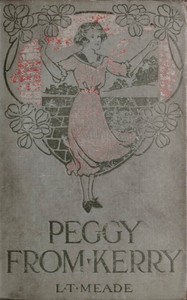
“No, it isn’t that, Molly; it’s something very different, something very sad. Poor Captain Desmond has just died of typhoid fever in India, and now, my darlings, comes the crux. He wrote on his deathbed to your father, making a sort of confession. He said that long ago, in Ireland, in the County Kerry, he met a beautiful Irish peasant girl, fell in love with her, and married her. They had one little daughter, and the mother died at the child’s birth. The little girl was brought up by her maternal grandparents until they died; then for the last five or six years some people of the name of O’Flynn took charge of her, her father paying them for doing so. The O’Flynns are very poor and common sort of people. The girl is fifteen years of age, and has lived all her life in Irish cabins in the County Kerry. Now, Peter Desmond on his deathbed told your father that the child is penniless, except for a small annuity which she will get from the Government as his daughter. He has asked your father to adopt this poor girl, to bring her here—here!—and to let her grow up as a lady; and your father says he will. Nothing will turn him, no amount of imploring on my part; he has made up his mind. Captain Desmond was his dearest friend. He is going to Ireland to-night to fetch this child—Peggy, he calls her. Now, what is to be done?”
Mrs. Wyndham burst into tears. “To think of such a creature coming to us!” she said. “Why, even the servants would be ashamed of her.”
Jess, the eldest girl, was quite silent; but Molly, after a moment’s pause, kissed her mother’s flushed cheek and said:
“Well, mums, I do think that father could do nothing else.”
Mrs. Wyndham gazed at the child in despair.
“It’s very hard on mums, I must say,” exclaimed Jessie.
“Yes, of course,” answered Molly; “but still it’s right. Right things are often hard,” she added.—“And, mother, we’ll look after her; you mustn’t be worried,” continued the girl.
“But it is on account of you both that I am so unhappy. Oh,” continued the good lady, “you have never seen an Irish peasant! She is a most disgraceful creature!”
“Oh mother, but this girl is a lady by birth!”
“On her father’s side,” said Mrs. Wyndham; “but what about her mother? Her father, as well as I can tell, has never troubled himself even to see her, and now he hands her over to us. I do call it terrible!”
As Mrs. Wyndham spoke she rose from her chair and stood for a few minutes looking out of the window at the peaceful landscape.
“Mother,” said Jessie suddenly, “couldn’t she go to school for a bit—until she’s polished up a little, I mean? Oh, I don’t mean to our school, of course, but to some other school.”
“I thought of that, my dears; but your father won’t have it. He says that if the child comes here she is to be treated from the first as a lady, as a daughter of the house; and if possible, and we can get Mrs. Fleming to take her, she is to go to your school at The Red Gables.”
“Oh mother!”
Both girls looked rather dismayed at this prospect. Mrs. Wyndham soon afterwards left them. She had to attend to her husband, who was making preparations for his journey.
“Now, my darling,” he said, as he kissed his wife affectionately, “you know, my dearest Lucy, there is nothing else to be done. Desmond was my best friend, and I’d rather die than neglect his child.”
Soon afterwards Mrs. Wyndham was left alone to her own reflections, and to the eager comments of her young daughters, who were full of curiosity about Peggy Desmond, wondering what sort of young savage would soon arrive at Preston Manor.
Meanwhile, Wyndham took train to Holyhead, crossed over to Dublin, and then took train from Dublin to Kerry. He arrived in the neighbourhood of the well-known town of Tralee in the course of the following afternoon; and, having inquired for the O’Flynns, was directed to their “bit of a house,” as the neighbour described it. Wyndham was a tall, well-set-up man of about forty years of age; he had a pleasant, kindly face, bright blue eyes, and was, in short, every inch a gentleman.
Now, no one in all the world knows better who is a gentleman and who is not than the peasant of Ireland. He sees who belong to the “quality,” as he calls it, and who does not, at a single glance; he also sees this fact, although one man may be dressed in rags and the other have a carriage and smart clothes, his ring with a diamond in it, and his swell manners. Mr. Wyndham was pronounced by the old man who directed him to the O’Flynns as a “oner.” “Why, thin, sure a gintleman to the innermost bone of him.”
He entered the small lane—or, rather, as the man shouted to him, “boreen”—and, walking down its narrow, pretty path, soon found himself outside a small cottage, which was surrounded by a sort of ill-kept farmyard. Some pigs were grunting and poking their noses into the soft earth, a dog sprang up at his approach and ran towards him, barking, a cat leaped out of sight and sprang into the branches of a neighbouring tree.
A girl who was standing by the cottage door came forward.
“An’ what may yer honour want?” she asked.
Wyndham looked at her curiously and with a sort of tremble at his heart. The girl bore a striking resemblance to his dearest friend, Peter Desmond. She had very large, dark-blue eyes, the true heritage of a Kerry girl; those eyes were put in, as is the proverbial expression, with “dirty fingers.” The thick, curly, long black lashes were lowered for an instant, then the eyes, bright as stars, fixed themselves on the stranger’s face. The girl’s hair was of a tawny shade, with a very slight touch, an almost imperceptible touch, of red in it; it was very thick, very long, and curled in fascinating little waves all over her small head. She wore a blue cotton frock which came down just above her ankles, coarse white stockings, and hobnailed shoes. Under her arm she carried a big dish filled with all sorts of farm refuse, which she had prepared to give to the fowls. Her sleeves were pushed up as far as her elbows, showing her pretty rounded arms, which were, however, reddened through exposure to all weathers.
“I need hardly ask your name,” said Wyndham. “You are, of course, Peggy Desmond?”
“Arrah, thin, I be,” answered the girl. “An’ what may ye be wantin’ wid me, yer highness?”
Wyndham put out his hand and took the rather dirty little one of Peggy Desmond.
“I have come from your father, my dear.”
“Ah! an’ wisha! have ye? Why, thin, I haven’t had a line from hisself this many a day. Is he took with the sickness forby, or does anything ail him at all, at all?”