Public-domain ebook
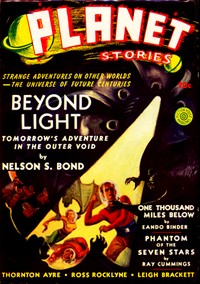
Phantom of the Seven Stars
by Ray Cummings
Language: en310 downloads on Project Gutenberg
Subjects
In: Science-Fiction & Fantasy·Adventure·Novels
Public-domain ebook sourced from Project Gutenberg #61855.
Public-domain ebook
by Ray Cummings
Language: en310 downloads on Project Gutenberg
Subjects
In: Science-Fiction & Fantasy·Adventure·Novels
Public-domain ebook sourced from Project Gutenberg #61855.
The opening · free to read
Lovely Brenda Carson, scholarly Jerome, pompous Livingston ... everyone aboard the Seven Stars scoffed at the idea of a Phantom Pirate. But I.P. agent Jim Fanning didn't laugh. He knew the luxury-liner's innocent looking cargo was already marked for plunder.
[Transcriber's Note: This etext was produced from Planet Stories Winter 1940. Extensive research did not uncover any evidence that the U.S. copyright on this publication was renewed.]
Part of my assignment on this space-flight of the Seven Stars was to watch the girl. That much, at least, wasn't hard. She was certainly easy to look at--a little beauty, slim with a pert, oval little face framed by unruly pale-gold hair. With mingled starlight and earthlight gleaming in that hair, it was like spun platinum. Her name was Brenda Carson. Certainly, she was an inspiring figure to any young man, in her white blouse and corded black and white trousers and her long black traveling cape with its hood dangling at the back of her neck and the cape folds flowing from her slim shoulders almost to the ground.
We were several days out from New York, with Mars, our destination, hanging like a great dull-red ball among the blazing stars in the black firmament ahead of us, when I first noticed that there was anything queer about Brenda. We were sitting under the glassite pressure-dome on the forepeak of the Seven Stars, bathed in the pallid starlight. By ship-routine it was mid-evening.
I gestured toward one of the side bull's-eyes of the bow-peak. "Gloomy-looking world, that Asteroid-9," I said.
The little asteroid, one of the many out here in the belt between the orbits of Earth and Mars, was a small leaden crescent of sunlight with the unlighted portion faintly putty-colored. It was, I knew, a world some five-hundred miles in diameter, amazingly dense so that its gravity was not a great deal less than Earth. A bleak, barren little globe. It had an atmosphere breathable for humans; there was water--occasional rainfall; but chemicals in the cloud-vapors poisoned the water for human consumption. The rocks were heavily laden with metals. But they were all base metals, of no particular value. So far as I knew, nobody had ever bothered to settle on Asteroid-9. It was completely uninhabited.
"Asteroid-9?" Brenda murmured. "Is that what it's called?"
Something in my chance remark had frightened her. Her blue eyes as she flung me a quick, startled glance were suddenly clouded with what might have been terror.
Her brother Philip was with us. He quickly said, "Asteroid-9? Somebody said we pass pretty close to it this voyage." He laughed. "Rotten sort of place, by what I've heard. You can have it and welcome."
I must explain that I was--and still am--an IP Man. My name, Jim Fanning. I was assigned as Lieutenant to Patrolship two. I had been on vacation, in New York. My ship, one of the biggest in the Interplanetary Patrol, was now on roving duty somewhere in the vicinity of Mars. Then suddenly an emergency with the Seven Stars had arisen. Chief Rankin had planted me on her. Only the captain knew my identity. To the dozen or so passengers, I was merely a young civilian traveler.
"I've never been to Asteroid-9," I was saying. And I, too, laughed casually, "I agree with you, Carson. Nice place to die in, but I guess that's all."
There was no question but what Brenda was trying to hide her sudden emotion. Terror? Was that it? We said no more about the asteroid; chatted of other things, and we were presently joined by another of the passengers.
"Ah, beautiful night," he greeted us. "I never get tired of the glories of the starways. Good evening, Miss Carson." He nodded smilingly to Philip Carson and me, and drew up a chair with us. His name was Arthur Jerome, well-known to me, though I had never before met him. He was a big, florid, distinguished-looking man of forty-odd; a habitual Interplanetary traveler, who between flights lectured over the earth television networks on things astronomical.
We talked for a while, and then suddenly Arthur Jerome said, "Nobody mentions the Phantom bandit. You know, if anything could spoil my interest in Interplanetary travel, it's to have a weird thing like that come up."
"Phantom bandit?" Brenda Carson murmured. "Is there--is there really such a thing?"
Arthur Jerome shrugged. "Naturally it's had no publicity. But things get out. Those last three accidents to space-liners--you can't hide that sort of thing. And you wouldn't call it supernatural. Or would you?"
The Phantom of the starways! That was the crux of my being here on the Seven Stars. Weird, mysterious thing--no wonder the Earth, Mars and Venus governments had not dared let it get any publicity which they could possibly avoid. For three months now, this Earth-year of 2170, mysterious accidents had been happening to commercial space-ships. Non-arrival at destination, and then later found by the Interplanetary Patrol, derelicts in space. Gruesome damn' thing. A ship unharmed, save that its air was gone. As though some mysterious accident had broken one of the pressure valves, or deranged the machinery of an exit-porte, so that the air had all hissed out. Ship of the dead. Everyone aboard lying asphyxiated.
It was eerie.
A "ghost-vessel" attacking the liners? A modern version of the ancient Flying Dutchman legend? Radio newscasters talked of things like that. A vengeful ghost-ship roaming the starways, with dead pirates aboard, bent on attacking the living navigators whom they hated just because they were alive. It made nice gruesome broadcasting to give the television audience the shivers. Supernatural legends easily get support. Particularly from hysterical, imaginative women, or cranks who crave publicity. Reports had come from amateur astronomers who owned fairly decent telescopes that they had seen the wraith of a pallid ghost-ship hovering up in Earth's stratosphere; passengers on liners had hysterically thought they saw the same thing.
A supernatural menace. But no reputable observer had ever seen anything. Our Interplanetary Patrol was completely baffled. And what the public didn't know was that those wrecked vessels--one of them, at least--had shown evidence that it had been hit by an electronic space-gun with a range of several hundred miles, which had broken the pressure-dome and let the air out. And in every case the wrecked ship was looted; the passengers' money and jewelry gone; the Purser's safe rifled.
"Anyway, it's a good thing for us," Arthur Jerome was saying, "the little Seven Stars ought not to be much of a prize for the phantom raider." He grinned, with his hand ruffling his sandy hair. "Let's hope we escape."
The Seven Stars not much of a prize? It was certainly reasonable enough to think that. We had a few Martians in the second-class section, and a few Earthmen passengers; and just an average commercial cargo. That's what anyone would think; and only the captain and I knew differently. Our cargo was anything but average. The boxes, as they had come aboard and been stored in the hold, were labeled as American preserved food-stuffs; technical commercial instruments, German-made prisms, lenses and the like. But in reality those boxes were crammed only with modern electronic weapons of war. It was a shipment purchased by the Martian government which was faced by the insurrection of its wealthy colony on Deimos. They were unusual weapons of exclusive Earth-manufacture. Small, for short-range, hand-use only; weapons to disable, but not injure. The recently publicized so-called "paralysis gun" was one of them. The Martian government, humane at least in battle with its own people, desperately needed this type of weapon in its forthcoming invasion of Deimos to subdue the rebels.
Not much of a prize, our little commercial liner Seven Stars this voyage? Just the opposite! Those rich colonists of Deimos most certainly would pay well to keep this shipment away for Mars! Would news of it have leaked out? Would the Phantom of the Starways attack the Seven Stars for just that purpose? Chief Rankin, of the Interplanetary Patrol, certainly thought it a possibility. He had put me aboard here; and as only the Captain and I knew, my ship--Patrolship-2--had been ordered to join us out here somewhere and convoy us to Mars. Convoy us against an attack by an enemy that you couldn't see!
"The Phantom raider!" Young Philip Carson was echoing Arthur Jerome's lugubrious words. "You suppose there is really any such thing?" I saw him exchange a glance with his sister. He laughed, but it wasn't much of a success.
"I doubt it," I agreed. "So far as I ever heard, those accidents were--well, just accidents. An air-valve can go wrong, you know, and dump the air out of a ship. Air goes quickly, and with a pretty powerful rush, if it once gets started.... Gruesome kind of talk, Miss Carson," I added lightly.
She tried to smile. My heart went out to her in that moment. Her beauty, I suppose; but somehow she seemed horribly pathetic. That mention of Asteroid-9 mysteriously frightened her; and now this mention of the phantom spaceship terrified her even more.
"You're right," Arthur Jerome agreed. "The supernatural is fascinating. Or a thing that you can't see but still can kill you--that's just as gruesome."
"And fascinating?" Philip Carson put in sourly. "Well, it may be to you, but it's frightening my sister. Let's talk of something else."
Then another passenger joined us. That girl was a magnet to men.
"Well, well, Miss Carson," he boomed as he came up. "You are looking very beautiful in the starlight." He sat down with us. His name was Walter J. Livingston--the Very Honorable Walter J. Livingston to give him his official title. He had just been appointed by the President of the World-Federation as Earth Ambassador to the Martian Government; was on his way there now to present his credentials. He was a big, heavy-set fellow, with a mass of iron-gray hair, a ribbon across his ruffled shirt-bosom; and the out-jutting jaw and booming voice of a born politician. Did he by any chance know the contents of the Seven Stars' cargo, this voyage? So far as I had been informed, he did not. I studied him now, and instinctively I didn't like him--possibly because of the extravagant compliments he was paying Brenda Carson.
The talk went on, and presently as I glanced up to the little control tower under the pressure-dome above us, I saw the bulky figure of Captain Wilkes standing there. He caught my gaze and furtively gestured. I excused myself in a moment; sauntered down the narrow side deck, turned a distant corner of the little superstructure. Then I went up to its roof, and forward again. In a moment I was in the control tower.
Patrolship-2, coming to convoy us. I took a look through the eye-piece of the telescope. Familiar vessel on which I had spent so many months. Its long cylindrical alumite hull, with the pressure-dome over its single upper deck, was painted by sunlight on one side and starlight on the other as it headed diagonally toward us. By the range-finder on the telescope I measured its visual length.
The book keeps going
Reading is free forever. Sign up and watch scenes appear while you read.



Scenes Storieta drew for other classics.
New illustrated classics
Once or twice a month: the latest books to get full character casts, scene art, and free comic editions. No account needed.