Public-domain ebook
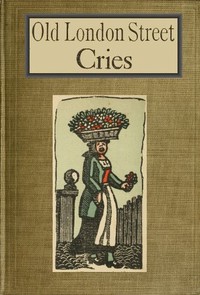
Old London Street Cries and the Cries of To-day With Heaps of Quaint Cuts Including Hand-coloured Frontispiece
English444 downloads on Project GutenbergDownload EPUB
Public-domain ebook sourced from Project Gutenberg #61861.
Public-domain ebook
English444 downloads on Project GutenbergDownload EPUB
Public-domain ebook sourced from Project Gutenberg #61861.
The opening · free to read
Since Lydgate's time the cries of London have been a stock subject for ballads and children's books, of which, in various forms, some hundreds must have appeared within the last two centuries. The cuts, unless from the hand of a Rowlandson or a Cruikshank, are usually of the mechanical order; and one finds copies of the same illustrations, though differently treated, constantly reappearing.
In the books there is usually a cut on each page, with a cry printed above or underneath, and in addition a verse of descriptive poetry, which, if not of the highest order, serves its purpose.
With his machine and ass to help To draw the frame along, Pray mark the razor-grinder's yelp The burden of his song. His patched umbrella quick aloft He mounts if skies should lower, Then laughing whirls his wheel full oft, Nor heeds the falling shower.
A well-known collection is that entitled "Habits & Cryes of the City of London, drawne after the Life; P. [Pearce] Tempest, excudit," containing seventy-four plates, drawn by Marcellus Laroon [Lauron], and republished in 1711. The first edition, with only fifty illustrations, had appeared some three-and-twenty years earlier; and many of the copper-plates in the later issue were so altered as to bring the costume into the fashion of the time of republication. The hats had their high crowns cut down into low; and shoe-buckles were substituted for laces. Otherwise the plates,--with the exception of some of the faces, which were entirely re-engraved,--were left in their original condition.[4] The letter-press descriptions are in English, French, and Italian. The engraver, Marcellus Lauron, or Captain Laroon, who was born in London, has left on record that his family name was Lauron, but being always called Laroon, he adopted that spelling in early life. Of the seventy-four plates, those representing eccentric characters, etc., are omitted from the list that follows:--
Any Card Matches or Save Alls? Pretty Maids, Pretty Pins, Pretty Women!
"I remember," says Hone, "that pins were disposed of in this manner, in the streets by women. Their cry was a musical distich:--
'Three Rows a Penny pins, Short, Whites, and Mid-dl-ings!'"
Ripe Strawberryes!
A Bed Matt [mat] or a Door Matt! Buy a fine Table Basket? Ha, ha, Poor Jack!
Can hardly be called a London cry: the call of a well-known character, who, accompanied by his wife, sold fish.
Buy my Dish of great Eeles?
Buy a fine singing Bird? Buy any wax or wafers? Fine Writeing Ink! A Right Merry Song! Old Shoes for some Broomes! Hott baked Wardens [stewed pears] Hott! Small Coale!
Swift mentions this cry in his "Morning in Town."
"The Small Coal Man was heard with cadence deep Till drowned in shriller notes of 'Chimney Sweep.'"
Maids, any Coonie [rabbit] Skinns? Buy a Rabbit, a Rabbit? Chimney Sweep! Crab, Crab, any Crab? Oh, Rare Shoe! Lilly White Vinegar! Buy any Dutch Biskets? Ripe Speregas! [asparagus] Buy a Fork or a Fire Shovel? [See p. 13.] Maids, buy a Mapp? [mop] Buy my fat Chickens? Buy my Flounders? Old Cloaks, Suits, or Coats?
[Succeeding Old Doublets, the cry of a slightly earlier period.]
Fair Lemons and Oranges?
Old Chaires to Mend? Twelve Pence a Peck, Oysters! Troope every one! [See p. 17.]
The man blowing a trumpet--troope every one!--was a street seller of toy hobby-horses. He carried his wares in a sort of cage; and to each rudely represented horse's head was attached a small flag. The toy hobby-horse has long since disappeared, and nowadays we give a little boy a stick to thrust between his legs as a Bucephalus. Hone opines that our forefathers were better natured, for they presented him with something of the semblance of the genuine animal.
Old Satten, Old Taffety, or Velvet! Buy a new Almanack! Buy my Singing Glasses!
These were long bell-mouthed glass tubes. The writer recollects that when a boy he purchased, for a copper or two, fragile glass trumpets of a similar description.
Any Kitchen Stuffe have you, Maids? Knives, Combs, or Inkhorns! Four for Six Pence, Mackrell! Any work for the Cooper? Four Paire for a Shilling, Holland Socks! Colly Molly Puffe!
The cry of a noted seller of pastry. He is mentioned in the Spectator, No. xxv.
Sixpence a pound, Fair Cherryes! [See p. 21.]
Knives or Cisers to Grinde! Long thread Laces, long and strong! Remember the poor Prisoners!
In a series of early prints in the Bridgewater library, from copper plates, by an unknown artist, probably engraved between 1650 and 1680, there is one thus titled: "Some broken Breade and meate for ye poore prisoners: for the Lorde's sake pittey the poore." Within the memory of our fathers a tin box was put out from a grated window in the Fleet prison, a prisoner meanwhile imploring the public to remember the poor debtors. In the "Cries of York, for the amusement of young children," undated, but published probably towards the end of the last century, are the following lines:--
Of prisoners in the Castle drear Come buy a Kalendar, Their crimes and names are set down here 'Tis Truth I do declare.
A brass Pott or an Iron Pott to mend! Buy my four ropes of Hard Onyons! London's Gazette here!
The London Gazette, established in 1665.
Buy a White Line or a Jack Line, or a Cloathes Line. Any old Iron take money for? Delicate Cowcumbers to pickle! Any Bakeing Peares? New River Water!
The cry of "Marking Stones," which marked black or red, and preceded the daintier cedar-encased lead pencil of our own time, is not mentioned by Laroon. J. T. Smith,[5] says that the colour of the red marking-stone was due to "Ruddle," a colour not to be washed out, and that fifty years ago (he wrote in 1839) it was the custom at cheap lodging-houses to mark with it on linen the words, "_Stop thief!_"
The following lines are from a sheet of London Cries, twelve in number, undated, but probably of James the Second's time:--
Buy marking-stones, marking-stones buy, Much profit in their use doth lie; I've marking-stones of colour red, Passing good, or else black lead.
In the British Museum is a folio volume containing another curious little collection, on three sheets, of early London cries; also undated and of foreign
workmanship, but attributable to the time of Charles II. The first sheet has a principal representation of a rat-catcher with a banner emblazoned with rats; he is attended by an assistant boy, and underneath are these lines:--
He that will have neither Ratt nor mousse, Lett him pluck of the tilles And set fire of his hows.
Cooper. En of golde! Olde Dublets! Blackinge man. Tinker. Pippins! Bui a matte! Coales! Chimney swepes. Bui brumes! Camphires! [Samphire] Cherrie ripe! Alminake! Coonie skine! Mussels! Cabeches! Kitchen stuff! Glasses! Cockels! Hartti Chaks! Mackrill! Oranges, Lemens! Lettice! Place! Olde Iron! Aqua vitæ! Pens and Ink! Olde bellows! Herrings! Bui any milke?
Piepin pys! Osters! Shades! Turneps! Rossmarie Baie! Onions.
The principal figure on the second sheet is the "Belman," with halberd, lanthorn, and dog.
Mayds in your Smocks, Loocke Wel to your locke-- Your fire And your light, & God Give you good-night. At One o'Clock.
The book keeps going
Reading is free forever. Sign up and watch scenes appear while you read.



Scenes Storieta drew for other classics.
New illustrated classics
Once or twice a month: the latest books to get full character casts, scene art, and free comic editions. No account needed.