Printed and Published by H. Jones, at the Atmospheric Gas Printing Works, “Advertiser” Office, Llangollen.
LADY ELEANOR CHARLOTTE BUTLER AND MISS SARAH PONSONBY, OF PLAS NEWYDD.
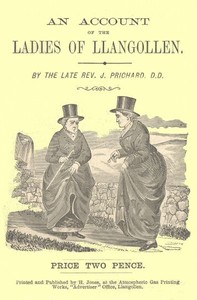
LADY Eleanor Butler and Miss Ponsonby were Irish ladies of rank and beauty, who loved each other with an affection so true that they could never bear the idea of the separation which the marriage of either would necessitate. They, therefore, resolved on lives of celibacy, and, refusing many handsome offers, fled from home. They were, however, overtaken and brought back to their respective relations. Many attempts were made to draw Miss Butler into marriage, but all were in vain. In a short time the ladies eloped again, each having a small sum with her; and it was said that, although Lady Eleanor arrived here in the natural aspect of a maid of 34, Miss Ponsonby accompanied her in the guise of a smart footman, in top boots and buskin breeches. It was about the year 1778 when these errant ladies visited Llangollen. While rambling along this charming locality, their eyes rested on a gentle eminence near the village, and there they resolved to fix their abode. They, accordingly, purchased the estate, built a new cottage on the site of the old one, laid out gardens, pleasure grounds, rural walks and bridges, by which they might enjoy the natural charms of this picturesque retreat. Their mode of life being very singular, and their costume still more so, they soon became noticed by the many travellers who passed through North Wales. The celebrated comedian Charles Mathews thus describes their appearance:—“As they are seated, there is not one point to distinguish them from men; the dresses and powdering of the hair, their well-starched neckcloths, the upper part of their habits (which they always wear, even at a dinner party) made precisely like men’s coats, with regular black beaver hats, everything contributing to this semblance. To crown all, they had crop heads, which were rough, bushy, and white as snow.”
Plas Newydd was built at the north-east end of a field called the Maes, and was, therefore, called _Penymaes_—The end of the Maes.
The ladies were, according to their means, charitable to the aged, sick, and infirm; and had been taught, by wisdom and experience, that the best way to help the poor labourer was by giving him employment. The workman, having precious commodities for the market of the world—physical power, knowledge, and good common sense—that were of more value to society than gold or land, would, by being given an opportunity to use his capacities, be able to support himself and family, without losing his independence, and humbling himself to be a crouching beggar, producing no honey to the common hive. Although their farm had only thirteen acres of land—four of their own, and nine held as tenants, they kept a carpenter, a cowman, a man for all work on the farm, and in the hay-harvest an additional number of men and poor women; with two ladies’ maids and three female servants in the house. By the help of these male hands, they made every inch of ground productive, and every hedge-fence and walk pleasant to the sight—well answering their end, and the house healthy, orderly, and comfortable. In employing the labouring class, they were as wise and praiseworthy as the Society of Friends.
We recollect another feature in the character of the Ladies of Penymaes,—their non-interference with the religion of their servants. They wished all to be religious, and possess the root of the matter. Though they were LADIES, they left conscience to be ruled by its rightful Owner; they followed the example of a certain German sovereign, who, when some of his courtiers advised him to compel all his subjects to be of the same religion as himself, replied, “I rule over the bodies of my faithful subjects; as touching the soul I am not their king, but a fellow-subject with them to the Great King, who can govern the soul, and has reserved conscience as His own sacred province.” Lady Eleanor and the Honourable Miss Ponsonby knew too well that coercion might make people worthless hypocrites; but teaching the truth, a life consistent with the truth of God, with loving persuasion, only could make sincere followers of Him, who says, My son, give me thine heart.
Allow us to relate another incident in the lives of the Ladies of Llangollen that fell under our observation, under the following heading:—_Kindness creates kindness and liberality_. Mr. Thomas Jones, of Bachau Mill, and the minister of Penybryn Chapel were the collectors for the Bible Society through the township of Bachau, from year to year, for thirty years. Penymaes being in their district, the collectors called there as well as every other house in the township, and were received with a smile, wishes of success, and a handsome subscription from the ladies’ maids, Misses Elizabeth and Jane Hughes, and something from the other servants. Either Miss Jane or Miss Elizabeth would always present the collecting book to the ladies. But the book, for years, would be returned from the ladies’ room, without anything to gladden the collectors’ hearts. However, one year, Miss Jane said, with a double smile, and appearance of confidence on her face, “Please, I will take your book to Lady Eleanor and Miss Ponsonby.” She soon returned with a yellow piece that did gladden the hearts of the collectors, and added, “You must be sure, every year, to call on the ladies.” And so they did as long as the last of them remained on earth, and met with equal success and cheerfulness. The collectors had no clue to the welcome change at Penymaes, in collecting, for years after the death of Miss Ponsonby. In course of time, Miss June Hughes (now Mrs. Roberts, Ormonde Cottage, Berwyn Street,) was united in marriage to Mr. Edward Roberts, timber merchant, and attended the means of grace at Penybryn Chapel, and became a useful member there. When the minister of Penybryn was taking tea at her house, she asked him, “Do you remember the time you and Mr. Jones received the first half-sovereign for the Bible Society from the dear ladies!” “Yes, as it were yesterday, but we know not the cause of our success.” “Well, I shall tell you. Do you remember Lady Eleanor’s severe illness about two years before she died?” The minister replied, “I do, and shall never forget it.” “You, therefore, remember your praying so earnestly for her, and for her recovery, that you, and many of the congregation, were moved to tears? Next day, someone, that was present at Penybryn, described at Plas Newydd the remarkable prayer, and its effects upon yourself and those present. When the ladies heard of the prayer they felt so much that they remembered the words of the Apostle James (chap. v. 16), ‘The effectual fervent prayer of a righteous man availeth much.’ And Lady Eleanor soon recovered, and was restored to her usual health: and both believed that the God of the Bible had saved her life, and restored her health, and determined, to the end of their days, to subscribe for the Bible; and so they did, as you know.” The minister thanked Mrs. Roberts for the encouraging relation that revealed the secret of the collectors’ success, on behalf of the British and Foreign Bible Society, at Plas Newydd.
Miss Seward, the clever and amusing gossip, says of the “ladies,” whom she rhapsodizes as “the enchantreses” of Plas Newydd:—
“Lady Eleanor is of middle height, and somewhat beyond the embonpoint as to plumpness; her face round and fair, with the glow of luxuriant health. She has not fine features, but they are agreeable; enthusiasm in her eye, hilarity and benevolence in her smile. Exhaustless is her fund of historic and traditionary knowledge, and of everything passing in the present eventful period. She expresses all she feels with an ingenuous ardour, at which the cold-spirited beings stare. I am informed that both these ladies read and speak most of the modern languages. Of the Italian poets, especially of Dante, they are warm admirers. Miss Ponsonby, somewhat taller than her friend, is neither slender nor otherwise, but very graceful. Easy, elegant, yet pensive, is her address and manner.
“Her voice, like lovers’ watched, is kind and low.”
“A face rather long than round, a complexion clear but without bloom, with a countenance which, from its soft melancholy, has a peculiar interest. If her features are not beautiful, they are very sweet and feminine. Though the pensive spirit within permits not her lovely dimples to give mirth to her smile, they increase its sweetness, and, consequently, her power of engaging the affections. We see, through her veil of shading reserve, that all the talents and accomplishments which enrich the mind of Lady Eleanor exist, with equal powers, in this her charming friend.”
The celebrated Madame de Genlis, in an entertaining miscellany, under the title of “Souvenirs de Felicie L—,” has given the following graphic narrative of “The Fair Recluses of Llangollen:”—
During my residence in England, nothing struck me so much as the delicious cottage of Llangollen, in North Wales. It is not a little extraordinary, that a circumstance, so singular and remarkable, as that connected with this retreat, should hitherto have escaped the notice of all modern travellers. The manner in which I became acquainted with it was this:—During our long stay at Bury, a small company of five or six persons, including ourselves, met every evening from seven till half-past ten o’clock. We diverted ourselves with music and conversation, so that the time passed very agreeably. One night, friendship happened to be the subject of conversation, and I declared that I would with pleasure undertake a long journey to see two persons who had long been united by the bonds of genuine friendship. ‘Well, madam,’ replied Mr. Stuart (now Lord Castlereagh), ‘go to Llangollen; you will there see a model of perfect friendship, which, will afford you the more delight, as it is exhibited by two females who are yet young and charming in every respect. Would you like to hear the history of Lady Eleanor Butler and Miss Ponsonby?’—‘It would give me the greatest pleasure.’—‘I will relate it to you.’ At these words the company drew nearer to Mr. Stuart, we formed a little circle round him, and after recollecting himself a few moments, he thus began his narrative:—
‘Lady Eleanor Butler was born in Dublin. She was left an orphan while in her cradle; and possessing an ample fortune, together with an amiable disposition and a beautiful person, her hand was solicited by persons belonging to the first families in Ireland. At an early age she manifested great repugnance to the idea of giving herself a master. This love of independence, which she never dissembled, did no injury to her reputation; her conduct has always been irreproachable, and no female is more highly distinguished for sweetness of temper, modesty, and all the virtues which adorn her sex. In early life a mutual attachment took place between her and Miss Ponsonby, by an accident, which made a deep impression on their imagination. They had no difficulty to persuade themselves that heaven had formed them for each other; that is, that it had designed each of them to devote her existence to the other, so that they might glide together down the stream of life, in the bosom of peace, the most intimate friendship, and delicious independence. This idea their sensibility was destined to realize. Their friendship gradually grew stronger with their years, so that when Miss Ponsonby was seventeen, and Lady Eleanor Butler thirty-four, they mutually engaged never to sacrifice their liberty, or to part from each other. From that moment they formed the design of withdrawing from the world, and of settling for good in some sequestered retreat. Having heard of the charming scenery of Wales, they secretly absconded from their friends for the purpose of fixing upon their future residence. They visited Llangollen, and there, on the summit of a hill, they found a little detached cottage, with the situation of which they were delighted. Here they resolved to form their establishment. Meanwhile the guardians of the young fugitives sent people after them, and they were conveyed back to Dublin. They declared that they would return to their hill as soon as they were free. Accordingly, when Miss Ponsonby was twenty-one, in spite of the entreaties and remonstrances of their relatives and friends, they quitted Ireland for ever, and flew to Llangollen. Miss Ponsonby is not rich, but Lady Eleanor possesses a considerable fortune. She purchased the little hut and the property of the hill, where she built a cottage, very simple in external appearance, but the interior of which displays the greatest elegance. On the top of the hill she has formed about the house a court and flower-garden; a hedge of rosebushes is the only enclosure that surrounds this rural habitation. A convenient carriage-road, the steepness of which has been diminished by art, was carried along the hill. On the aide of the latter some ancient pines of prodigious height were preserved; fruit trees were planted, and a great number of cherry trees in particular, which produce the best and finest cherries in England. The two friends likewise possess a farm for their cattle, with a pretty farm-house and a kitchen-garden close by. In this sequestered abode, these two extraordinary persons, with minds equally cultivated, and accomplishments equally pleasing, have now resided ten years, without ever having been absent from it a single night. Nevertheless, they are not unsociable; they sometimes pay visits to the neighbouring gentry, and receive, with the greatest politeness, travellers on their way to or from Ireland, who are recommended to them by any of their old friends.’