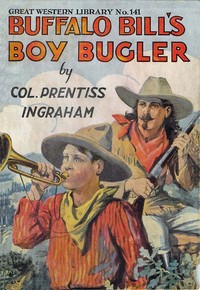
Public-domain ebook
Buffalo Bill's Boy Bugler; Or, The Last of the Indian Ring
Language: en1,780 downloads on Project Gutenberg
Subjects
In: Historical Novels·Adventure·American Literature
Public-domain ebook sourced from Project Gutenberg #62057.
Public-domain ebook
Language: en1,780 downloads on Project Gutenberg
Subjects
In: Historical Novels·Adventure·American Literature
Public-domain ebook sourced from Project Gutenberg #62057.
This work is a classic dime‑novel adventure built around the larger-than‑life figure of Buffalo Bill, written by Prentiss Ingraham, a close associate of the famed scout. The narrative opens with a nostalgic sketch of the men who first chronicled Cody’s exploits for the New York Weekly, then shifts into a vivid courtroom scene in Bozeman where “Red Dick” and “Doc Downs” stand trial for a cattle‑sheep conflict. As the crowd’s tension rises, a dramatic entrance by the flamboyant “Fighting Dan” Grey steals the focus, his booming threats and theatrical gestures setting the tone for a tale of lawlessness, rivalries, and frontier justice.
Ingraham’s prose is brisk, colloquial, and peppered with the exaggerated dialect of the Old West, reflecting the sensational style of late‑19th‑century popular fiction. The story’s rapid pacing, colorful characters, and frequent gun‑fights will appeal to readers who enjoy pulpy Westerns, historical yarns about Buffalo Bill, and the raucous energy of period serials. Those who appreciate a blend of mythic frontier lore with the swagger of dime‑novel storytelling will find this volume a lively, if unapologetically melodramatic, glimpse into the mythmaking of the American West.
The opening · free to read
(BUFFALO BILL).
It is now some generations since Josh Billings, Ned Buntline, and Colonel Prentiss Ingraham, intimate friends of Colonel William F. Cody, used to forgather in the office of Francis S. Smith, then proprietor of the New York Weekly. It was a dingy little office on Rose Street, New York, but the breath of the great outdoors stirred there when these old-timers got together. As a result of these conversations, Colonel Ingraham and Ned Buntline began to write of the adventures of Buffalo Bill for Street & Smith.
Colonel Cody was born in Scott County, Iowa, February 26, 1846. Before he had reached his teens, his father, Isaac Cody, with his mother and two sisters, migrated to Kansas, which at that time was little more than a wilderness.
When the elder Cody was killed shortly afterward in the Kansas “Border War,” young Bill assumed the difficult rôle of family breadwinner. During 1860, and until the outbreak of the Civil War, Cody lived the arduous life of a pony-express rider. Cody volunteered his services as government scout and guide and served throughout the Civil War with Generals McNeil and A. J. Smith. He was a distinguished member of the Seventh Kansas Cavalry.
During the Civil War, while riding through the streets of St. Louis, Cody rescued a frightened schoolgirl from a band of annoyers. In true romantic style, Cody and Louisa Federci, the girl, were married March 6, 1866.
In 1867 Cody was employed to furnish a specified amount of buffalo meat to the construction men at work on the Kansas Pacific Railroad. It was in this period that he received the sobriquet “Buffalo Bill.”
In 1868 and for four years thereafter Colonel Cody served as scout and guide in campaigns against the Sioux and Cheyenne Indians. It was General Sheridan who conferred on Cody the honor of chief of scouts of the command.
After completing a period of service in the Nebraska legislature, Cody joined the Fifth Cavalry in 1876, and was again appointed chief of scouts.
Colonel Cody’s fame had reached the East long before, and a great many New Yorkers went out to see him and join in his buffalo hunts, including such men as August Belmont, James Gordon Bennett, Anson Stager, and J. G. Heckscher. In entertaining these visitors at Fort McPherson, Cody was accustomed to arrange wild-West exhibitions. In return his friends invited him to visit New York. It was upon seeing his first play in the metropolis that Cody conceived the idea of going into the show business.
Assisted by Ned Buntline, novelist, and Colonel Ingraham, he started his “Wild West” show, which later developed and expanded into “A Congress of the Rough-riders of the World,” first presented at Omaha, Nebraska. In time it became a familiar yearly entertainment in the great cities of this country and Europe. Many famous personages attended the performances, and became his warm friends, including Mr. Gladstone, the Marquis of Lorne, King Edward, Queen Victoria, and the Prince of Wales, now King of England.
At the outbreak of the Sioux, in 1890 and 1891, Colonel Cody served at the head of the Nebraska National Guard. In 1895 Cody took up the development of Wyoming Valley by introducing irrigation. Not long afterward he became judge advocate general of the Wyoming National Guard.
Colonel Cody (Buffalo Bill) died in Denver, Colorado, on January 10, 1917. His legacy to a grateful world was a large share in the development of the West, and a multitude of achievements in horsemanship, marksmanship, and endurance that will live for ages. His life will continue to be a leading example of the manliness, courage, and devotion to duty that belonged to a picturesque phase of American life now passed, like the great patriot whose career it typified, into the Great Beyond.
It had come out of the long familiar war between the cattlemen and sheepmen. “Red Dick” and “Doc” Downs, cattlemen, were on trial for the shooting of Josh and Cabe Grey, sheep herders, and the slaughter of three hundred sheep. A typical Western crowd had drifted into Bozeman, including many soldiers from Fort Ellis. It was noon and the sun hung high and blazed down relentlessly on the perspiring spectators, as they poured out of the stuffy courtroom, at recess. Red Dick and Doc Downs were to be taken across the street to the hotel for lunch, and the crowd settled across the way to cheer or hiss the prisoners, as its sympathies dictated, as the handcuffed men were led forth by the officers.
Red Dick was known as a bad man and he looked the part. He stood six feet three in his stockings, was straight as an arrow, and, without an ounce of superfluous flesh, weighed 190 pounds. Contrary to the suggestion of his cognomen, he was not of Indian descent, but below the belt of tan at his neck the unbuttoned collar revealed skin as white as marble. It was a mass of curly, fiery-red hair that had given Richard Davids, from Vermont, his nickname in the West.
Red Dick’s steely gray eyes flashed, his hawk-bill nose sniffed contemptuously, and his short-cropped red mustache twitched nervously as he was led out of the courtroom and the hiss of his enemies fell on his ears.
Then came hoots and howls and verbal insults, intermingled with “tigers!” and “good boy, Dick!” “We’ll stand by you, Red!” etc.
At one time it seemed probable that the factional spirit among the spectators would lead to riot, as the feeling ran high and the crowd began surging back and forth about the prisoners, preventing the advance of the officers in charge.
At that moment there was a commotion far down the street, a clatter of pounding hoofs, a wild yell and a fusillade of revolver shots. Then there burst on the view of the crowd a figure so startling as to, for the moment, drive all thoughts of the prisoners from the minds of the wrangling spectators.
It was a great, rawboned, buckskin stallion, tearing up the main thoroughfare at a terrific pace, headed directly at the startled crowd. Astride the animal was a man to match--a tall, gaunt, broad-shouldered fellow in buckskin trousers and red flannel shirt, his long mustache sweeping back about his neck and fluttering in the wind with the corners of the handkerchief knotted there. In each hand the recognized “bad man” carried a big revolver with which he was boring holes in the ether by way of announcing his approach.
The horse, with wide-distended nostrils and showing belts of white around the iris of its eyes, dashed madly at the crowd, which scattered like chaff.
Almost upon the officers and their prisoners the big rider yelled:
“Whoa!”
The animal stopped so suddenly that it sat upon its haunches and slid for a yard or two while the rider seemed almost precipitated over its suddenly dropped head.
He landed squarely in front of the officers, his towering height now seen to the full, with a gun in each hand, and leaning far forward until his black and flashing eyes were on a level with those of Red Dick, he bellowed:
“So yo’re ther skunk thet plugged my brothers, air ye?”
Red Dick, with all his boasted bravery and deeds of dare-deviltry, cowered before the newcomer.
“It’s ‘Fighting Dan’ Grey!” gasped the crowd, as it scurried for quarters beyond the line of the big guns, which they felt sure were soon to be in action.
The officers shrank, too, and reached for their own guns in a half-hearted way.
Big Fighting Dan disdained the motion to draw on him, except to roar:
“Keep yer pepper boxes under yer co’t tails, officers, er it’ll be bad fer yer digestion.
“An’ so yo’re it! hey?” he boomed again.
“Waal, yo’re in ther han’s o’ ther law, jes’ now, an’ old Dan respects ther law, but Heaven hev mercy on yore pesky hide if I ever set my eyes onto yuh outside o’ ther clutches o’ ther sheriff an’ his men.”
Shoving his guns into his belt, the dark man continued:
“But I’m hyar an’ yo’re hyar, so now’s ther time ter pay my complerments--an’ thar yew hev um!”
He had suddenly reached forward, and, before the officers could protest or others divine his intention, he had grasped Red Dick by the chin with one hand and by the curling red hair with the other, and tipped the prisoner’s head far back. Then an amber stream left Dan’s dark lips, and Red Dick’s face ran with tobacco juice as he was released, a spluttering, raving, helpless wretch, while Fighting Dan turned away, swung into his saddle, and with a few parting shots dashed down the street and disappeared.
Taking advantage of the dazed condition of the crowd, the officers hurried their prisoners into the hotel.
Red Dick’s handcuffs were removed to allow him to wash the tobacco stains from his face, but he was in too much of a rage to eat. He sat and indulged in savage mutterings by way of intrenchment of his vow to torture Fighting Dan at the stake, if he--Dick--ever got out of the grip of the law.
Doc Downs had little to say. He had escaped the wrath of Fighting Dan, for which he was thankful, and the sympathy and hatred of the crowd seemed to centre on Red Dick, rather than on him.
Doc was shrewd enough to keep still and remain in the background. Doc was not a practicing physician, as one might infer from his nickname. If there was anything which Doc knew less about than another, it was the application of drugs or the uses of lance and bandage. For some reason which never had been explained, Doc’s parents had given him the prefix “Modoc.” As a boy he had been “Mo,” and then “Mod,” now “Doc.”
Doc wasn’t smart enough to be a first-class bad man, although he had aspirations in that direction, and he was too indolent to earn an honest living. So, when Red Dick, the dashing cowboy, blew into town one day and flourished a wad that would have blocked the pathway of a four-year-old steer, Doc hitched onto the tail of the curly-haired comet.
The book keeps going
Reading is free forever. Sign up and watch scenes appear while you read.



Scenes Storieta drew for other classics.
New illustrated classics
Once or twice a month: the latest books to get full character casts, scene art, and free comic editions. No account needed.