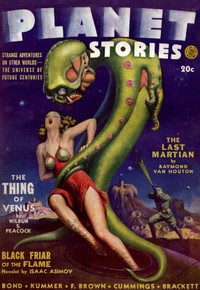
Planetoid-150 was a world of horror. A star of death, ruled by a weird and beautiful Earthian goddess.
[Transcriber's Note: This etext was produced from Planet Stories Spring 1942. Extensive research did not uncover any evidence that the U.S. copyright on this publication was renewed.]
The weird purple glow of the planetoid was apparent now, even to the naked eye. The end of Roy Atwood's long, lonely journey was at hand. In the narrow control-turret of his small spaceship he sat gazing. Planetoid-150, in the belt out here, far beyond Mars, was a great leaden disc now occupying nearly a quarter of the firmament. And the purple glow of the Xarite was puzzling. On Earth, young Atwood's father had located the treasured substance with a giant electro-spectroscope; seen it after patient search as a tiny tracery, a faint band upon the prismatic 'graph of the light from this distant world.
And now Atwood was here, seeking it. Long since he had discarded his spectroscope, here in the spaceship turret. It had been his compass, the identification of Planetoid-150, enabling him to chart his course. It was unnecessary now. He stared, puzzled. Surely there must be an immense amount of the electroidally active _Xarite_--the name his father had given it--here on this little world. And all concentrated almost in one spot, apparently. The weird purple sheen was intense; a patch down there on the putty-colored surface of the five-hundred-mile-diameter asteroid. Occasionally he could see it clearly. Then at other times the leaden, sullen, low-hanging cloud masses of the unknown little world wholly obscured it.
With his journey's end so near, Atwood's heart was pounding. But a grimness was on him. He was a young fellow; just twenty-four this Earth-summer of 2050, a handsome young giant whose hundred and ninety pounds were stretched over a powerful, yet almost lanky, frame. In the Government College of New York, he had been a champion athlete. What would he be here?
Actually, Atwood cared very little what strange form of life might exist here on Planetoid-150. His was not a trip of scientific exploration. Now that the beginning of Interplanetary travel was at hand, he was willing to leave all that sort of thing to the professional scientists. His was a secret adventure, and so he had of necessity come alone. His purpose was to land on this unknown little world, and get a small quantity of the treasured Xarite. With that safely stored in the foot-long, insulated cylinder which now was ready to strap on his back, he would leave and get back to Earth as speedily as possible.
It had been a long journey. Atwood contemplated it now as the round disc of the asteroid enlarged until it was beneath him, stretching all across the lower firmament; and he set his anti-gravity plates to resist his fall and verified that the repellent rocket-streams of electroidal gases were ready for the final atmospheric descent. By his calculation he would emerge from the clouds fairly close to the Xarite purple glow. It would be early evening here. He recalled the details of Planetoid-150 which had been in the letter to him from his dead father. Meager details indeed. Dr. Paul Atwood had calculated the asteroid at between five and six hundred miles in diameter.
Then the clouds broke away. Atwood's heart was pounding as he stared down for his first real sight of the unknown world. At first it was a blur of deep purple radiance. It seemed to blind him, this weird glow to which his eyes were unaccustomed. But presently he could see better.
Ahead, the purple glow suffused the night with its faint but lurid sheen. Then his eyes seemed to grow accustomed to the purple so that he had the illusion of it fading a little with the details of the scene taking form. A broken forest stretched here--a strange, spindly form of purple and red vegetation. In places it grew a hundred feet or more high in a tangled, lush, solid mass of interwoven vines. There seemed no trees. It was all slender-stalked, spindly.
Atwood stared, amazed, puzzled. The forest, if it could be called that, grew in dense patches, interspersed with open spaces where there was apparently a little soil. Others were naked, gleaming masses of metallic rock. The forest patches swayed in a gentle night-breeze like marine vegetation in water. The stalks of the vines were thick with giant pods; balloon-like things twenty feet or more in length. It was as though gases of decomposing vegetation within them were lifting them so that their upward pull held erect the swaying, hundred-foot stalks.
Off in the distance, from the height at which he stared down, Atwood could see a thread of river. It gleamed dull purple-green, from the _Xarite_-glow, and the reflection of the cloud-light. The same glow of cloud-light shone on the forest-top.
Landing demanded all of Atwood's attention, so that after his first quick scrutiny of what lay down there, he looked about for a place to land. He headed for a dim open space in the forest, an almost level hundred-foot area seemingly of rocky soil.
Then, at last, he had landed; brought the forty-foot, narrow little ship down flat upon its spreading base fins. With air helmet beside him in the event this atmosphere was not breathable, he cautiously opened a pressure-exit porte. The cylinder's air did not go out. On the contrary, the outer pressure was greater, so that the planetoid's air came hissing in--a rush at first, then a filtering drift, and then it stopped.
Atwood's head reeled. He gripped his air-mask; then his head steadied and he discarded the mask. Breathable air. It was heavy; moist, aromatic with strange smells of the forest. But breathable. In a moment he hardly noticed its strangeness. In the silence, mingled with the thumping of his heart against his ribs, a low hum now was audible coming through the open porte. The voice of the forest. The blended hum of insect life. Was it that? He listened. It was a weird hum. So faint it seemed that he heard it within his head, rather than against his ear-drums. A tiny throbbing sound. But he seemed to know that it was vast. The blend of billions of still more tiny sounds. And queerly, it seemed hideous. A thing at which he should shudder. A thing of terror.
With a lugubrious grin he shoved away the thought. Certainly it was no more than a hunch, a premonition.
Atwood was clad in short, tight trousers, grey shirt open at his muscular throat, and heavy boots. His crisp curly blond hair was matted with sweat on his forehead. The descent through the atmosphere had made his little ship insufferably hot. This moist, heavy night air was a relief, but not much. At his wide leather belt, pulled tight around his waist, he carried a small electroidal flash-gun in a holster. The insulated cylinder into which he would put the Xarite was slung with a leather strap over one shoulder. In a hand-case he carried his portable mining equipment and a few explosive-capsules. But he did not expect to need any of it. Surely this Xarite was on the surface. And with a glow like this, it must exist in almost a pure state. Perhaps it was not more than a mile from here in a concentrated lode somewhere here in this weird forest. All he needed was a scant pound of it. He might have it and be back here in an hour or two.
Fully ready now for what he hoped was a simple quest, Atwood stepped through the exit porte. Within the ship his interior gravity was maintained at about that of Earth. But as he stepped over the threshold, the gravity of the planetoid gripped him. Amazing change. He clutched at the porte-casement to steady himself. His weight--certainly most of it--had gone. Swaying on his feet, the lightness made him reel. Then gingerly he took a step. Seemingly he weighed now no more than ten or fifteen pounds. Carefully, with flexed knees, he impelled himself upward. It was the sort of leap which on Earth would have taken him a foot or so off the ground. He rose now to a height higher than his head, and came down, landing in a scrambling heap.
For a while, amused in spite of his grimness, Atwood experimented. By the feel of his cautious attempts, a good running leap would sail him a hundred feet or more, and probably smash him against a rock. Better be careful at first. It wouldn't be hard to kill himself, making errors with a power like this. His muscles were so powerful now in comparison with his weight.
Then he was ready to start. That faint weird humming still was audible. But there seemed nothing living here--no insect life underfoot, no birds in the trees. And, suddenly, he stood staring, stricken. Something was up on the top of the nearby patch of forest. The matted vegetation up there a hundred feet above him was so solid that he realized now he probably could manage to walk upon it. Something was moving up there. A swaying little blob, vaguely white.
Atwood stood silent, watchful with his gun in his hand. The blob seemed about five feet tall. White limbs; a flowing drape. Then, as it moved, a little more light came upon it--starlight filtering down now through a break in the overhead clouds.
Atwood sucked in his breath with his amazement. A girl! A human girl! Apparently she had not seen him; and, suddenly, she jumped from the top of the swaying mass of vines and came fluttering down. A girl, with pale drapes held like wings in her outstretched hands, so that like a bird she fluttered down and landed lightly on her feet. She was only a few paces from Atwood when she saw him. For an instant, amazed, she stood staring, like himself, stricken. An Earthgirl? Certainly she looked it. A slender little thing with dark flowing tresses; a draped robe to her knees--a robe with a flowing cape at her shoulders, the ends of which she had gripped to spread it like wings as she jumped down. And now he saw that the robe wasn't fabric, but seemingly made of woven, dried vegetation.
"Well--" Atwood gasped. "What in the devil--"
With a cry like a frightened animal she stooped, seized a chunk of rock; flung it. The rock came, very much as a hurled rock would, on Earth. It struck Atwood's shoulder. The girl turned, and with a leap made off.
"I'll be damned," Atwood muttered. His caution, this time, was gone. He jumped, went thirty feet, landed on his side. Already the girl was gone. Then he saw her as like a monkey she went up a vine-rope. He tried it; hauled himself up with amazing speed. On the vine-top he tried running. But after a leap or two, with the girl far ahead of him, he found himself entangled, floundering in the matted mass of vines. His gun had been knocked from his hand, lost as it fell down into the leafy abyss.
The girl, apparently less afraid of him now, stood a hundred feet away, balanced on a swaying, rope-like vine as she peered at him.
"All right," Atwood muttered. "I guess I can't catch you."
Certainly he had no idea that she could understand him. But, suddenly, she laughed--a little rippling rill of human laughter, mingled with awe.
"You speak my language?" Her soft voice was amazed. English! It was quaintly, queerly intoned. But English nevertheless. And she added, in wonderment. "Who are you that you speak the language of the Gods?"