Public-domain ebook
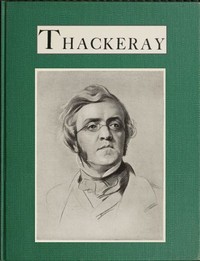
Thackeray
by Chesterton, G. K. (Gilbert Keith); Melville, Lewis
Language: en370 downloads on Project Gutenberg
Subjects
In: Biographies·British Literature
Public-domain ebook sourced from Project Gutenberg #62086.
Public-domain ebook
by Chesterton, G. K. (Gilbert Keith); Melville, Lewis
Language: en370 downloads on Project Gutenberg
Subjects
In: Biographies·British Literature
Public-domain ebook sourced from Project Gutenberg #62086.
The opening · free to read
Thackeray, from the beginning of his life until the end, consistently and seriously preached a gospel. His gospel, like all deep and genuine ones, may be hard to sum up in a phrase, but if we wished so to sum it up we could hardly express it better than by saying that it was the philosophy of the beauty and the glory of fools. He believed as profoundly as St. Paul that in the ultimate realm of essential values God made the foolish things of the earth to confound the wise. He looked out with lucent and terrible eyes upon the world with all its pageants and achievements; he saw men of action, he saw men of genius, he saw heroes; and amid men of action, men of genius, and heroes he saw with absolute sincerity only one thing worth being--a gentleman. And when we understand what he meant by the phrase, the absolute sufficiency of a limpid kindliness, of an obvious and dignified humility, of a softness for noble memories and a readiness for any minute self-sacrifice, we may, without any affected paradox, but rather with serious respect, sum up Thackeray’s view of life by saying that amid all the heroes and geniuses he saw only one thing worth being--a fool.
The real falsehood--if there be a falsehood--of Thackeray’s view of the world was, in fact, the very opposite of that cynicism and worldliness once attributed to him. In so far as he did misrepresent life, it was rather in the direction of showing too much bold disdain of Vanity Fair and too much absolute faith in the saints, his unworldly women and his easily swindled gentlemen. He permitted this pietism of his to blind him to the vivid atrocities of the character of Helen Pendennis, supposing that her having lived all her life in a country homestead was some kind of preventive against cruelty and paganism and heathen pride. Thackeray is, if anything, too much on the side of the angels. He was a monk who rushed out of his monastery to cry out against a gaudy masquerade that was roaring around it, and ever since his monk’s frock has been mistaken for one of the masquerade dresses and applauded as the best joke in the whole fancy dress ball.
There are, of course, exceptions, or what may appear to be exceptions, to such a generalisation. So deep and genuine was Thackeray’s insight into the normal human spirit that he detected this element of idealism where it might least be expected. The
From a portrait painted by Frank Stone in 1836, in the possession of Mrs. Richmond Ritchie, and reproduced by kind permission of the owner]
The residence of Thackeray’s mother, where the novelist lived for a time on his return from Paris in 1837]
character of Major Pendennis, for instance, is simply a great lighthouse or beacon tower, not merely of social satire, but of eternal ethical philosophy. In Major Pendennis, consciously or unconsciously, is traced the valuable truth that almost every man is, by the nature of things, an idealist. To go to great houses, to wear the latest and yet the most dignified attire, to know the right people, to do and say at every instant the thing which is most perfectly and exquisitely ordinary, this is a principle of life against which a sane man might have a great deal to say; but one thing he could not say, he could not say that it is materialistic. One moral merit it has: at least it is totally useless. A place in Society is not something to drink; an invitation card from Lord Steyne is not something to eat. Poor old Pendennis did not sleep softer in his incomparable clothing; he was a poor man, lonely and constantly troubled. Nothing supported him but his own monstrous and insane religion. He was, as it were, a glorious heretic, a martyr to false gods; and nothing sadder or more honourable has ever been conceived in fiction than that scene in the end of “Pendennis,” in which the old man, having, with a valour and energy that stirs us like a cavalry charge, defeated all machinations that would have robbed his nephew of name and fame, suddenly finds the nephew himself ready to fling down the whole laborious edifice in the name of an unintelligible scruple. “And Shakespeare was right, and Cardinal Wolsey, begad. If I had served my God as I’ve served you----” It has the pathos of the meeting of two faiths; the good Moslem staring at the good Crusader.
Thackeray’s residence from 1837 to 1840, where “The Paris Sketch-Book” was written]
This was the greatness of Thackeray, the man whom sentimentalists without hearts or stomachs have conceived as a mere satirist, that he felt, perhaps, more fully and heavily than any other Englishman the immeasurable and almost unbearable emotion that is involved in the mere fact of human life. Dickens, with his indestructible vanity and boyishness, is always looking forward. Thackeray is always looking back in life. And no man will ever properly comprehend him until he has reached for a moment that state of the soul in which melancholy is the greatest of all the joys.
G. K. CHESTERTON.
THE CHARACTERS AND PLACES OF THACKERAY’S BOOKS
“Since the author of ‘Tom Jones’ was buried, no writer of fiction among us has been permitted to depict to the utmost of his power a MAN. We must drape him and give him a certain conventional simper. Society will not tolerate the Natural in our Art. Many ladies have remonstrated and subscribers left me, because, in the course of the story, I described a young man resisting and affected by temptation. My object was to say, that he had the passions to feel, and the manliness and generosity to overcome them. You will not hear--it is best to know it--what
1841.
De La Pluche M. A. Titmarsh Major Gahagan
“COMIC TALES AND SKETCHES”]
moves in the real world, what passes in society, in the clubs, colleges, mess-rooms, what is the life and talk of your sons. A little more frankness than is customary has been attempted in this story; with no bad desire on the writer’s part, it is hoped, and with no ill-consequence to any reader. If truth is not always pleasant, at any rate truth is best, from whatever chair--from those whence graver writers or thinkers argue, as from that at which the story-teller sits as he concludes his labour, and bids his kind reader farewell.” So runs a passage in the preface to “Pendennis.”
From a terra-cotta bust by Sir Edgar Boehm, R.A. after the plaster cast by Joseph Durham
“I cannot help telling the truth as I view it, and describing what I see. To describe it otherwise than it seems to me would be falsehood in that calling in which it has pleased Heaven to place me; treason to that conscience which says that men are weak; that truth must be told; that faults must be owned; that pardon must be prayed for; and that Love reigns supreme over all.” This is Thackeray’s confession of literary faith.
“My object is not to make a perfect character of anything like it,” he wrote to his mother when “Vanity Fair” was appearing in monthly parts. “Our friend is not Amadis or Sir Charles Grandison,” he wrote of Philip Firmin, “and I don’t for a moment set him up as a person to be revered or imitated, but try to draw him faithfully as Nature made him.”
The late Anthony Trollope stigmatised Thackeray as an unmethodical writer. Certainly the great man, as author, bound himself by no hard and fast rules. His plan was to create mentally two or three of his chief characters and write from page to page, with only a general notion of the course he would be taking a few chapters later. But then to compensate for the lack of method he lived with his characters, shared their joys and sorrows, and spoke of them as if they were real creatures of flesh and blood. “Being entirely occupied with my two new friends, Mrs. Pendennis and
Showing the portrait of Thackeray by Samuel Laurence, and busts of Sir William Molesworth and Charles Buller
(Reproduced by kind permission of the Committee of the Reform Club)]
her son Arthur Pendennis,” he wrote to Mrs. Brookfield from Brighton in 1849, “I got up very early again this morning. He is a very good-natured, generous young fellow, and I begin to like him considerably. I wonder if he is interesting to me from selfish reasons, and because I fancy we resemble each other in many parts.” “I wonder what will happen to Pendennis and Fanny Bolton,” he remarked in another letter to the same correspondent; “writing and sending it to you, somehow it seems as if it were true.” Mrs. Ritchie remembers entering her father’s study one morning about two years later and being motioned away, and how, an hour later, he went to the school-room and, half-laughing, half-ashamed, said: “I do not know what James can have thought of me when he came in with the tax-gatherer after you left, and found me blubbering over Helen Pendennis’s death.”
Thackeray’s home from 1846 to 1853, where “Vanity Fair,” “Pendennis,” and “Esmond” were written]
“I don’t control my characters,” he asserted one day. “I am in their hands, and they take me where they please.” And when a friend remonstrated with him for having made Esmond marry “his mother-in-law,” he only replied: “_I_ didn’t make him do it; they did it themselves.” It may be because the characters were so real to the creator that they live in the memory of the reader. If Thackeray was the first to shed tears over the death of Helen, certainly he has not been the last. Who can read with dry eyes of the reconciliation of mother and son at the death-bed? “As they were talking the clock struck nine, and Helen reminded him how, when he was a little boy, she used to go up to his bed-room at that hour and hear him say Our Father. And once more, oh once more, the young man fell down at his mother’s sacred knees, and sobbed out the prayer which the Divine Tenderness uttered for us, and which has been echoed for twenty ages since by millions of sinful and humble men. And as he spoke the last words of the supplication, the mother’s head fell down on her boy’s, and her arms closed around him, and together they repeated the words ‘for ever and ever’ and ‘Amen.’”
Where Thackeray lived from 1853 to 1862, during which period he wrote the “Lectures on the Georges,” the end of “The Newcomes,” “The Virginians,” part of “Philip,” and many of the “Roundabout Papers.”]
Readers of Thackeray’s works must have noticed how frequently the characters reappear in tales other than that in which they are first introduced. Reference is made to them and to their doings in book after book, until we feel that we know them personally. Thackeray loved to reintroduce his old friends, and it was his intention--frustrated by an all too early death to write a novel of the times of Henry V., in which the ancestors of his Pendennises and Warringtons should have foregathered. A long and fascinating article might be written tracing the subsequent careers of the characters from the glances we obtain of them at odd moments.
How many novelists are there who have such a gallery of characters as can be collected from Thackeray’s books? What admirable realism! What marvellous insight into the natures of men and women!
The book keeps going
Reading is free forever. Sign up and watch scenes appear while you read.



Scenes Storieta drew for other classics.
New illustrated classics
Once or twice a month: the latest books to get full character casts, scene art, and free comic editions. No account needed.