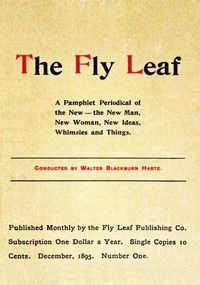
Of course the most important event of the month in this favored part of the world is the unheralded advent of such a robust youngster as the FLY LEAF. Oh yes, thank you, Mrs. Grundy, we are doing very well indeed--a very healthy and vigorous infant and a favorite already; and we may be able to show a very pretty set of teeth in a month or two, if occasion should demand. Some of our distinguished contemporaries will perceive the delicacy of this metaphor; albeit the babe is quite good-natured.
And now a few words about the aims and purposes of the FLY LEAF will be in order--and the incidental commentary may be found to be equally interesting. For the FLY LEAF, although but the bantling of yesterday, has been nursed in the lap of harsh experience, and is at least as wise as some drivelling and decrepit contemporaries it finds lagging superfluous on the stage.
It is true that the field of contemporary journalism is already fairly well stocked with various periodicals, of various shades of unprovoked domesticity, and innocuous intention in the way of imparting that miscellaneous misinformation, which is the mental stock-in-trade of the millions everywhere, and put into print day after day, is the most effective bar to tolerance and growth and hospitality of thought. But there is plenty of room for the FLY LEAF. These highly respectable publications are all competing with each other, and reaping the rich rewards that are the portion of those who have invested their capital in the impossible virtues and spotless innocence of the Young Person. They are all reported to be very prosperous, and we cannot bring ourselves to believe so highly of human nature in the bulk as to doubt the truth of their returns.
But the FLY LEAF will occupy a field that all these periodicals regard with the suspicion of conservatism. It will not impinge on their field, and they cannot by any possibility intrench upon its. For it is a magazine of the New, the Modern, the Young Man, the Young Woman, Today and its stirring, probing, fantastical spirit.
With the immense reading public that exists in this land of popular education and enlightenment--a public which expands every year, as generation after generation takes its place in the ranks of life--there is room for all sorts of periodicals; and instead of these various periodicals being in rivalry, they actually raise up new readers for each other. Even the old fogy magazines have helped to prepare the way for honest bubbling thought and fancy and humor. They have unwittingly and unwillingly educated their readers for the FLY LEAF. The more literature is cultivated in America--the more writers with fresh opinions and experiences and ideas increase--the more readers there will be to encourage the treatment of ever new and wider aspects of the complex life of this vast and complex aggregation of people.
In the pages of these respectable domestic periodicals, old-fashioned folk, who lived before thought was let loose in the English tongue among respectable, law-abiding people, and who linger on to the confusion of poetry and new ideas and new interests, can still doze over profound articles on “How to Cook a Beefsteak” and fiction that has even less relevance to the comedy and tragedy of real modern life. But all inspiring literature is drenched in the spirit and vigor of Youth--even though the writers may be only belated boys. It is the New in eternal nature that entrances the imaginations of thinkers and poets. The day is coming when the periodicals now devoted to the dissemination of the platitudes and ideas of two or three generations ago will have to awaken to the fact that the Young Man and the Young Woman of this era demand the heart of life in their literature, or they will be compelled to give way to bolder spirits, such as are now gathering strength in every modern literature. Already the tide has set in. Hence the FLY LEAF.
The FLY LEAF belongs to this end of the century. It is essentially modern. It does not look to the future, however, with any affected fin de siecle weariness or ennui, but with the hopefulness and stirring courage of youth. It does not aim to be Decadent, or pin its faith to any particular Ism; although it will always be hospitable to art and beauty and truth from any quarter.
The Editor and his coadjutors are of the new school of younger writers, and they aim to unite free sincere thought with humor and fantastic whimsies and imagination; to be serious and amusing; earnest and honest; but never dull. The underlying purpose and inspiration of our efforts will be to strike this Modern note and awaken this broader Modern spirit, which marks the literature of our era off from all the ancient thought and literature of the world.
The FLY LEAF will deal with the Here and Now, with the aims and ideals of the Young Man and the Young Woman, with the drift and tendencies of American social and literary thought. It will embody the New Spirit of the age that is moving the literature of all the world, but it will be distinctively an American periodical.
The FLY LEAF hopes that in this struggle for the recognition of this broader spirit in criticism and the material of literature, and for the encouragement of American writers of ability, it will receive the cordial support of the younger generation of readers throughout the country.
THE NEW MYSTICISM.
The latest development of the new mysticism, or symbolism, or impressionism, which first came to us from the Continent, has just reached the Editor of the FLY LEAF from the pen of an old friend.
It appears that my friend had been reading Maurice Maeterlinck’s “The Blind” and “The Seven Princesses,” and he had come to the conclusion that a painful poverty of ideas was palpably wrapped up in a barren iteration of half meaningless and half ludicrous phrases. He then turned to Stephen Crane’s recently published “Black Riders,” thinking that symbolism might be a little more coherent and comprehensible in the alembic of the colder and clearer Anglo-Saxon intellect and imagination. He had heard Crane’s impressionistic book of rhythms spoken of in the inner circles of the New York and Boston literary world as a collection of startling psychological pictures--the Heaven and Hell of the human soul by flashlight. The Boozy Prophet, Crane has been called by a certain eminent critic--and there’s invitation to human nature in such a piquant characterization.
But, for a long while, he labored in Crane’s pages, without discovering the secret flame of spiritual insight that others had spoken of so confidently, and he began to suspect that the profundity which had allured so many minds was simply the fatal lure of the weirdly incomprehensible, which is the inspiration of a good many schools of art and new religions. He had looked for a burst of spiritual light that should spur his tired imagination to renewed efforts in setting forth the superior qualities of a certain brand of coal tar soap which was the inspiration of his Muse for so much a week. He sank into the rocker by the fire, and fell into a mood of despondent reminiscence, weaving all the sad strands of his life into haunting fancies. Then, as he says in his letter, a change suddenly came over him, and he sprang up feeling oppressed and dizzy with a flood of crimson thoughts that inspired his brain.--Ed.
Here is his account of what happened.
There is something irresistible about this new mysticism in poetry, which those who have not pondered over its potent fascinations cannot understand. It seizes upon the mind suddenly and without warning. For years all my dreams of literary achievement and fame had lain buried, and as I thought, a little sadly, dead--strangled by cruel circumstance and devoured by an ever increasing family. I had become completely reconciled to writing on tar soap and other commodities. But all of a sudden my thoughts seemed to plunge into an abyss of mystical yearnings after the impossible and infinite, and then I recalled some of Crane’s verses with a new and vivid realization of their photographic fidelity to perplexity of mind. Then, to my amazement, I felt the divine afflatus rise overpoweringly within me, and for the first time in my life I produced two lines which rhymed. They ran as follows:
A goblin hung on to the horn of the moon A-singing a love song composed by a coon.
I had never performed such a feat as this in my whole life before, for even in my hours of transcendent ambition I had recognized the essentially prosaic bent of my mind. I had always expected to be a great prose writer, and I had felt a rather indulgent condescension toward contemporary poets--especially those of my acquaintance. I used to think prose was the only vehicle of modern thought, and that all the great poets were dead. But when a man finds himself beginning to lisp in poetry at a belated age, his views on the significance of modern poetry are apt to undergo some important modification.
I thought this couplet a very fair beginning; but no well rounded thought would come that had any relevance to the goblin, the moon or the love song. So I leave the couplet to stand by itself as a picture, suggestive of the fact that ambition may miss its mark, but a love song will surely live in some heart. My next attempt--for I was on fire with symbolic rhapsody--was a little more successful. I submit it without comment. The lesson is so obvious.
I saw a bleeding head grinning, It grinned at me; I grinned at it, In fact, we both grinned irreverently.
But the smiling sun shone on!
I find the longer one delves in mystic poetry the deeper philosophical problems one can sound in a very few poignant flashes of symbolic description. Here is one of my happiest efforts:
As my worn soul lay wriggling in the dust, I cried aloud to God in indignation That he had so mistreated me; But God only laughed, until He’d like to bust And pointed out that dirt was all creation.
I turned off a number of other things, quite as profound and fantastical, and I find that in mystical poetry the Deity lends Himself to picturesque treatment a good deal more readily than any other person or subject of immediate and contemporary interest. So that in this way it leads the mind of the masses away from the frivolities of the hour to the larger considerations of life and destiny, and chastens folly with thoughts of the over-ruling immutable providence that is too often forgotten in the bustling cities of civilization.
I send you only one more piece, to which I have given the dignity of a title. It is “The Dissatisfactions of Luxury,” and is in two stanzas:
I heard a man mumbling in the horrid silence of the night. He was chaffering aloud with the good God; But God in the darkness vouchsafed no sign. And I asked him, scoffing, what he desired of the Omnipotent. “I am rich, I am Plutus,” answered he, angrily, “And I am bargaining for the moon.” “And why do you want it?” asked I in amaze. “Because I am tired of all my other toys.” “And the price?” asked I, scoffing, for I bore the badge of Lazarus. “Untold millions, heaped up to Heaven’s gate.” “Fool!” I cried in bitter derision; “Offer the good God your corrupt soul.”