Public-domain ebook
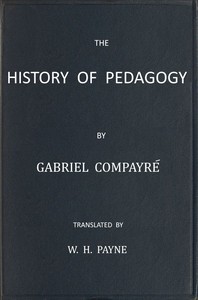
The History of Pedagogy
Language: en1,020 downloads on Project Gutenberg
Subjects
In: History - Other·Teaching & Education
Public-domain ebook sourced from Project Gutenberg #62376.
Public-domain ebook
Language: en1,020 downloads on Project Gutenberg
Subjects
In: History - Other·Teaching & Education
Public-domain ebook sourced from Project Gutenberg #62376.
The work is a scholarly survey of the development of educational thought, presented as a “history of pedagogy” rather than a full‑scale history of education. In its opening, the author argues that teachers have long neglected the historical dimension of their profession, despite the abundance of writings on practical and theoretical aspects. He proposes a critical, comprehensive yet readable account that distinguishes pedagogy (the art of instruction) from education (the broader cultural process), and outlines a chronological plan that moves from antiquity through the Middle Ages, the Renaissance, and modern times. The introduction emphasizes the need to examine both doctrines and actual institutions, suggesting that a true understanding of teaching requires knowledge of past experiments, philosophies, and the many “occult coadjutors” that shape learning.
Written in the formal, erudite style of late‑nineteenth‑century French scholarship, the text reflects the academic tone of its original 1879 publication and its 1886 English translation. Readers who appreciate meticulous historical analysis, the interplay of philosophy and practice, and a disciplined, essay‑like narrative will find it rewarding, particularly educators, historians of ideas, and scholars of cultural development who enjoy a measured, richly referenced exploration of how teaching has evolved.
The opening · free to read
TRANSLATOR’S PREFACE.
The two considerations that have chiefly influenced me in making this translation are the following:--
1. Of the three phases of educational study, the practical, the theoretical, and the historical, the last, as proved by the number of works written on the subject, has received but very little attention from English and American teachers; and yet, if we allow that a teacher should first of all be a man of culture, and that an invaluable factor in his professional education is a knowledge of what has hitherto been done within his field of activity, there are the best of reasons why the claims of this study should be urged upon the teaching profession. For giving breadth of view, judicial candor, and steadiness of purpose, nothing more helpful can be commended to the teacher than a critical survey of the manifold experiments and experiences in educational practice. The acutest thinkers of all the ages have worked at the solution of the educational problem, and the educating art has been practised under every variety of conditions, civil, social, religious, philosophic, and ethnic. Is it not time for us to review these experiments, as the very best condition for advancing surely and steadily?
2. The almost complete neglect of this study among us has been due, in great measure, to the fact that there have been no books on the subject at all adapted to the ends to be attained. A dry, scrappy, and incomplete narration of facts can end only in bewilderment and in blunting the taste for this species of inquiry. The desirable thing has been a book that is comprehensive without being tedious, whose treatment is articulate and clear, and that is pervaded by a critical insight at once catholic and accurate. Some years ago I read with the keenest admiration, the Histoire Critique des Doctrines de l’Éducation en France depuis le Seizième Siècle, by Gabriel Compayré (Paris, 1879); and it seemed to me a model, in matter and method, for a general history of education. Within a recent period Monsieur Compayré has transformed this Histoire Critique into such a general history of education, under the title Histoire de la Pédagogie. In this book all the characteristics of the earlier work have been preserved, and it represents to my own mind very nearly the ideal of the treatise that is needed by the teaching profession of this country.
The reader will observe the distinction made by Monsieur Compayré between Pedagogy and Education. Though our nomenclature does not sanction this distinction, and though I prefer to give to the term Pedagogy a different connotation, I have felt bound on moral grounds to preserve Monsieur Compayré’s use of these terms wherever the context would sanction it.
It seems mere squeamishness to object to the use of the word Pedagogy on account of historical associations. The fact that this term is in reputable use in German, French, and Italian educational literature, is a sufficient guaranty that we may use it without danger. With us, the term Pedagogics seems to be employed as a synonym for Pedagogy. It would seem to me better to follow continental usage, and restrict the term Pedagogy to the art or practice of education, and Pedagogics to the correlative science.
I feel under special obligations to Monsieur Compayré, and to his publisher, Monsieur Paul Delaplane, for their courteous permission to publish this translation. I am also greatly indebted to my friend, Mr. C. E. Lowrey, Ph.D., for material aid in important details of my work.
W. H. PAYNE.
UNIVERSITY OF MICHIGAN, Jan. 4, 1886.
The issue of a second edition has permitted a careful revision of the translation and the correction of several verbal errors. In subsequent editions, no effort will be spared by the translator and his publishers to make this volume worthy of the favor with which it has been received by the educational public.
W. H. P.
AUG. 1, 1886.
INTRODUCTION.
WHAT A COMPLETE HISTORY OF EDUCATION WOULD BE.--In writing an elementary history of pedagogy, I do not pretend to write a history of education. Pedagogy and education, like logic and science, or like rhetoric and eloquence, are different though analogous things.
What would a complete history of education not include? It would embrace, in its vast developments, the entire record of the intellectual and moral culture of mankind at all periods and in all countries. It would be a résumé of the life of humanity in its diverse manifestations, literary and scientific, religious and political. It would determine the causes, so numerous and so diverse, which act upon the characters of men, and which, modifying a common endowment, produce beings as different as are a contemporary of Pericles and a modern European, a Frenchman of the middle ages and a Frenchman subsequent to the Revolution.
In fact, there is not only an education, properly so called, that which is given in schools and which proceeds from the direct action of teachers, but there is a natural education, which we receive without our knowledge or will, through the influence of the social environment in which we live. There are what a philosopher of the day has ingeniously called the occult coadjutors of education,--climate, race, manners, social condition, political institutions, religious beliefs. If a man of the nineteenth century is very unlike a man of the seventeenth century, it is not merely because the first was educated in a Lycée of the University and the other in a college of the Jesuits; it is also because in the atmosphere in which they have been enveloped they have contracted different habits of mind and heart; it is because they have grown up under different laws, under a different social and political régime; because they have been nurtured by a different philosophy and a different religion. Upon that delicate and variable composition known as the human soul, how many forces which we do not suspect have left their imprint! How many unobserved and latent causes are involved in our virtues and in our faults! The conscious and determined influence of the teacher is not, perhaps, the most potent. In conjunction with him are at work, obscurely but effectively, innumerable agents, besides personal effort and what is produced by the original energy of the individual.
We see what a history of education would be: a sort of philosophy of history, to which nothing would be foreign, and which would scrutinize in its most varied and most trifling causes, as well as in its most profound sources, the moral life of humanity.
WHAT AN ELEMENTARY HISTORY OF PEDAGOGY SHOULD BE.--Wholly different is the limited and modest purpose of a history of pedagogy, which proposes merely to set forth the doctrines and the methods of educators properly so called. In this more limited sense, education is reduced to the premeditated action which the will of one man exercises over other men in order to instruct them and train them. It is the reflective auxiliary of the natural development of the human soul. To what can be done by nature and by the blind and fatal influences which sport with human destiny, education adds the concurrence of art, that is, of the reason, attentive and self-possessed, which voluntarily and consciously applies to the training of the soul principles whose truth has been recognized, and methods whose efficiency has been tested by experience.
Even thus limited, the history of pedagogy still presents to our inquiry a vast field to be explored. There is scarcely a subject that has provoked to the same degree as education the best efforts of human thinking. Note the catalogue of educational works published in French, which Buisson has recently prepared.[1] Though incomplete, this list contains not less than two thousand titles; and probably educational activity has been more fruitful, and has been given a still greater extension in Germany than in France. This activity is due to the fact, first of all, that educational questions, brought into fresh notice with each generation, exercise over the minds of men an irresistible and perennial attraction; and also to the fact that parenthood inspires a taste for such inquiries, and, a thing that is not always fortunate, leads to the assumption of some competence in such matters; and finally to the very nature of educational problems, which are not to be solved by abstract and independent reasoning, after the fashion of mathematical problems, but which, vitally related to the nature and the destiny of man, change and vary with the fluctuations of the psychological and the moral doctrines of which they are but the consequences. To different systems of psychology correspond different systems of education. An idealist, like Malebranche, will not reason upon education after the manner of a sensationalist like Locke. In the same way there is in every system of morals the germ of a characteristic and original system of education. A mystic, like Gerson, will not assign to education the same end as a practical and positive writer like Herbert Spencer. Hence a very great diversity in systems, or at least an infinite variety in the shades of educational opinion.
Still farther, educational activity may manifest itself in different ways, either in doctrines and theories or in methods and practical applications. The historian of pedagogy has not merely to make known the general conceptions which the philosophers of education have in turn submitted to the approbation of men. If he wishes to make his work complete, he must give a detailed account of what has been accomplished, and make an actual study of the educational establishments which have been founded at different periods by those who have organized instruction.
Pedagogy is a complex affair, and there are many ways of writing its history. One of these which has been too little considered, and which would surely be neither the least interesting nor the least fruitful, would consist in studying, not the great writers on education and their doctrines, not the great teachers and their methods, but pupils themselves. If it were possible to relate in minute detail, supposing that history would furnish us the necessary information on this point, the manner in which a great or a good man has been educated; if an analysis could be made of the different influences which have been involved in the formation of talent or in the development of virtue in the case of remarkable individuals; if it were possible, in a word, to reproduce through exact and personal biographies the toil, the slow elaboration whence have issued at different periods solidity of character, rectitude of purpose, and minds endowed with judicial fairness; the result would be a useful and eminently practical work, something analogous to what a history of logic would be, in which there should be set forth not the abstract rules and the formal laws for the search after truth, but the successful experiments and the brilliant discoveries which have little by little constituted the patrimony of science. This perhaps would be the best of logics because it is real and in action; and also the best of treatises on pedagogy, since there might be learned from it, not general truths, which are often of difficult application and of uncertain utility, but practical means and living methods whose happy and efficient applications would be seen in actual use.
The book keeps going
Reading is free forever. Sign up and watch scenes appear while you read.



Scenes Storieta drew for other classics.
New illustrated classics
Once or twice a month: the latest books to get full character casts, scene art, and free comic editions. No account needed.