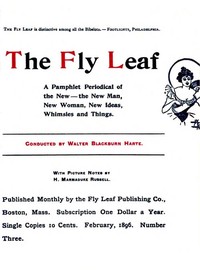
A Pamphlet Periodical of the New--the New Man, New Woman, New Ideas, Whimsies and Things.
CONDUCTED BY WALTER BLACKBURN HARTE.
WITH PICTURE NOTES BY H. MARMADUKE RUSSELL.
Published Monthly by the Fly Leaf Publishing Co., Boston, Mass. Subscription One Dollar a Year. Single Copies 10 Cents. February, 1896. Number Three.
Unique and Distinctive in Bibelot Literature.
THE CRITICS AGREE IN SAYING THE FLY LEAF FILLS A FIELD OF ITS OWN.
THE FLY LEAF is distinctive among all the Bibelots.--FOOTLIGHTS, PHILADELPHIA.
It is a delightfully keen little swashbuckler.--THE ECHO, Chicago.
The latest of the Bibelots. In my opinion it is the only one of the lot, including the “Chap-Book,” “Philistine,” etc., which knows what it is driving at. The editor of the “Chap-Book” toddles along, following or attempting to follow, the twists and turns of the public taste--at least that is what he wrote in a Note not long ago--and the editor of the “Philistine” curses and swears, and devastates the atmosphere, trying his best to kill everything. “THE FLY LEAF” at once impressed me that Mr. Harte knows what he wants, and seriously intends to have it. I hope he will.--THE NORTH AMERICAN, Philadelphia.
It will pay any one who wishes to keep up with the literary procession to peruse this sprightly little periodical.--THE EXAMINER, San Francisco, Cal.
That bright little bundle of anecdote, comment, essay, poetry and fiction, “THE FLY LEAF,” of Boston, comes out in particularly good style. It gives rich promise of many good things to come.--THE COMMERCIAL ADVERTISER, New York.
Number two of Walter Blackburn Harte’s dainty monthly “THE FLY LEAF,” is out, and filled with the spirit of youth and beauty in literature, and zealous with culture, taste and faith toward higher ideals, it is going about doing good.
Mr. Harte is strong, brilliant and brave as an essayist of the movement, and is making friends everywhere. The poetry and prose is all of high merit.--THE BOSTON GLOBE.
The thing I like about Mr. Harte is his splendid spirit of Americanism, his optimistic belief in native literature and native writers; his hatred of all things bordering on toadyism or servile flattery of foreign gods to the exclusion of home talent. This is the key-note of THE FLY LEAF, and Mr. Harte will be apt to say some trenchant, candid and always interesting things in its pages.--THE UNION AND ADVERTISER, Rochester, N. Y.
These are a few criticisms of the first two numbers, selected from a great heap of enthusiastic notices. THE FLY LEAF is promoting a Campaign for the Young Man in Literature. All the young men and women in America are discussing its unique and original literature, and spreading its fame.
He calls, from the hot road to us, who stray In shady pleasant woods abroad,-- Yes, Tolstoi, your path leads to God, But through the forest there may be a way.
IBSEN.
A cannon shot, not fired to kill, But to dislodge and make to rise The decomposing corpse that lies Beneath life’s surface, smooth and still.
CLAUDE F. BRAGDON.
SUCCESS.
Without one thought in his wide, empty brain (For Reason never sowed a seed to grow), He sits and writes page after page--no strain; Why? Chaff is cheap and sometimes looks like grain.
EUMENIDES.
All kindred gods have crumbled into dust Though latest born of that once teeming womb. Ye yet abide who shall not taste a tomb-- Of passion, gold, and fame the lashing lust.
PHILIP BECKER GOETZ.
A MODEST PROPOSAL FOR THE REHABILITATION OF LETTERS IN THE LITERARY SHOW.
We may take it that the old story of the Tower of Babel symbolizes the failure of the human mind to transcend the limits of natural knowledge. It is some old poet’s picture of the aspiring race lifting its bold head to steal God’s secrets from Heaven, stricken down into the dust, whence it came and to which it must return, foiled and despairing. But the babble of a million futile, unprovable human speculations continues to sway and mock generation after generation of men, wrapt in the ironies of the world of sense and necessity. So all human thought runs in cycles, and the latest heir of all the ages but gains the wisdom of increased doubt.
Our age raises its Babel of philosophies and creeds, as did the civilizations that have gone before, and left us but the fantasy of great and moving names. So our most cherished realities, for which we all suffer so much, and for which so many heretics suffer the rack and martyrdom, fade away into the gibes and bogies of tradition. Ah, how sad is the fantasy of names our freed tongues troll over so lightly! Let established wisdom learn tolerance in this levity of today’s knowledge. For those who hold to any idea or ideal, know the days of martyrdom are not yet over. The old Hebrew picture is as true of today as when first written. We, too, shall pass away into the fantasy of history. We, too, shall leave but the grinning skulls and bare bones of once vital but finally unbelievable religions and philosophies--precious, priceless scraps of rubbish and litter in the catacombs of decayed and buried cities.
But the times show a certain change in spirit. Our Babel of today does not assail God’s security, for our babble builders do not seek to play the prophet or the sage so much as to play the clown successfully. The seer who gives us words of fire and folly in his futile attempt to cleave body and soul with the sword of thought, at least contrives to show us that life here can be sweet and beautiful and grand. Those whose fearful content with the life of sense and show drags us all to the level of our necessities, make life even more of an irony; for they deny the intellect and spirit their right of unfettered freedom in the domain of thought. And when thought is fettered with the appetites, life, indeed, becomes a very slavery. And half our writers are in servitude to the Egyptians. Only a few thinkers lie sullen and idle in the sun--profitless vagabonds, who can only work by whim and inspiration.
At this end of the century our Babel lacks the genuine inspiration of ancient prophecy and poetry. It is taken for granted, seemingly, that as we cannot reach God, it is not worth while to rise in thought above the mere show of life, and so all the mystery of man is swept out of our literature and philosophy. We are deafened with a million small noises of small, soulless, unreal persons. The old stirring voices that thrilled us with the clamor and sternness of life, are, for the most part, silenced or muffled, because those who grow fat on the partial enlightenment of the masses, will not allow any sort of literature to prosper which, in the words of the Areopagitica, contains “views or sentiments at all above the level of the vulgar superstition.” The literature that sprang from the marrow of the intellect, the core of the heart and life, is out of fashion, is a drug in the market. This is a day in which mere noise and notoriety completely ousts and worsts any real thought in every joust of letters. In fact, literature is read less as letters, in the old sense, than as autobiography of scandalous and notorious people. Only the sensational in literature can attract attention. There are lots of good books published every year, but they steal quietly into the world, and no one knows about them. They burden the bookseller’s shelves for awhile, and their only chance of circulation is finally that some whimsical crank may pick them out of the “remainder” boxes, when their one brief season of undisturbed respectability on the shelves is over.
It is with the idea of partially remedying this state of affairs, in which the odds are so uneven, that I venture to offer a few suggestions on the advisability of adopting an old and picturesque institution from a totally different Trade, and adapting it to the needs of contemporary Literature. This is the explanation of the caption of this paper, which may be a little perplexing to some unsophisticated readers. I propose to borrow the main features of the old clothing Fair, which is held among the Hebrews every Sunday morning in Petticoat Lane, London,--one of the most picturesque Babels in the world.
This would even up matters a little. I do not propose any reform, and I should not dare to mention any of the remarkable modern instances of success in literature by persons who produce much fiction which is not literature. They are sufficiently glaring to advertise themselves among book lovers. But I do want to lead a forlorn hope to re-establish some sort of social and moral, if not intellectual, equilibrium between poor handicapped brains and overwhelming brass. At the present moment the calling of literature is the caravan or the refuge of the charlatan, the demagogue, the weakminded, the social fop, the hysterical and the notorious. My aim in this modest proposal is simply to remove a few obsolete superstitions and traditions of literary dignity that, once swept away, will leave all competitors for fame on the same footing. Perhaps we may then hope to see the few writers who are marred with a simple equipment of inspiration and talent enjoy some sort of equality with those who bring to the conquest of literature the overwhelming advantages of sex, brass, social authority and money.
Let us first touch upon certain aspects of criticism and publicity in the Literary Show. It will then be perfectly clear to the most prejudiced reader--and I expect prejudice in this wicked world--that my suggestion of a Sunday Fair for Literature is the most feasible and dignified expedient that can now be adopted, if any of us are to continue the struggle for some literary achievement and standard and some genuine thought in our modern Babel.
It has always been a question in the mind of the present writer whether most men, that is, sane men, do not actually know, in their own hearts, just about what they stand for absolutely in life, or whether saints and rogues, wise and unwise, we are all deluded about ourselves. Heine, who wrote with so much charm about himself, and could scarcely have found a more interesting subject, was of the opinion that one cannot tell the truth about one’s self; and, since the greater portion of mankind is of this opinion, autobiography is the most irresistible form of literature.
But it is unfortunate there is not more division of opinion on the subject, because, while this view may add to the interest of autobiography, it weakens its weight and authority; and there are good reasons for supposing that one of the necessary “short cuts” of contemporary literature of the near future will be the brief critical autobiography.
There is not a mother’s son of us in the whole scribbling guild, great or small, puffed or starved, can get his fill of praise; for there are too many of us scribbling in these latter years, and that man is fortunate who is famous for a whole season. There are but few who can reasonably hope for a life in the memory of mankind as long as Mumm’s champagne. It may be there are but few of us deserve it. Such scraps of comfort as occasionally fall to our lot are almost invariably disappointing, for our friends are perversely addicted to flattering us in good, round, general terms, which save thought and lack positiveness, or else they appreciate us for the very qualities it is perfectly evident we do not possess in the least degree. But this is the inevitable result of the production of literature by lightning-like machinery working day and night.