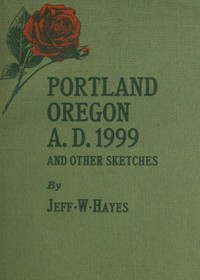
"I was born in the year of our Lord, 1828, and am, consequently, in my 86th year. I have lived a long time, but when I glance backward, it seems but yesterday that I nestled in my mother's arms. I was born in Virginia in the year Andrew Jackson was elected President and my parents took me to Washington on the day of his inauguration. We traveled in our own vehicle, drawn by two dapple grey horses, and we had several neighbors as companions each having a conveyance of their own.
"Schools were unknown in our neighborhood and my early education was derived from my parents, principally, assisted by a maiden aunt, who spent each summer at our plantation.
"My clothes were cut out, fitted and made by my aunt, and my hats lacked any feather trimmings or other finery. The material of my dresses was generally of a slate color, and but few other shades were affected. All of our neighbors dressed in the same way, without any affectation of style whatsoever. But enough of this.
"The musical instruments of that day were the melodeon, harp and violin. There were very few of even these, and were confined, the melodeon to the village church, the violin to our darkey's cabins.
"We read by a tallow dip during the winter nights, but there was not very much to read, our library consisting of the family Bible, Bunyan's Pilgrims Progress, together with a weekly paper published in Philadelphia, that had originally been started by Benjamin Franklin.
"It was in the year 1850 that my people began talking of going West, and tried to glean all the information they could concerning the country they selected, the best means of getting there and the prospects for disposing of our plantation. It took us three years to finish all of our preparations, and on April 18th, 1853, our caravan started on the trail leading Westward.
"I was 26 years old, and at a time of life when I could thoroughly enjoy the ever varying changes of climate and scenery.
"We found the Indians very friendly, even to kindness, and we bestowed on them many cheap trinkets in return for food and skins, of which they possessed a variety.
"We made many stops on the way as we reached the then frontier settlements, now large and prosperous cities, and it was not until we had crossed the Missouri river, near Omaha, that we began anticipating trouble from the Indians. We experienced the usual hardships and vicissitudes from this cause, nothing unusual in those times, and arrived in the then little city of Portland, March 19th, 1854.
"I startled our little party, on our arrival in Portland, by announcing that the next time I crossed the Continent it would be on the steam cars.
"Long and loudly was I laughed at for my optimism, and it did really seem impossible for a locomotive to be capable of climbing those seemingly inaccessible peaks.
"Had I prophesied all that was in my mind, my friends might have thought that I was deranged. I could have said that I could see people flying through the air in vehicles shaped like birds from the Atlantic to the Pacific and that the almost impenetrable forests of Oregon would one day be entirely laid low by the woodman's axe.
"There were many other things which I could see were bound to come but I thought it wisest to keep the light of my prophecies to myself rather than give them to unheeding ears.
"What I saw in those days, however, will not compare to the marvels which come to me now, at my advanced age.
"I have given a receptive ear to the spirit which tells me what others would pronounce 'queer notions,' but which I declare to be scientifically natural. I will tell you of all these things and you may publish them to the world, and allow them to be a judge of my optimistic views. I will tell you what I see and also of what I know is sure to come, so that all who read may know and understand, and put themselves in readiness for the great events which are bound to ensue by A. D. 1999."
The old lady then, her eyes beaming with intelligence and in the most natural and unassumed manner, voiced the following prophecies:
"Of course," she began, "I may not be able to tell you all that is in store for future generations, but I will say enough to interest everybody and to warn everybody who will care to heed my admonitions.
"The era of quick transit has already arrived and people love to travel fast, and opportunity will be given all who care to adopt this pastime. Very soon the locomotive and trolley car will be altogether too slow for travel and aerial voyages, both for pleasure and business will ensue. The force used for this purpose will be varied and may be electricity, gasoline, compressed air, or perhaps still another potent agent, at present undeveloped, which will usurp the place of all others, be cheaper, safer and more reliable than any known energy. The cars will be made entirely of steel bands and so constructed that but little damage may be apprehended from a collision with another flying machine. A parachute, arranged to work automatically will be the chief protector of this winged machine and this part of the apparatus will be so constructed as to render an accident almost an impossibility. Indeed, these carriers will be so made that a party soaring in the air at a height of 500 feet will look down and express a feeling of sympathy for those who must brave the dangers besetting life on the surface of this mundane sphere.
"These air carriers will be simple, and a good bright boy can manufacture his own vehicle to take him to and from school and at a less expense per day than is now paid for street car fare, and at a lesser risk to life and limb. The grocer will make his deliveries by his air machine. The butcher boy will abandon his automobile and bring his meat deliveries by the way the bird flies. As there can be no tracks laid in the air, no one will be pestering the City Commission for a franchise to run his company's cars over a certain strata of air, but there will be cars for hire, just the same, and there will be, no doubt, long trains operated in the air not much unlike the system at present in vogue on the surface. The death dealing automobile will be a thing of the past and even the merry motor cycle will have gone the way of the equine. Railroads and railroad stocks will suffer and the roads will languish and die. Aerial locomotion will usurp the place of the steamer and the steamship, since it will be proven to be quicker, safer and less expensive. Country homes will be easy of access and, consequently, more popular and the suburbs will be peopled by an ever-increasing number. There is no end to the advantages which the flying machine possesses over the present modes of locomotion and it is merely a question of solving the problem of entire safety, economy and simplicity of construction and operation, all of which will have been surmounted in A. D. 1999.
"Although the aerial navigation is itself an important feature of future progress, it is not at all the most prominent of innovations. I will tell you of the new era of building.
"Portland in 1913 was considered a beautiful city, but how much more beautiful does it look in 1999. I will endeavor to give you a little idea.
"The wooden houses have become a thing of the past and strong, warm concrete dwellings are the order of the day. These abodes although immensely superior to the dwellings of 1913 are less in cost and more adaptable for homes. Every working man has his own flying machine and his own home and should be happy and comfortable. The city is compact and the business houses are lofty and well constructed, safety to occupants being the chief care.
"Owing to the fact that there are few, if any, automobiles or other rapid methods of travel to take up the streets of our city, there was an order issued by the City Commissioners removing the hard surface pavements and authorizing the Commissioner of Public Service to sow the streets in rye grass and Kentucky blue grass, so that the city of Portland is one perpetual system of parks, where the youngster may play to his heart's content. Just imagine what a beautiful city we have and how our past day metropolis would pale into insignificance beside the picture I have drawn. Roses are planted in the streets and we are really and truly the 'Rose City'."
At this juncture the old lady paused to consult some notes which she read to herself, presently beginning again, this time with a new topic:
"Emigration flocked to Oregon after the opening of the Panama canal and under the new conditions many of these newcomers settled in and around Portland. The great territory of Alaska has been pretty thoroughly prospected and our city is the chief market for that great and wonderful country. Our population equals or surpasses that of Greater New York in 1913 and there is work for everyone. Portland embraces the entire county of Multnomah and a portion of other adjacent counties and extends in an unbroken line from Oregon City on the South to the delta of the Columbia river on the North, East to the foot of Mt. Hood and West to Hillsboro. There are no more bridges across the Willamette river, tubes 75 feet wide at every other street taking the place of the bridges. These tubes are about a mile in length and start from Broadway on the West side and extend to Grand avenue on the East. Public docks extend from St. Johns to Milwaukie and cover both sides of the river, which is dredged the entire length of the dockage.
"Many of the hills back of the city, including Portland Heights, Kings Heights and Willamette Heights are leveled, only Council Crest with its historic traditions being allowed to remain. This gives a vast area to West Portland which is really vital to its business supremacy. Columbia Slough was reclaimed and most of the manufacturing industries are carried on at that point. St. Johns was again taken into the fold and made happy."
Again did the old lady consult her notes, making a selection for a new topic, smilingly began:
"The old Commission form of government inaugurated in 1913 proved a success in every way. The first Mayor under the Commission, H. Russell Albee, with his quartette of capable assistants, Messrs. Wm. H. Daly, W. M. Brewster, R. G. Dieck and C. A. Bigelow set the pace for their under officials who tried to emulate their superiors' good work, the public reaping splendid results therefrom. Each succeeding administration endeavored to excel the former's record and Portland has been well governed for the past 86 years. Auditor Barbur, too, gave the city the fruits of his ripe experience in municipal matters and was rewarded by being elected again and again. When the city swallowed up the county of Multnomah, additional commissioners were necessary to take care of the increased business, and so popular did this system of government become with the people that a State Commission form of government was agitated and finally adopted. The Governor and his Cabinet, composed of 12 commissioners were moved to Portland which became the state capitol. The State Commission had the power to enact laws and possessed all the functions of a state legislature, meeting each day to pass upon matters which might come up for discussion or adjustment. The Governor serving in 1913, Oswald West declined the honor of running on a state commission basis and that privilege fell to Robert Stevens who safely guided the bark of Oregon through the breakers.