
Public-domain ebook
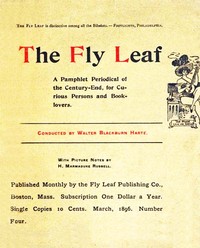
The Fly Leaf, No. 4, Vol. 1, March 1896
by Various
Language: en247 downloads on Project Gutenberg
Subjects
In: Poetry·Humour·Plays/Films/Dramas
Public-domain ebook sourced from Project Gutenberg #62591.
Public-domain ebook
by Various
Language: en247 downloads on Project Gutenberg
Subjects
In: Poetry·Humour·Plays/Films/Dramas
Public-domain ebook sourced from Project Gutenberg #62591.
The opening · free to read
A Pamphlet Periodical of the Century-End, for Curious Persons and Booklovers.
CONDUCTED BY WALTER BLACKBURN HARTE.
WITH PICTURE NOTES BY H. MARMADUKE RUSSELL.
Published Monthly by the Fly Leaf Publishing Co., Boston, Mass. Subscription One Dollar a Year. Single Copies 10 Cents. March, 1896. Number Four.
Unique and Distinctive in Bibelot Literature.
THE CRITICS AGREE IN SAYING THE FLY LEAF FILLS A FIELD OF ITS OWN.
THE FLY LEAF is distinctive among all the Bibelots.--FOOTLIGHTS, Philadelphia.
It is a delightfully keen little swashbuckler.--THE ECHO, Chicago.
The latest of the Bibelots. In my opinion it is the only one of the lot, including the “Chap-Book,” “Philistine,” etc., which knows what it is driving at. The editor of the “Chap-Book” toddles along, following or attempting to follow, the twists and turns of the public taste--at least that is what he wrote in a Note not long ago--and the editor of the “Philistine” curses and swears, and devastates the atmosphere, trying his best to kill everything. “THE FLY LEAF” at once impressed me that Mr. Harte knows what he wants, and seriously intends to have it. I hope he will.--THE NORTH AMERICAN, Philadelphia.
It will pay any one who wishes to keep up with the literary procession to peruse this sprightly little periodical.--THE EXAMINER, San Francisco, Cal.
That bright little bundle of anecdote, comment, essay, poetry and fiction, “THE FLY LEAF,” of Boston, comes out in particularly good style. It gives rich promise of many good things to come.--THE COMMERCIAL ADVERTISER, New York.
Number two of Walter Blackburn Harte’s dainty monthly “THE FLY LEAF,” is out, and filled with the spirit of youth and beauty in literature, and zealous with culture, taste and faith toward higher ideals, it is going about doing good.
Mr. Harte is strong, brilliant and brave as an essayist of the movement, and is making friends everywhere. The poetry and prose is all of high merit.--THE BOSTON GLOBE.
The thing I like about Mr. Harte is his splendid spirit of Americanism, his optimistic belief in native literature and native writers; his hatred of all things bordering on toadyism or servile flattery of foreign gods to the exclusion of home talent. This is the key-note of THE FLY LEAF, and Mr. Harte will be apt to say some trenchant, candid and always interesting things in its pages.--THE UNION AND ADVERTISER, Rochester, N. Y.
These are a few criticisms of the first two numbers, selected from a great heap of enthusiastic notices. THE FLY LEAF is promoting a Campaign for the Young Man in Literature. All the young men and women in America are discussing its unique and original literature, and spreading its fame.
Like a thumb-nail sketch In the world of art; Like a humming-bird In leafy bowers; Like a pure quatrain In a poet’s heart; Like a harebell blue In a garden of flowers; Or like (I think this figure better) The post-script at the end of her letter.
WAITMAN BARBE.
TO BE PUBLISHED SHORTLY.
LUCKY RICHARD’S MANUAL ON HOW TO SPEND MONEY.
INTENDED FOR PERSONS OF SIMPLE TASTES WHO HAVE HAPPENED TO STRIKE TEN!
This is probably the last subject under heaven I ever dreamed I should find occasion to discuss in print. But we are the playthings of Fate, and at this moment I am wholly immersed in weighty affairs and endless calculations as to what my income would be if this bibelot of literature became indispensable, as it undoubtedly should be, in thousands of homes in this country. When I have the figures satisfactorily arrived at on the basis of ten thousand subscribers, I see how easy it would be to introduce the periodical to the friends and relations of these ten thousand should-be delighted subscribers. Then my figures are naturally inconclusive and, as my wife says, with a fine belief in my destiny that is quite irresistible, absurdly modest. Then I’m bound to consider her figures, and her arithmetic becomes more convincing with her wants. She says that, out of a population of seventy million souls, there must be at least one million readers for the FLY LEAF.
A woman who marries into Grub Street never appreciates the situation quite so vividly as the man who is to all intents and purposes born into it. To begin with, she is naturally somewhat prejudiced in her husband’s favor. I was foreordained by Providence for a career in Grub Street, and I could not marry out of it. A long acquaintance with its chances has made me less sanguine than my helpmate, and a million rather staggered me. I know that only good dead authors get a million readers, and then only in stolen editions. So to keep my wife’s imagination within bounds I told her it was true there were seventy millions in this country, but that not even the most credulous acceptors of that bad makeshift, human nature, would dream of calling them seventy million souls. The huge bulk was simply the mob! In the residuum some souls, and perhaps half a million intelligent people, were possibly to be found. Luckily some sense of humor saves me from the temptation of reckoning my possible gains in periodical literature on the data furnished by the Census Bureau.
But my wife, whose devotion to the severe goddess of literature is somewhat vicarious, cannot altogether stifle some pangs of envy as she regards the fine new silk dress of the janitor’s wife, or learns that Mr. So and So, who is in the advertising business, has just given his wife a new span of trotting horses for her new racing cutter. This is enough to make a woman hiss invidious things about the calling of literature.
A woman may love literature for her husband’s sake, or even for its own, and yet she cannot help looking into the haberdashers’ and milliners’ windows with wistful hungry eyes. And the goddess of literature does not allow her votaries, especially the married ones, anything but the shabbiest of shoddy drabs. So my wife declares that one million out of seventy is a moderate and conservative estimate, and she will not abate the figures one jot or tittle. I am convinced that the feminine love of finery and comfort and elegance constitutes a temperamental inadaptability to high aims in literature.
It all came about in this way: We were out marketing--my better half and I--and we got mixed up with the crowd of swell people pouring into the main entrance of the opera-house, and, as we passed under the brilliantly lighted portico, my wife stopped a moment and peered in to catch the name of MELBA on the billboard.
“We never go to see anything nowadays,” she said, a little regretfully, as we moved on. Then we crossed the street and joined the shopping crowd, pushing and elbowing in opposing streams on the other pavement, and presenting an entirely different appearance to the radiant throng about the opera-house. “Oh, well,” I answered, “you can’t expect literature to prosper in a year of financial panics, depreciated dollars and war scares. We must be content to just grub along.” “But I should like to hear Melba and Calve--and I’ve not been to a single Symphony this winter. Then, too, we’ve only seen one play, and that was stupid. And we couldn’t even afford to go up in the gods to see Irving or Beerbohm Tree. It’s a shame the way the speculators run the prices up for everything good!”
“Well, you saw Otis Skinner in ‘Villon the Vagabond,’ and that was a good bit of romantic acting.” “Oh, I know, but I do wish we didn’t always have to go up in the gods.” “Get more performances for your money.”
“If I could turn dramatic critic now--and, ’pon my soul, I don’t see why not! The trick’s comparatively easy. My father remembers the great Edmund Kean, and I remember what he says of him; and then there is theatrical literature in abundance.” “Oh, no; there’s no fun in seeing a play if you’ve got to go home and write about it. You know that. But there is no reason why we shouldn’t go to the opera and sit in the best seats, if you only put all your energy and lots of good things into what you call your organ of civilization. Of course it should succeed--and once the book lovers and reading public know what it really is, it must succeed.”
“And then--why, what shall we do with all our money? I can’t think how we shall spend it.”
“We shan’t get too rich in a hurry. This is the one direction in which you women have a fine sweep of imagination--but it is not so easy to make money as it is to spend it in imagination. People don’t care for simply good stuff in periodical literature, nowadays. It must intoxicate them with the odor of blood, and I can’t do that--I can’t do Jack the Giant Killer stories. I abominate anachronisms of mood in literature. Fancy an old friar writing on modern sex problems! But refined literary taste craves gore, and plenty of it, and gore is sent by the shipload from over the sea. The British make the best literary butchers--it comes natural to them to hack and chop and stab. The renaissance of blood and thunder in fiction is the wonder of our age. We cure any tendency to thinking by letting blood, just as the old surgeons did all forms of virulent disease a generation or so ago.”
“Oh, but surely, there is just a big enough public for good wit and good humor to make our venture a success--and then with a million readers we can hear Melba in the orchestra chairs.”
“A million--what an imagination you’ve got! That would be a ten-strike!”
“Well, why shouldn’t you have a ten-strike? I’m sure you deserve it.” “All moralists do--but ten-strikes do not go to the deserving. Providence does not reward virtue in this fashion.” “Then Providence should. I’m sure you ought to succeed--and I’ve made up my mind about it. We’ll do lots of things with our million. I think we’ll begin by ceasing to buy our tea where they give the crockery with it. But tonight I want a little pitcher.
“Then--just think!--I wouldn’t have to go to the butcher’s and watch the scale to see whether I get fair weight or not. I wouldn’t care--I’d order by telephone, and I’d get the very best parts of the meat instead of the good parts, and you could eat the fillet of beef all the time to build you up and make blood and brain. You must hurry up and get that million.”
“I’m all right as it is, but I do like a tender steak. And I think we’d quit something of our enthusiasm for Boston baked beans, though I’ve got quite to enjoy them. Still, it’s a sort of acquired patriotism--and, like most forms of patriotism, popular because it’s inexpensive. Then we wouldn’t have frankfurters so often. And we could begin to cultivate a taste for paté de fois gras instead--although I think it looks hateful.”
“Yes, and we’d have enough table napkins for unexpected callers.” “And ones for everyday, too.” “You shouldn’t speak so loud about such things in the crowd. I’m sure that woman heard you--she stared so hard. Oh, and we’d have silver rings for them!”
“Better get married again and see if we couldn’t get a stock of silver this time. Generous folk always load the rich down with plenty of silver. At poor people’s weddings one sees nothing but cake baskets.” “We got a brass lamp and some napkin rings.” “Did we? I don’t remember; we must have lost the rings.” “No; they turned brassy, and I didn’t dare to put them on the table any longer.
The book keeps going
Reading is free forever. Sign up and watch scenes appear while you read.



Scenes Storieta drew for other classics.
New illustrated classics
Once or twice a month: the latest books to get full character casts, scene art, and free comic editions. No account needed.