Public-domain ebook
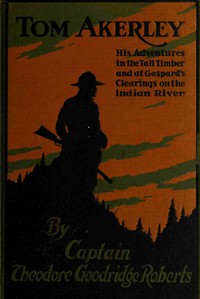
Tom Akerley His Adventures in the Tall Timber and at Gaspard's Clearing on the Indian River
Language: en335 downloads on Project Gutenberg
Subjects
Public-domain ebook sourced from Project Gutenberg #62652.
Public-domain ebook
Language: en335 downloads on Project Gutenberg
Subjects
Public-domain ebook sourced from Project Gutenberg #62652.
The opening · free to read
The night was hot and hazy. The aerodrome was in darkness save for a moving light in the black maw of one of the hangars and a shine from the open window of the office on the other side of the ground. All the machines were down and in.
Two men were in the small hut which served as field-headquarters and office for this particular unit of the Dominion Air Force. They sat at opposite sides of a large table, one leaning back in his chair with a cigar in his mouth, the other stooped forward over a map which he studied intently. Clerks, orderlies, pilots, observers and mechanics all were gone, with the exceptions of these two and the man with the lantern across at the hangars.
“Ottawa seems determined to decorate every one who ever flew, be he alive or dead,” remarked the elder of the two, without removing the cigar from his mouth and still gazing upward at the low ceiling. “We seem to have more Military Crosses and such things than we know what to do with.”
“Yes, sir?” returned the younger officer inquiringly, looking up from the map.
“It seems so to me,” continued Colonel Nasher. “You knew a fellow named Angus Bruce, I believe.”
“Yes, I knew Angus Bruce.”
“Ottawa suggests a posthumous Military Cross for him.”
The younger officer said nothing to that, although the expression of his face suggested that he wanted to say a great deal. Instead of speaking he fell to studying his map again. The line of his mouth was tense. Even the set of his broad, lean shoulders looked tense. A keen observer would have noticed a general air of tenseness about him—tenseness of self-control practiced under difficulties.
“But I think my letter to Ottawa will fix that,” added the colonel, still speaking around his cigar.
The other looked across the table again.
“Fix it?” he queried.
His voice was low but slightly tremulous.
“Kill it,” replied the colonel.
“I don’t understand you, sir,” said the junior, still speaking quietly. “Bruce earned it several times, to my personal knowledge.”
“I don’t agree with you. I knew the fellow for years. We used to live in the same town. There’s a yellow streak in the breed. You can’t make a silk purse out of a sow’s ear.”
“He had no yellow streak. He proved his courage a dozen times—scores of times—his courage and his worth.”
“So you say, major.”
At that the major pushed his chair back and stood up.
“Yes, that’s what I say!” he cried.
Colonel Nasher sat up straight, plucked his cigar from his mouth and stared at his second-in-command.
“And I mean what I say,” continued the major, in a loud and shaken voice. “And I know what I am talking about.”
“But you forget to whom you are talking!” roared the colonel.
“No I don’t,” retorted the younger man, wildly. “I am talking to you—and there is some true talk coming to you. You’ve been asking for it ever since I joined this outfit. I know what your game is. You want to get me out—to make people believe that my nerve is gone and I’m no longer fit for the service. I’m fit enough—fit for anything but to sit and listen to you lie about a friend of mine—about the memory of a friend who was killed over the Boche lines. You’re not fit to name a man like Angus Bruce. You never saw him fight. You never saw anybody fight. A yellow streak? I have seen him go up alone after four of them! You’ll swallow that lie, Colonel Nasher, here and now!”
The colonel got to his feet, glaring. He was a large man with a large face. The only small things about him were his heart and mind. His eyes looked like polished gray stones in his red face.
“Your dead friend won’t get his cross and you’ll lose yours!” he cried, pointing a thick finger at the ribbons on the major’s breast. “I’ll break you for this, you upstart! Consider yourself under arrest. I’ll teach you that you’re not in France now!”
The major stepped swiftly and with smooth violence around the end of the table; and then, quick as a flash, his right fist came in contact with the colonel’s red chin. Down went the colonel with a crash.
The major stood above his prostrate C. O. for a few seconds, staring down at the motionless bulk and shaking as if with fever chills.
“What’s the use!” he exclaimed hysterically, turning away. “I’m as helpless as if I were under French mud with Angus Bruce.”
He took his leather cap and leather coat from a hook on the door, opened the door and stepped into the dark warm night. He saw the lantern beyond the level field and hastened across to it.
“I want the old bus out again, Dever,” he said.
“Very good, sir,” replied Dever.
They wheeled the ’plane from the open hangar. The major put on his leather coat and cap and climbed in. He started the engines and switched on the internal lights. Then he leaned over and said, “You remember Major Angus Bruce, don’t you?”
“Yes, sir, I remember him well,” replied the man on the ground. “We don’t forget that kind, sir, do we—nor ever will.”
“A good soldier, Angus Bruce.”
“One of the smartest and bravest in the Old Force, sir. He crashed his sixth just a day after you crashed your seventh, sir.”
“Yes, I remember it. Now get me off, Dever, and then go over to the office and see if the colonel wants anything. If he needs a stimulant I think you’ll find something of the sort in the right-hand drawer on his side of the table.”
“Very good, sir. When’ll you be back?”
“Not before sunrise. Don’t wait up for me.”
Dever gave a downward heave on a propeller-blade. Then the wide, white ’plane slid, roaring, into the darkness.
Akerley was flying low; and when he saw the little smudge of yellow light on the black expanse beneath him he went down to it like a wing-weary duck to the sheen of water. The numbness of indifference and confusion that had possessed him for an hour or more passed swiftly from his brain and spirit. His nerves snapped back to duty and his vision cleared. The light expanded to his gaze as he neared it and by its form and position he judged it to come from an open doorway of modest dimensions. It streamed out upon a green level; and he reasoned hopefully that the level ground would, very likely, be of considerable extent in front of the building. So he shut off his flagging engines, swooped around, dipped and flattened.
The book keeps going
Reading is free forever. Sign up and watch scenes appear while you read.



Scenes Storieta drew for other classics.
New illustrated classics
Once or twice a month: the latest books to get full character casts, scene art, and free comic editions. No account needed.