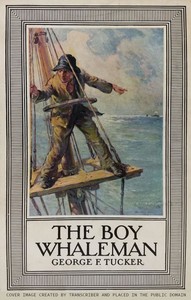
Public-domain ebook
The Boy Whaleman
Language: en342 downloads on Project Gutenberg
Subjects
In: Historical Novels·Adventure·Novels
Public-domain ebook sourced from Project Gutenberg #62689.
Public-domain ebook
Language: en342 downloads on Project Gutenberg
Subjects
In: Historical Novels·Adventure·Novels
Public-domain ebook sourced from Project Gutenberg #62689.
The opening · free to read
When I was a boy, New Bedford was not, as it is now, a great manufacturing city, but the best known and largest whaling port in the world. The wharves were then busy places; there vessels were “fitted”, as they used to say, and sent out on their long voyages; other vessels returned and discharged their cargoes. Great casks of oil were arranged in rows on the wharves; those that were sold were carted off on curious old trucks called gears, and those that were to await a better market were given a thick covering of seaweed. Everybody talked ships and oil. One would hear people say, “The Janet is reported in the Indian Ocean, clean,” that is, had taken no oil; “The Adeline is heard from in the Pacific, having made a ‘good cut’,” that is, had taken a lot of oil; “There is news from the Marcella from the other side of land, having done well.” “The other side of land” meant the other side of the world, as Australia and New Zealand, in the waters round which many whalers used to cruise.
My father, when a young man, went whaling for a single voyage which lasted for more than three years. He was a sailor, or, to use the regular phrase, a foremast hand, and at the end of two years he became a boat-steerer or harpooner. When I was a little boy he used to take me on his knee and tell me stories about the life of the whalemen,—of chasing whales and harpooning them; of angry whales smashing boats and chewing them to bits; of towing whales to the ship and cutting them in and trying them out; of losing the ship and remaining all night in the open boats; of encountering great storms and riding them out in safety; of meeting after many months another New Bedford vessel, and getting the latest news from home, and of visiting in the Pacific Ocean islands inhabited by savages.
At an early age I made up my mind to go to sea. On Saturday afternoons I used to roam about the wharves and sometimes ventured into the ships, only to be ordered out. But one day a man, called a shipkeeper, was very kind to me. The shipkeeper was the man who had charge of the wharf and the ships moored to it. He was a kind of general manager. They were taking out the cargo from a vessel.
“Haven’t I seen you around here before?” he asked.
“Oh, yes, many times. I’ve been down here on the wharves nearly every Saturday afternoon for several years.”
“How old are you?”
“Twelve.”
“What is your name?”
“Homer Bleechly.”
“I suppose you would like to go to sea—wouldn’t you?”
“Indeed, I would.”
“As cabin boy?”
“Yes.”
Then he said thoughtfully, “Not yet, boy, not yet. It’s a hard life, so you’d better wait awhile.”
“That was what my father said.”
The shipkeeper continued, “You go home and get a basket and a pail, and I’ll take you up into the loft and give you something that will make you happy.”
I did as he said, and on my return he took me to a building at the head of the wharf, in the front part of which was the merchant’s office, and in the story above, a great loft full of whaling gear and a great many other things which the vessels had brought home from far islands in the Pacific Ocean. There was a boat like a canoe, only larger and better shaped. It was different from anything I had ever seen, and was made by savages on distant shores. Then there were paddles beautifully made, with carvings done, the shipkeeper told me, with shark’s teeth and bits of sea shells. There were lots of war clubs and spears and strange-looking tools and utensils. I wanted to ship on a vessel at once and sail for the Pacific Ocean.
“Here, boy,” said the shipkeeper, “give me your basket and pail.”
He reached down into a great cask set on end and took out three large objects, each about the size of a football. “These are coconuts with the husks on. When you get home take a hatchet and cut off the husks and you’ll find the coconut.”
Then he put a big dipper down into another cask and took up a lot of pickled limes and poured them into the pail. This he repeated several times. “There, boy,” he said, “now take them things home, if you can carry them. But don’t you tell any other boys that you got them things here, for, if you do, we’ll be pestered by all the boys in town.”
When I reached home with my prizes and showed them to my mother, the good woman looked troubled. I had often told her that I wanted to go to sea and she had done all she could to discourage me. I now renewed my desire, and, when my father came home, she took the matter up with him, and they both told me how hard the sailor’s life was and how little money there was in it.
“Yes, I know, father,” I said, “but haven’t you taken me on your knee and told me all about your own voyage and the strange places you went to?”
“Yes, my dear son, but I didn’t tell you about the unpleasant things and the hardships a sailor has to put up with.”
My home was a happy one, and I was the only child. No one ever had a better mother. My father was a good man and a model parent. He earned fair wages and provided well for his little family. Why should I be discontented? Because, like many a boy, I was unreasonable. Yet, was I wholly to blame? Life in a seaport town appeals to the fancy of a boy. Longfellow wrote,
I remember the black wharves and the slips, And the sea-tides tossing free; And Spanish sailors with bearded lips And the beauty and mystery of the ships, And the magic of the sea, And the voice of that wayward song Is singing and saying still: “A boy’s will is the wind’s will, And the thoughts of youth are long, long thoughts.”
I determined to hide on some vessel, and, when she was well out to sea, show myself and apply for the position of cabin boy. As I look back upon my foolish purpose, I deeply regret my ingratitude to my parents and the pain I caused them. In one sense it was a simple thing to run away, but quite another to succeed in it. Before sailing, a whaler would drop about three miles down the harbor and remain there at anchor for several days in charge of the shipkeeper. Then captain, officers and crew would go down in boats, weigh anchor, and off the ship would go on her long voyage.
Soon a vessel owned by the merchant who employed my friend the shipkeeper was all ready for sea. In the late afternoon I made up a bundle of clothes and went down on the wharf and walked aboard the vessel in a free and easy way. No attention was paid to me, and fortunately the shipkeeper was at the farther end of the wharf. I went down into the cabin, and I recall how clean everything was with the coating of fresh paint. I crawled into a berth, feeling sure that at six o’clock the shipkeeper would lock the door without coming into the cabin. By this time I was getting a little afraid and almost wished that I was at home. At last I heard the town clock ring out the hour of six, and then came a footstep nearer and nearer, and lo! it was the shipkeeper. He was startled when he saw me, and for a moment appeared angry. Then he said:
“I didn’t expect to see you here. Didn’t you know that I would have to lock up the cabin every night until the vessel sails, and that you would surely get caught?”
“Yes, but I want to go as cabin boy, and I thought that they wouldn’t ship me in the office.”
“Does your mother know you are here?”
“No.”
“Don’t you see how foolish this all is? Now get out and I’ll take you home.”
I objected and he insisted. I was ashamed and did not want to go home—not that I feared punishment, but because I shrank from facing my parents. The shipkeeper took me along with him and left me with my mother. I am not going to dwell on what happened at home. I have only to say that I had a long talk with my parents that evening, and I promised that I would never attempt to run away again and that I never would ship for a voyage without their consent.
But the sea continued to call me, and Saturdays I still visited the wharves. I read every volume I could get on the life of the sailor, and was particularly delighted with such books as Dana’s “Two Years before the Mast”, and Melville’s “Moby Dick.” With the aid of my friend, the shipkeeper, I collected all kinds of articles brought home on the ships until I had a veritable little museum.
And here, let me say that my parents took the proper course. My mother was apparently troubled, but she conferred with my father, and it was agreed that when I was old enough I might go to sea. “When I was old enough” was not very definite. I felt that I was old enough then, but I knew that my parents thought otherwise. At thirteen I entered the High School and at fifteen I felt that I had sufficient education, at least for a sailor, and I implored my parents to let me go.
“You aren’t old enough,” said my mother.
“But yesterday, mother, you said that I was large and strong for my age—as large and strong as a man of eighteen.”
My mother made no reply, but there were tears in her eyes.
It was July and vacation. I was restless and impatient. Hitherto I had worked during vacations for a cooper, doing odd jobs, but now the cooper sent me home with the statement that I was of no use to him. Years afterward my mother told me that she and my father conferred and decided that it was the best course to let me ship, provided my age was not against me.
In the fifties of the last century, whaling was at its height. In the warm weather ships were constantly coming and going. There was no lack of vessels, but would they ship a boy of fifteen who was as large and strong as a man of eighteen? Of course my father’s consent was necessary. I went to my old friend, the shipkeeper. One of his employer’s vessels named the Seabird was to sail in a few weeks, and I was anxious to go in her.
The book keeps going
Reading is free forever. Sign up and watch scenes appear while you read.



Scenes Storieta drew for other classics.
New illustrated classics
Once or twice a month: the latest books to get full character casts, scene art, and free comic editions. No account needed.